


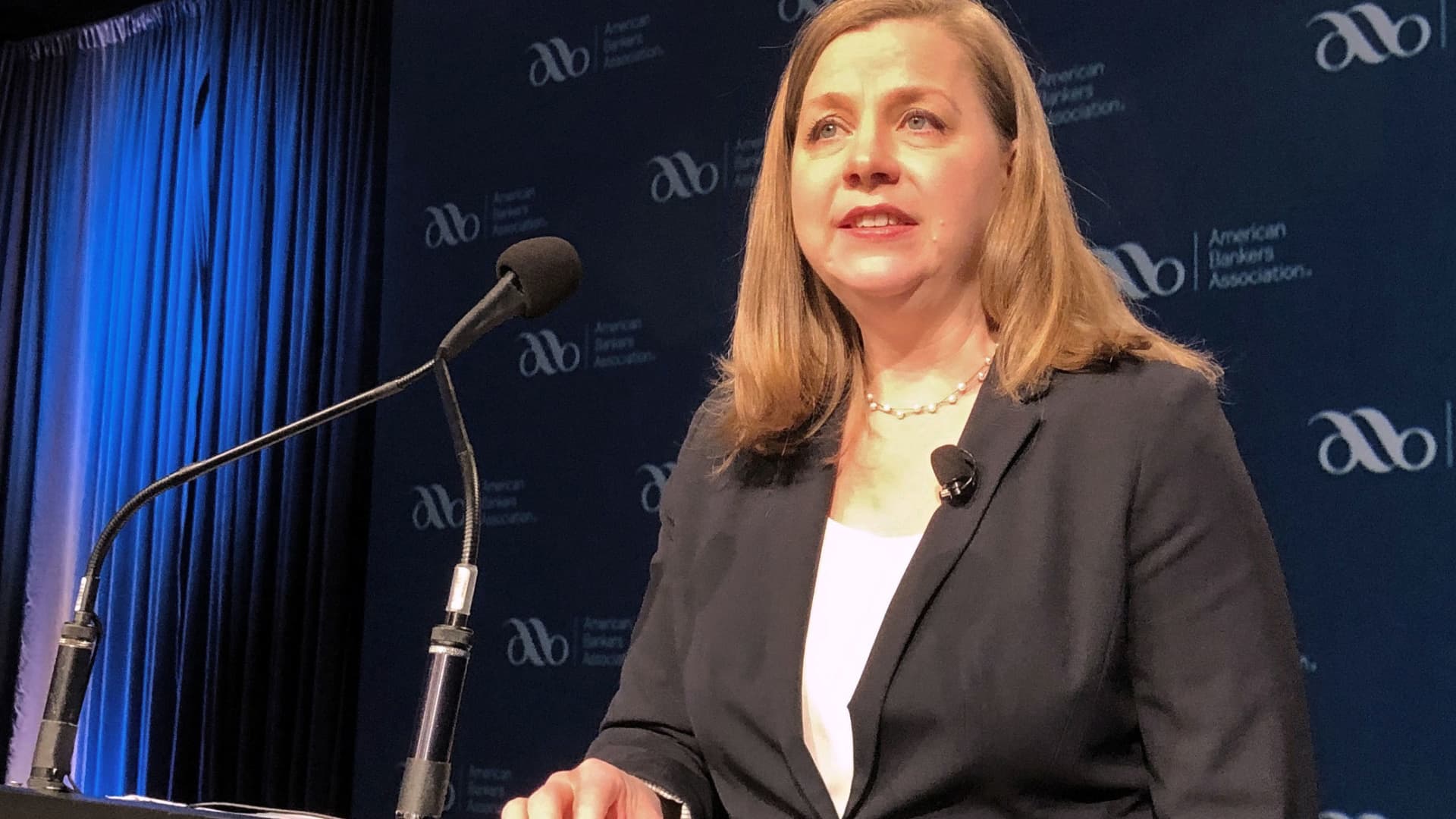
Federal Reserve Bank Governor Michelle Bowman gives her first public remarks as a Federal policymaker at an American Bankers Association conference In San Diego, California, February 11 2019.
Ann Saphir | Reuters
Federal Reserve Governor Michelle Bowman said Saturday she supports the central bank’s recent big interest rate increases and thinks they are likely to continue until inflation is subdued.
The Fed, at its last two policy meetings, raised benchmark borrowing rates by 0.75 percentage point, the largest increase since 1994. Those moves were aimed at subduing inflation running at its highest level in more than 40 years.
In addition to the hikes, the rate-setting Federal Open Market Committee indicated that “ongoing increases … will be appropriate,” a view Bowman said she endorses.
“My view is that similarly sized increases should be on the table until we see inflation declining in a consistent, meaningful, and lasting way,” she added in prepared remarks in Colorado for the Kansas Bankers Association.
Bowman’s comments are the first from a member of the Board of Governors since the FOMC last week approved the latest rate increase. Over the past week, multiple regional presidents have said they also expect rates to continue to rise aggressively until inflation falls from its current 9.1% annual rate.
Following Friday’s jobs report, which showed an addition of 528,000 positions in July and worker pay up 5.2% year over year, both higher than expected, markets were pricing in a 68% chance of a third consecutive 0.75 percentage point move at the next FOMC meeting in September, according to CME Group data.
Bowman said she will be watching upcoming inflation data closely to gauge precisely how much she thinks rates should be increased. However, she said the recent data is casting doubt on hopes that inflation has peaked.
“I have seen few, if any, concrete indications that support this expectation, and I will need to see unambiguous evidence of this decline before I incorporate an easing of inflation pressures into my outlook,” she said.
Moreover, Bowman said she sees “a significant risk of high inflation into next year for necessities including food, housing, fuel, and vehicles.”
Her comments come following other data showing that U.S. economic growth as measured by GDP contracted for two straight quarters, meeting a common definition of recession. While she said she expects a pickup in second-half growth and “moderate growth in 2023,” inflation remains the biggest threat.
“The larger threat to the strong labor market is excessive inflation, which if allowed to continue could lead to a further economic softening, risking a prolonged period of economic weakness coupled with high inflation, like we experienced in the 1970s. In any case, we must fulfill our commitment to lowering inflation, and I will remain steadfastly focused on this task,” Bowman said.


