


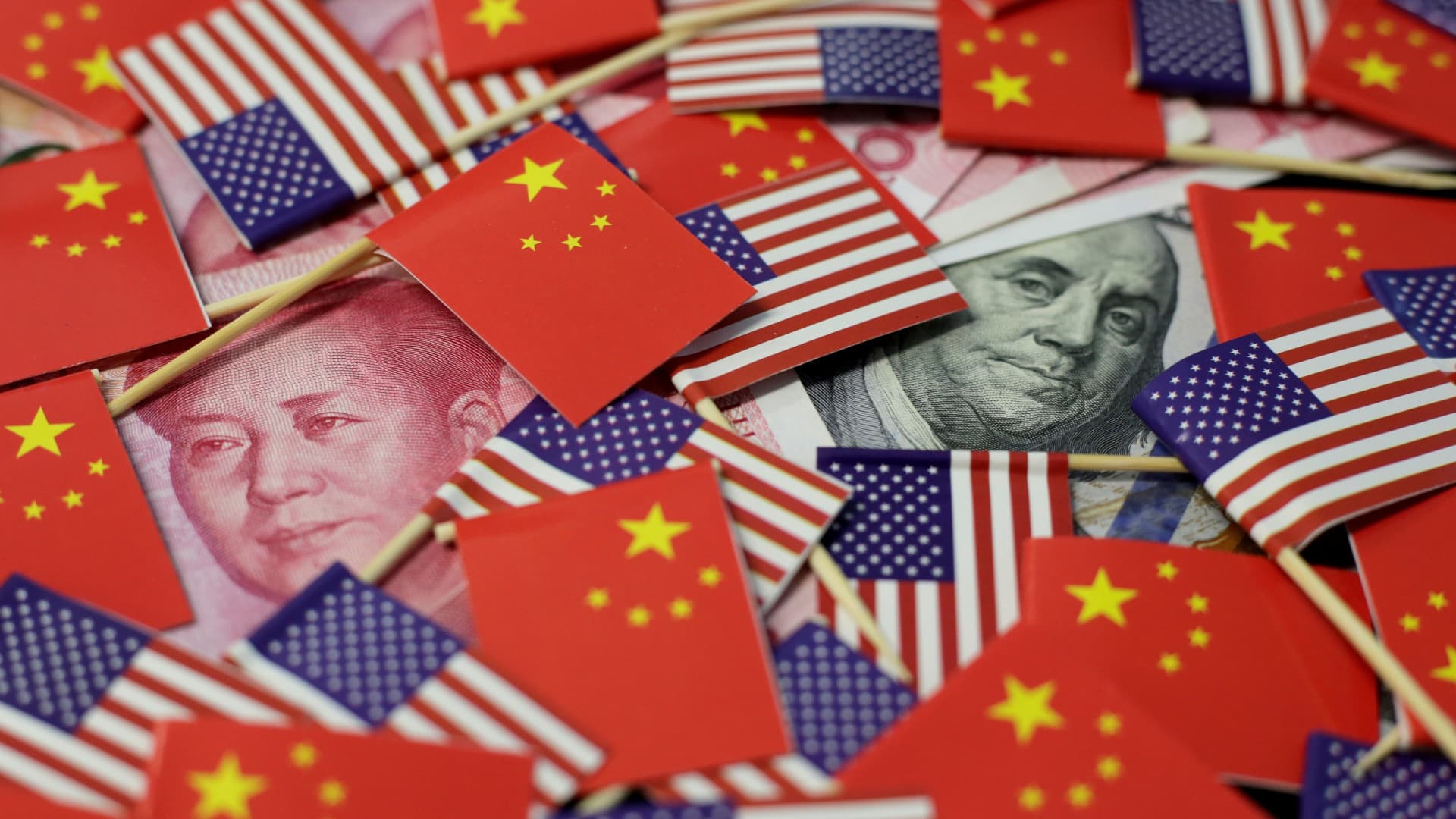
BEIJING — The U.S. 10-year Treasury yield has risen rapidly to three-year highs, erasing its gap with its Chinese counterpart, something that hasn’t happened for more than a decade.
As the yields cross paths – the U.S. one rising above China’s – that theoretically reverses an investment strategy that bought Chinese bonds for the greater return they offered relative to U.S. Treasurys.
It’s not immediately clear whether the move is sustained and big enough to have large-scale implications, but the development is a market signal that investors are watching.
The U.S. 10-year Treasury yield traded near 2.857% as of Wednesday night, slightly below the Chinese 10-year government bond yield of 2.873%, according to Refinitiv Eikon data. The U.S. yield climbed above its Chinese counterpart early last week for the first time since 2010, and has tried to hold onto a small premium in the last few days.
The market development reflects diverging monetary policy between the two countries, analysts said.
The People’s Bank of China is loosening monetary policy and cutting rates, while the U.S. Federal Reserve is tightening monetary policy and raising rates.
China and the U.S. also face different inflation dynamics, with surging producer prices in both countries, but smaller consumer price increases in China.
Chinese yuan in focus
Investors are watching the implications of the narrowing yield gap for the Chinese yuan. A worry is that if the yuan weakens too much, that could lead to capital outflows.
“Currently, there is no sign China or the United States will shift their monetary policy focus,” Gao Xiang, bond analyst at Hangzhou-based Nanhua Futures, said in a Chinese statement translated by CNBC.
“Both sides’ interest rates will continue to exhibit relative independence,” Gao said. “In this process, the yuan exchange rate will play an important role as a buffer, and also be an important indicator for the future.”
In the last few months, the yuan has traded near three-year highs against the U.S. dollar, and weakened slightly in recent weeks. The onshore yuan traded near 6.37 versus the greenback Tuesday afternoon, 0.38% weaker for the year so far.
But right now, China’s high trade surplus more the offsets the impact of the narrowing yield gap on the yuan, Larry Hu, chief China economist at Macquarie, said in an email.
The Chinese yuan will face more depreciation pressure from a decline in China’s trade surplus, Hu said. To him, the convergence in the U.S. and China 10-year yield is not that big of a deal since the gap has been narrowing for more than a year.
A country has a trade surplus if its exports exceed its imports. China reported a trade surplus of $47.38 billion in March, down sharply $115.95 billion in the January to February period.