


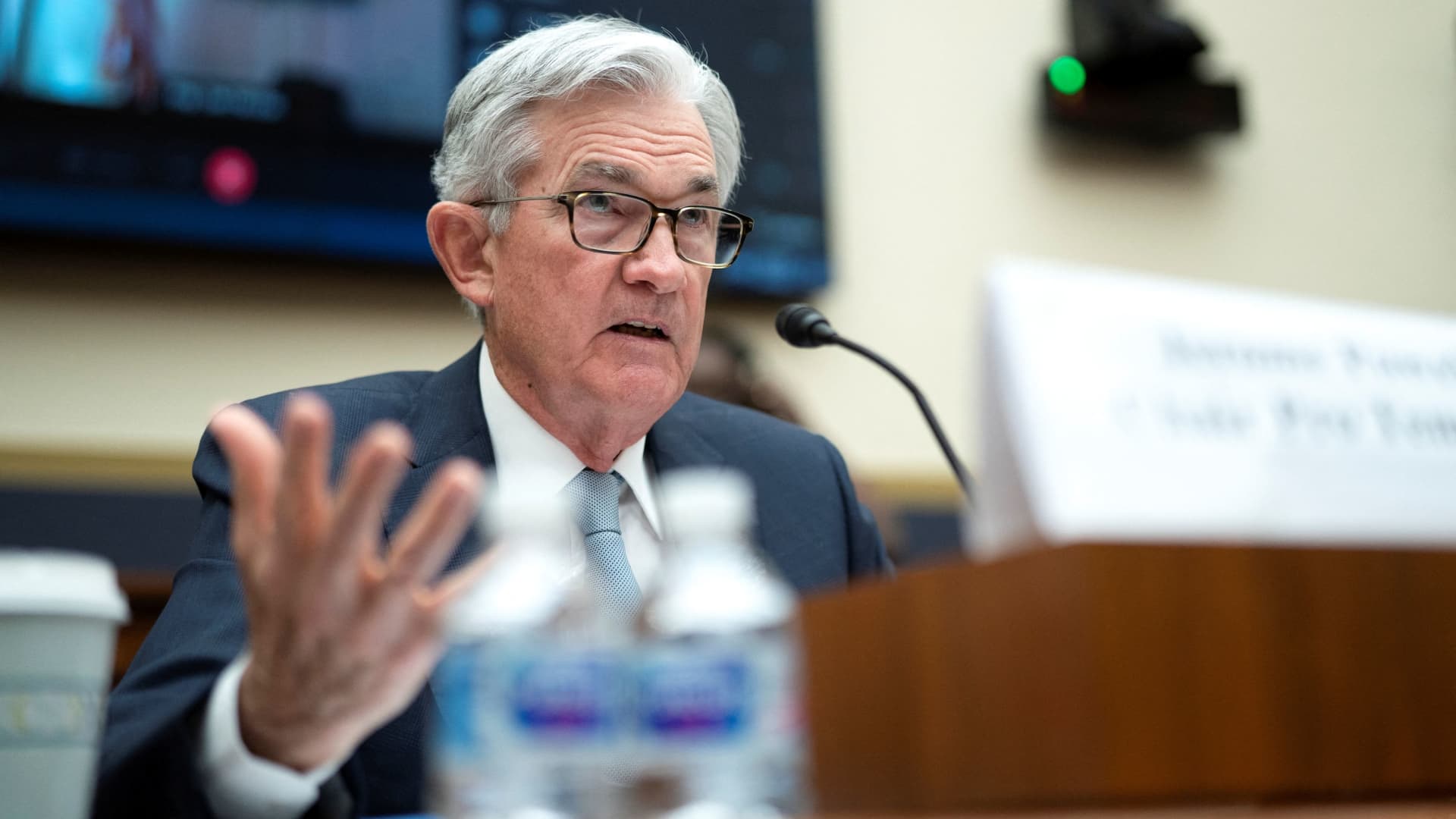
The Federal Reserve is expected to hike interest rates and cut its balance sheet aggressively over the next 16 months, according the May CNBC Fed Survey, and most respondents believe the process will end in a recession.
A rate hike of half a percentage point (50 basis points) is expected to be announced Wednesday by the Fed, the first in 22 years, followed by another one in June. After that, the panel of 30 respondents differs from fed fund futures market pricing in mostly seeing 25 basis point rate hikes.
But they still see a sharp rise in rates. Respondents, who include economists, fund managers and strategists, see the funds rate hitting 2.25% by year end and rising to a terminal rate of 3.08% by August 2023. The terminal rate is 72 basis points higher than the March survey and is hit three months earlier. Rates come down after that, ending 2023 at 2.6%.
The Fed is forecast to run a total of $2.7 trillion off its near $9 trillion balance sheet over 2 years and 5 months, more quickly than previously forecast. And 57% believe the fed will eventually sell assets, rather than just allowing the balance sheet to runoff.
“I don’t think markets appreciate that (quantitative tightening) is very aggressive, and this double-barreled tightening will be disruptive,” wrote Peter Boockvar, chief investment officer at Bleakley Advisory Group. “A lot of rate hikes have, of course, been priced in, but we’ve also not yet priced in the economic impact of the most aggressive monetary tightening cycle in the post-Volcker world.”
No soft landing
The quick pace of tightening and the stubbornness of inflation leads a majority to believe the Fed will not achieve a soft landing. Asked if the effort to bring down inflation to 2% will create a recession, 57% said it would, 33% said it would be avoided and 10% didn’t know. August 2023 is the average starting month among those who think a recession is coming and 53% say it will be moderate while 43% believe it will be mild.
“I still expect that a recession will be needed to get inflation back down to the Fed’s 2% target, but the recent increase in market interest rates, in anticipation of expected tightening by the Fed, has reduced the likely severity of that recession and has slightly increased the slim chance that the Fed can pull off a soft landing,” wrote Robert Fry, chief economist, Robert Fry Economics LLC, in response to the survey.
Joel Naroff of Naroff Economics writes: “The likelihood is that things will be worse and last longer than in most models, meaning that the Fed’s ability to fashion a soft landing is highly unlikely. If it happens, it will be through sheer luck only.”
For the next 12 months, the recession probability ticked up just a bit to 35% from 33% in the prior survey. The probability of recession over the next year also rose two points for Europe and stands now at 53%. Europe has been much harder hit by the economic fallout from the Ukraine war.
Powell’s rating takes hit
Fed Chair Jerome Powell’s overall rating has taken a hit as a result of the recent sharp change in policy and inflation outbreak. During the pandemic, respondents gave him straight A’s for his economic leadership. His overall grade now is a B-. Powell’s rating fell in four of eight categories with the biggest drop coming in economic forecasting. His grade for economic expertise and overall monetary policy both dropped slightly. He received better marks for leadership, transparency, and communications.
“It seems incredibly odd to even remotely believe Fed Chair Powell is even a touch hawkish and has any control over inflation,” wrote Richard Bernstein, CEO of Richard Bernstein Advisors. “Inflation is the highest in 40 years, yet the real fed funds rate is historically negative. You can’t fight inflation with a negative real fed funds rate.”
On inflation, 74% of respondents believe it has already peaked, up from 7% in the March survey, but most don’t believe that the Fed will be successful in hitting its 2% target until 2024. The CPI is forecast to end the year at 5.6%, up 4 tenths from the prior survey, and end 2023 at 3.3%, unchanged from the March survey.
The growth outlook has been reduced sharply this year with GDP forecasts averaging 2.2%, down 70 basis points from March while the 2024 average fell 30 basis points to 2%. Those forecasting a recession averaged 1.6% and those who don’t think the Fed’s inflation fight will contract the economy came in at 2.4%.
Despite calls for recession and a downgrade to growth, survey respondents see some equity upside: specifically, 5% this year and 8% next year for the S&P 500 from current levels. For the first time since we’ve asked the question, the CNBC Risk Reward Ratio — which nets out the possibility of a 10% increase or decrease in stocks over the next six months — is balanced at zero. It’s been negative over the past five surveys. On balance, however, the group still sees stocks overvalued relative to their outlook for earnings and growth.
“The current decline in equities is a correction in an ongoing bull market and will not be accompanied by an economic contraction,” said Hugh Johnson of Hugh Johnson Economics. “We are most likely within 4%-7% of the bottom of the correction and the upside after the correction is finished will be 4.5% -7.5%.”