


Jim Watson | AFP | Getty Images
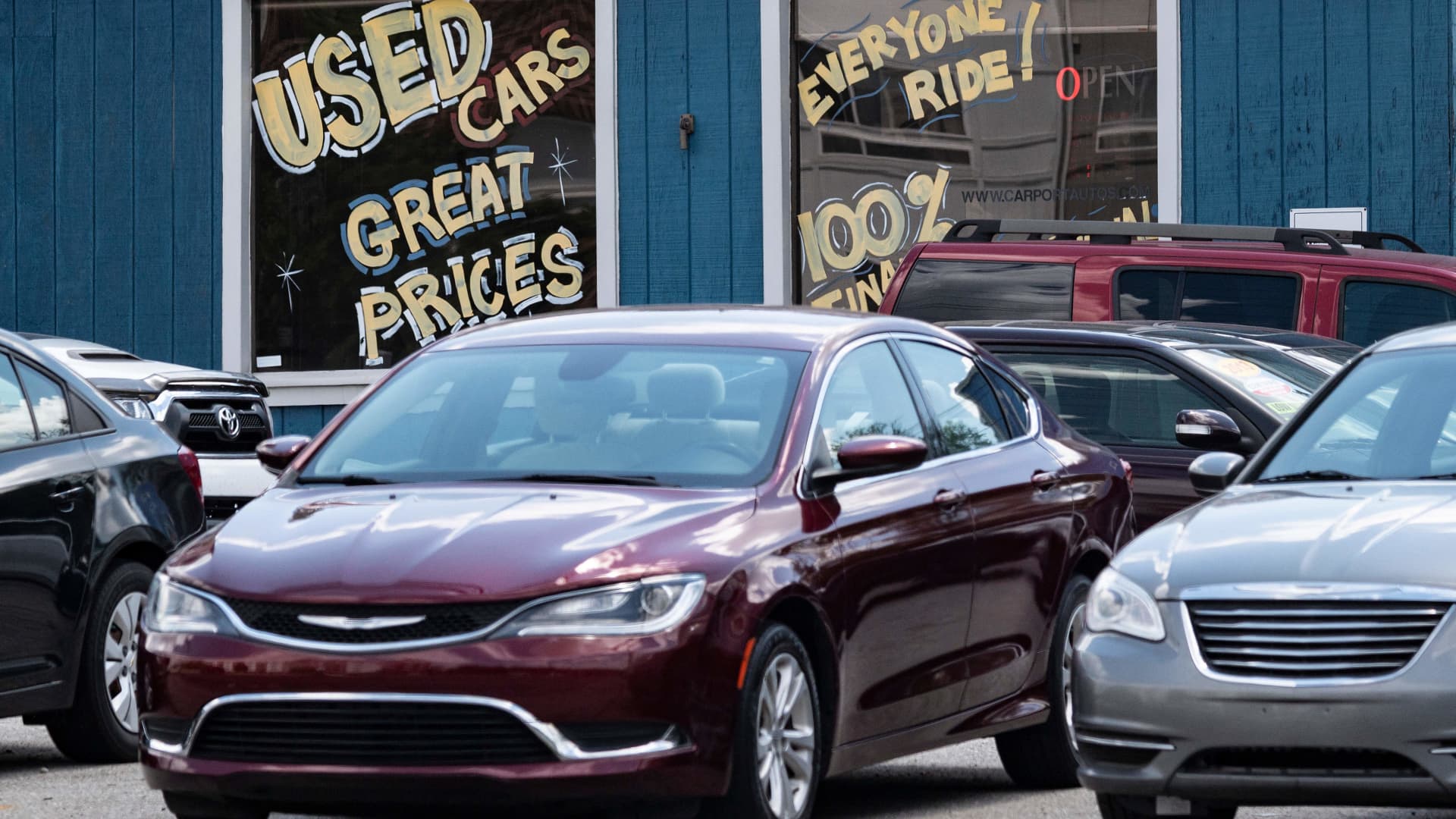
It’s no secret that used-car prices have skyrocketed over the last two years amid an industry turned upside down by supply-chain issues and reduced new-car inventory.
But how much extra are consumers paying? An average of $10,046 more — 43% — than if typical depreciation expectations were in play, according to a June 30 snapshot of prices in the “Return to Normal” index released by CoPilot, a car shopping app.
The average price tag for a used vehicle is $33,341, a 0.5% increase from May and just $172 below the peak in March, the CoPilot research shows. If depreciation forecasts had held true, the average price would be $23,295, according to CoPilot’s index.
More from Personal Finance:
6 strategies to recession-proof your finances at any age
Before you ‘chase dividends,’ here’s what to know
Focus on your ‘personal economy,’ not a possible recession
“Despite signs of a slowing economy, rising interest rates and high fuel prices, the used-car market is holding firm,” said CoPilot CEO and founder Pat Ryan.
Consumer buying remains strong at least partly due to spillover demand from the new-car market. Supply-chain issues — primarily an ongoing shortage of computer chips — have left dealer lots with fewer new vehicles to sell.
It’s a ‘long road back to normal’
The amount that consumers are paying above normal also depends on the age of the car. Nearly new vehicles (1 to 3 years old) have an average listing price of $42,314, which is $13,145 more (45%) than the projected normal amount of $29,169, according to the CoPilot index.
By contrast, vehicles that are 8 to 13 years old come with an average price of $18,038, or $5,416 more (43%) than the previously forecast $12,622. That category is the only age segment whose average price has been trending downward for several months.
“While there are some segments showing initial signs of softening, the used car market overall still has a long road back to normal,” Ryan said. “Despite a number of challenges facing the overall economy, the market has not softened to the degree that might have been expected.”
How to get the best price on a new or used vehicle
For buyers, having a trade-in is their best bet for getting the price of a car — new or used — down. The average trade-in equity is an estimated $10,381, a 49.2% increase from a year ago and the first time above $10,000, according to a joint forecast from J.D. Power and LMC Automotive.
Nevertheless, be prepared for sizable monthly payments: They average $678 over 70.3 months (a couple months shy of six years) for new cars, and $555 over 70.8 months for used vehicles, according to most recent data from Edmunds.com. Interest rates also have ticked up and now average 5% for new-car loans and 8.2% if you’re borrowing to buy a used vehicle.
If you’re looking at getting a new (or used) vehicle, here are some tips from Edmunds:
- Know your trade-in value. The extra equity from a trade-in is your biggest negotiating tool in today’s market.
- Know your pre-approved interest rate (i.e., from a credit union or bank). Even if you have excellent credit, it’s good to get pre-approved for a loan and know what interest rate you qualify for — which helps determine how much car you can actually afford — and then see if a dealership will match or beat the rate you can get elsewhere.
- Know your overall budget. With prices and interest rates heading higher, you may not be able to afford as much car as you think. Consider costs aside from monthly payments, including depreciation, taxes, fees, fuel, maintenance and repairs.

