


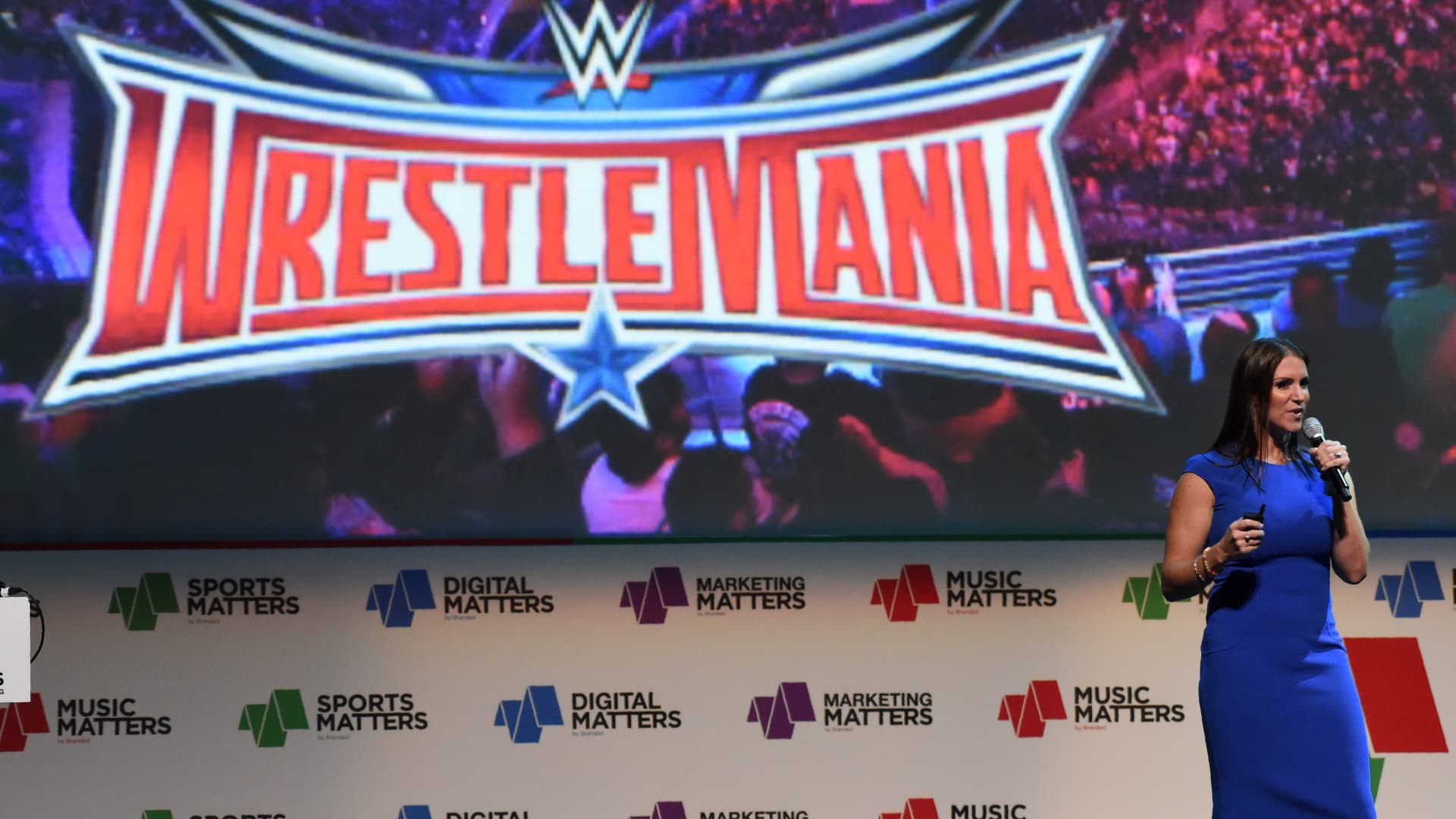
Chief Brand Officer and TV Personality of WWE, Stephanie McMahon delivers her keynote address at the opening of Sports Matters in conjunction with All That Matters 2016 in Singapore on September 14, 2016.
Roslan Rahman | AFP | Getty Images
WWE and industry analysts agree: The pro wrestling and media company can squeeze more revenue out of sponsorship deals.
The company leans on the intellectual property built around performers such as superstar personalities like The Undertaker, John Cena, Dwayne “The Rock” Johnson, Roman Reigns and Bianca Belair. Revenue from its live events, which are returning as Covid restrictions ease, and media offerings are fueled in part by sponsorship dollars.
WWE this year aims to fill football stadiums and expand its programming, according to Frank Riddick, WWE’s chief financial officer. Riddick, who took over the job in November, said after last week’s earnings release that the company is making sponsorship a priority this year.
In 2021, WWE reported roughly $72 million combined for advertising and sponsorships in its media and live events businesses.
WWE made more than $10 million in sponsorship fees alone for last month’s marquee Wrestlemania 38, executive Stephanie McMahon said last week. That was a record for the two-day event held at AT&T Stadium in Dallas. WWE’s sponsorship partners include Toyota, DoorDash, Rocket Mortgage and Rihanna’s Fenty Beauty cosmetics line, said McMahon, who is also the daughter of longtime CEO Vince McMahon.
Analysts suggest the WWE is undervalued when it comes to sponsorship revenue, estimating the company lures around $35 million per year just from sponsorships. That’s less than combat-sports company UFC, which attracts more than $100 million annually, according to a Guggenheim Partners note to clients last month.
While WWE lags behind UFC in overall popularity, its fans are the most likely to notice sponsors, according to sponsorship consulting firm IEG. Sixty-seven percent of WWE’s fans are more likely to consume brands associated with the company, according to IEG’s research, which used data from polling outfit YouGov. That’s ahead of the 55% average for the group of the 11 biggest sports leagues, including the NFL, which is by far the most popular sports organization in the United States.
“All that does is spell potential and opportunity,” said Peter Laatz, IEG’s global managing director. He said he thinks WWE can clear over $100 million in annual sponsorship revenue.
But he also noted WWE might not be the “right fit for the most affluent categories or top tier brands.”
The WWE did not return a CNBC request to discuss its sponsorships.
WWE’s place in the streaming world
WWE gets most of its revenue from its media business, accounting for $278.1 million of its $333.4 million overall revenue in the quarter ended March 31. Advertising and sponsorship revenue in the media segment grew 27% to $19.8 million from the year-ago period.
The company is preparing for a key media deals amid an “increasingly cluttered streaming marketplace,” WWE President Nick Khan said on last week’s earnings call. Hulu’s deal for day 2 rights around WWE’s weekly “Raw” program expires this year.
Day 2 rights allow subscribers to watch “Raw” and “Smackdown,” another weekly show, 24 hours after they first air. Raw airs live on USA Network, and Smackdown is shown on Fox. After 30 days, subscribers to NBCUniversal’s Peacock service can watch the shows. (In 2021, WWE entered a five-year deal with NBCUniversal for a reported $1 billion to license its library and show live main events on Peacock.)
Khan also suggested a new player could enter the sports streaming game.
“It’s just a matter of time before Netflix goes with live,” said Khan. He added the live events generate the highest consumer impressions for networks and streaming companies.
Netflix is indeed looking to bounce back as its results suffer while viewers shake off pandemic restrictions and head back out into the world. In April, Netflix reported a decline in subscribers and warned of millions of more losses in the months ahead. Co-CEO Ted Sarandos said at the time he doesn’t see a profitable way for the streamer to get into sports, although its “Formula 1: Drive to Survive” series has been a smash hit.
Netflix probably wouldn’t be interested in WWE, anyway, according to longtime media rights advisor Lee Berke, since the wrestling company is already tied up with Peacock. He said it would make more sense for the NBCUniversal service to add more WWE rights.
“That’s a major relationship for them, and there’s a lot they can do to build on that,” said Berke, CEO of LHB Sports, which advises the sports entertainment industry. “But if [Netflix] is going to make a move for WWE, I see them making an aggressive for all of their content or major live events.”
WWE is also looking at overseas expansion, particularly in India, home to a billion people and a growing middle class. WWE estimates its content is shown in more than 180 countries. The company said it drew 25 million viewers for an exclusive event showcasing U.S. WWE wrestlers competing against India-born performers. Wrestlemania drew more than 50 million viewers last month in India.
Khan, the WWE president, called India a “hugely important market.” But, he added, WWE is waiting for networks to finish bidding on rights to cricket – the most popular sport in the country – before the company determines its future media marketplace there.
Disclosure: Peacock owner NBCUniversal is also the parent company of CNBC.

