



Wilson products at the Paragon Sports store in the Chelsea neighborhood of New York on Jan. 4, 2024.
Jeenah Moon | Bloomberg | Getty Images
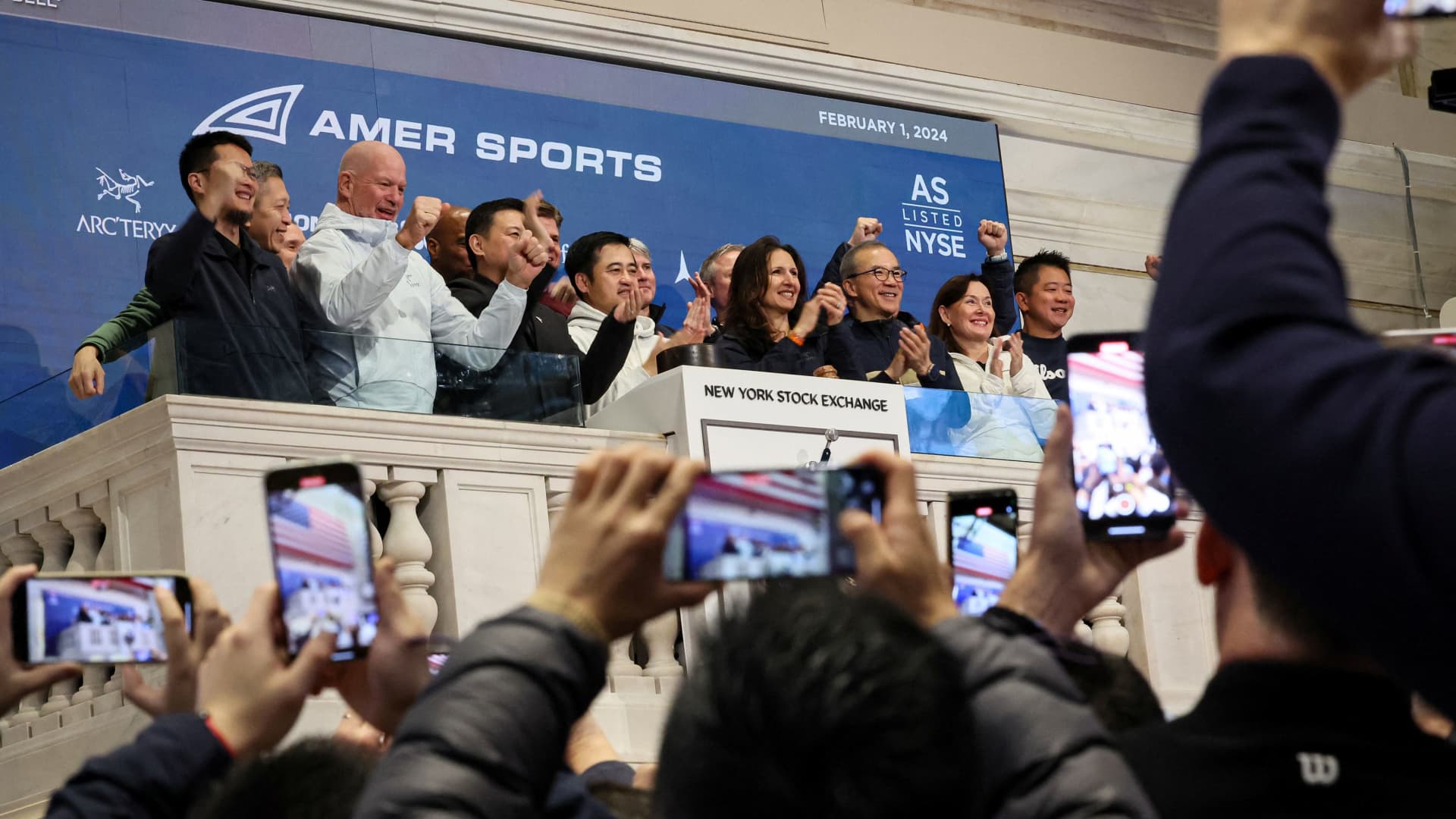
Amer Sports, the Finnish athletic company behind the Wilson tennis racket and Arc’teryx, debuted on the public markets Thursday with a 5% pop after pricing its IPO at a discount.
The stock opened at $13.40 a share on the New York Stock Exchange under the ticker “AS.” Amer had priced its IPO at $13 per share and raised $1.37 billion in the offering. It had originally expected to offer 100 million shares at $16 to $18 each.
The offering values Amer at about $6.3 billion, down from a previous valuation of up to $8.7 billion.
Amer’s decision to discount its IPO came after Federal Reserve Chair Jerome Powell indicated the central bank isn’t ready to start cutting rates, casting a pall over market sentiment and the floundering IPO market.
Wall Street has been eager to see a resurgence in the IPO market after it grounded nearly to a halt over the past two years, but recent debuts, including from German shoemaker Birkenstock, have been muted and failed to impress.
Amer Sports, (AS.N) parent company of sporting goods brands, banner hangs on the front of the New York Stock Exchange (NYSE) during the company’s IPO in New York City, U.S., February 1, 2024.
Brendan McDermid | Reuters
Amer runs some of the most recognizable brands in the athletic space. But its balance sheet is saddled with $2.1 billion in debt, and it didn’t post any profits between 2020 and September 2023, according to a securities filing.
In the nine months ending Sept. 30, the company saw $3.05 billion in revenue, up from $2.35 billion in the same period a year ago. It posted a net loss of $113.9 million during the period, higher than the $104.4 million it lost in the year-ago period.
The company’s business in China has been growing at a time when tensions are rising between the U.S. and Beijing. Many companies are trying to diversify their market share so they’re not as exposed to disruptions in the region.
In 2020, Amer did 8.3% of its business in Greater China and in 2022, that figure nearly doubled to 14.8%. In the nine months ending Sept. 30, 19.4% of sales came from the region.
In an interview with CNBC, CEO James Zheng said “China is important” to Amer but “it’s just part of the whole.”
“Our biggest market is still in North America representing 40% of business and Europe represents 32%. China right now only represents 20%, so it’s a part of the business,” said Zheng. “We are a global company.”
Don’t miss these stories from CNBC PRO:


