


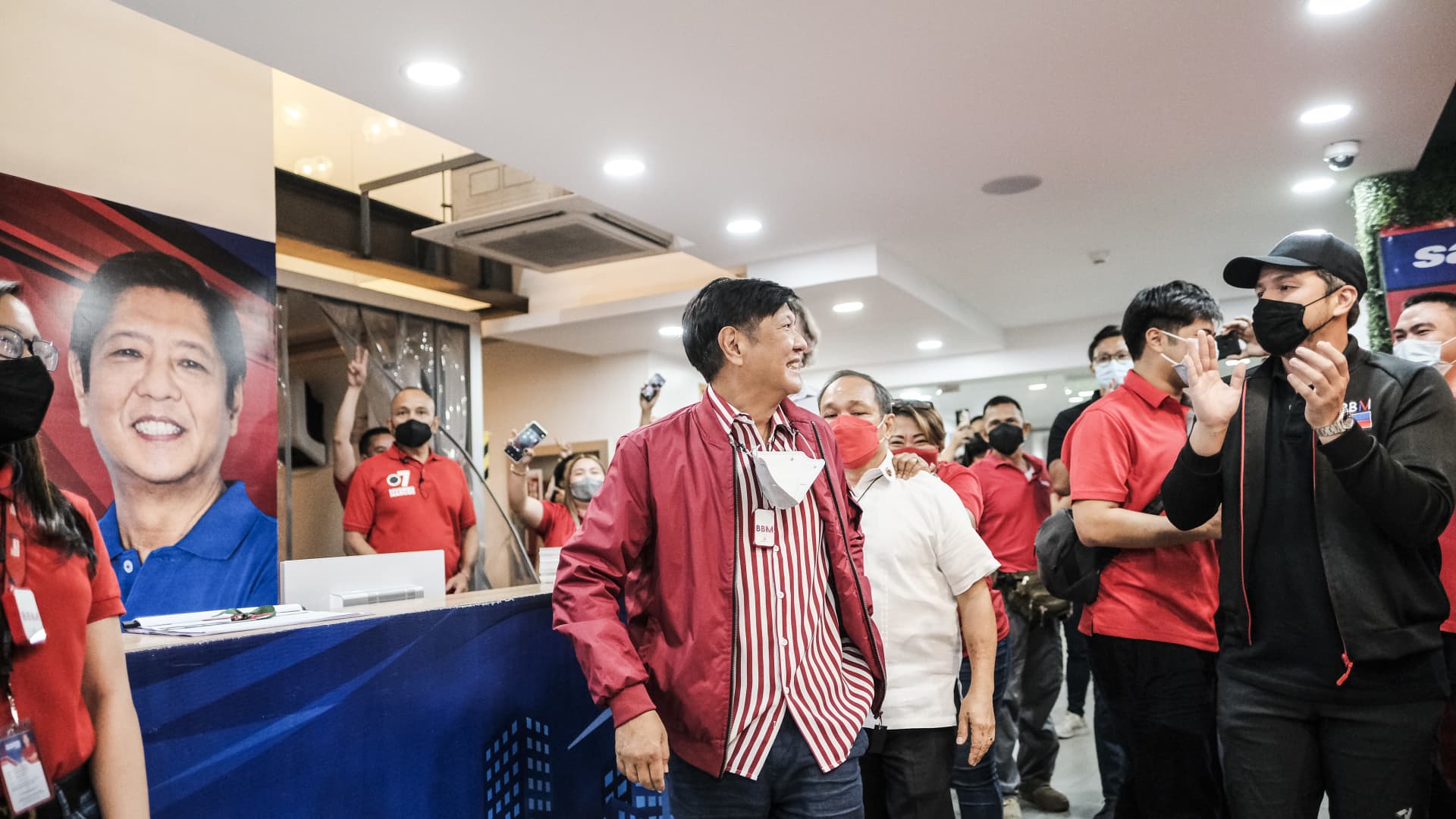
A landslide victory is on the cards for Ferdinand “BongBong” Marcos Jr. in the Philippines, seen here at his campaign headquarters in Mandaluyong City, Manila, on Monday.
Veejay Villafranca/Bloomberg via Getty Images
It appears all but certain that Ferdinand Marcos Jr., the namesake son of the late dictator, will become the Philippines’ next president.
The unofficial vote count so far shows that Bongbong, as he’s popularly known at home, is set for a landslide victory — pulling ahead by a wide margin against his closest rival, incumbent Vice President Leni Robredo. Official results are expected near the end of the month.
A Marcos Jr. presidency would be vastly different from the six years under President Rodrigo Duterte, said Victor Manhit, managing director of advisory firm BowerGroupAsia.
“Duterte was a mayor of a small town, a mayor who became president. Marcos Jr. is much more cosmopolitan in his upbringing. He has a better understanding of what is happening around the world,” he told CNBC on Tuesday.
What it means for foreign policy
With Southeast Asia being the main theater of a tussle for dominance between the U.S. and China, countries in the region are caught between the two rival powers.
Marcos Jr.’s presidency will be closely watched in this context. In the South China Sea, China is embroiled in maritime disputes with a number of countries like Indonesia, Malaysia and Vietnam, along with the Philippines.
“When he started his campaign, Marcos Jr. started with an appeasing position on China. But as he went into the campaign he was able to listen to the clamor of the Filipino people, who were concerned over China’s aggression in areas that were contrary to Philippine national interests,” Manhit said.
Marcos Jr.’s sense of the Philippines’ place in the world could drive policy in a radically opposite direction from Duterte, he said.
However, another analyst said the new leader will likely have less room for maneuver than his predecessor.
“The Philippines tried an outstretched hand, and China bit it. That is why the Duterte government has re-embraced the U.S. alliance and gotten tougher on Beijing over the last two years,” said Gregory Poling, a senior fellow and director of the Southeast Asia Program at the Centre for Strategic and International Studies in a note.
“The Philippine public and bureaucracy are even more distrustful of China than they were six years ago in the wake of their landmark arbitration victory in the South China Sea,” Poling said.
“Marcos Jr. might try to revive Duterte’s early outreach to Beijing, but he is unlikely to toss the U.S. alliance overboard as part of the effort,” he said.
What it means for trade and businesses
Before the pandemic hit in 2019, the Philippines was one of the fastest growing economies in the world but its services and remittances-led economic model was hit hard by Covid-19.
Marcos, who will inherit a large budget deficit, has not spelt out his plans to get the economy back on track after the devastation of the pandemic.
However, indications are that infrastructure development will be a core part of his agenda.
Frank Thiel, president of the AmCham Philippines, said he is “mildly optimistic” that Marcos will continue to support projects started by Duterte.
“The ‘Build, Build, Build’ infrastructure program has been very successful, we hope that that will be continued and expanded further,” he said, referring to Duterte’s trademark infrastructure project aimed at generating jobs and reducing poverty in the country.
“It is clear infrastructure development will be a core part of Marcos’ agenda — even if questions remain over the precise priorities, how he will finance these, and the extent to which private/foreign capital will be utilized,” said Peter Mumford, practice head for South and Southeast Asia at Eurasia Group, in the note on Tuesday.
On the trade front, a Marcos presidency could mean that a free trade agreement between the U.S. and the Philippines gets back on the table, according to Thiel.
“We think this may be an opportunity. It’s a new administration. New ideas, new plans, new programs,” Thiel told CNBC’s “Squawk Box Asia” on Tuesday.
Marcos is broadly pro-FDI but one of the key watchpoints under his administration will be whether corruption and cronyism—already notable risks in the Philippines—worsen.
Peter Mumford
Practice Head, South & Southeast Asia, Eurasia Group
“Marcos is broadly pro-FDI but one of the key watchpoints under his administration will be whether corruption and cronyism — already notable risks in the Philippines — worsen,” Mumford said.
His landslide electoral victory is a plus in that it offers his presidency a strong start.
“In particular, it will create a strong initial gravitational pull on members of Congress — particularly helpful with the Senate, which tends to be more independent-minded — and will mean more technocrats/economists will be willing to serve in his cabinet,” Mumford said.
— CNBC’s Abigail Ng contributed to this report.