


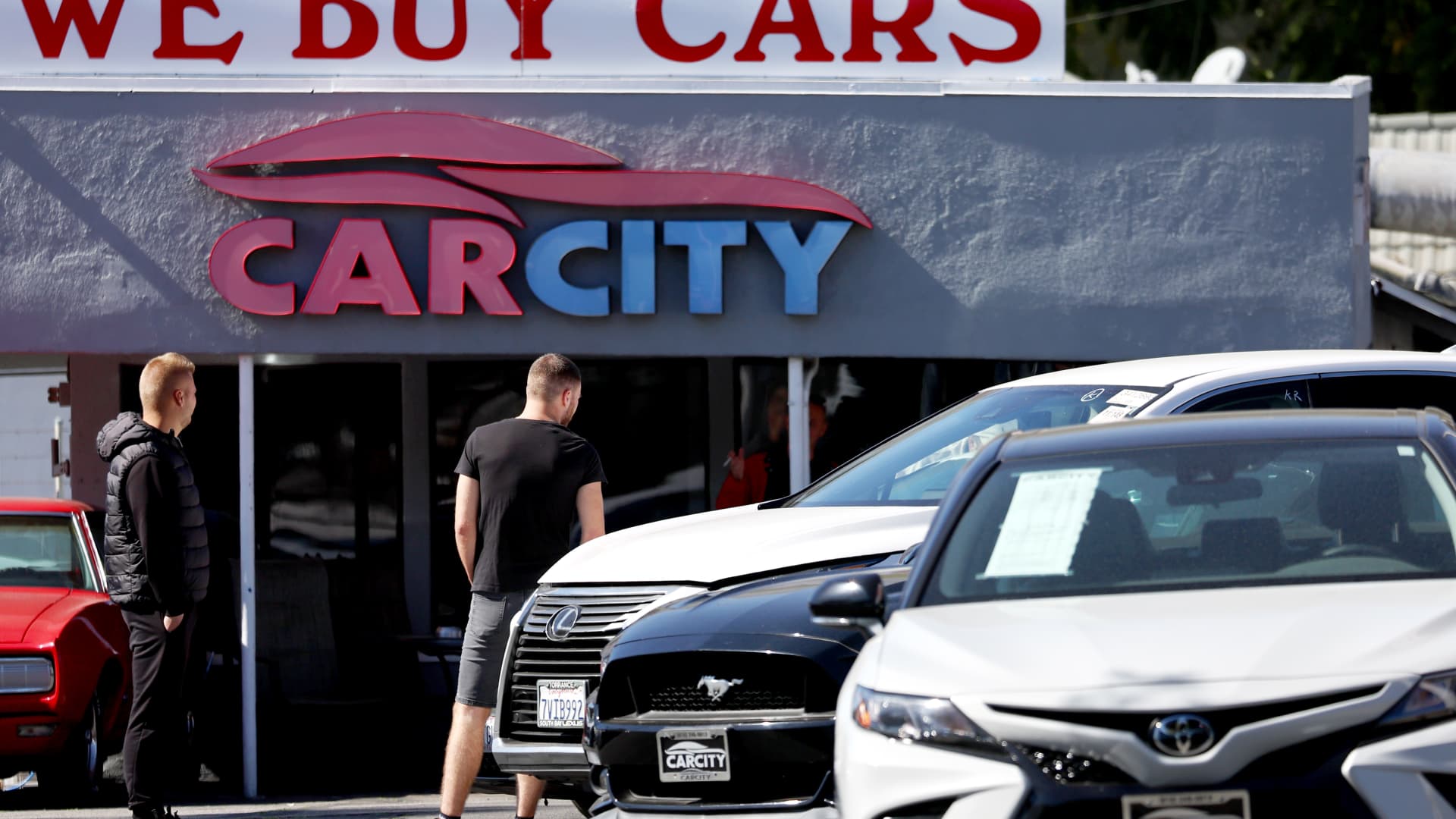
Customers browse in a used car lot on February 15, 2023 in Glendale, California.
Mario Tama | Getty Images
All new vehicles become used cars and trucks once they’re sold.
It’s an obvious statement, but one that needs to be laid out to explain the root cause for ongoing inventory and pricing issues in the U.S. used vehicle market, which has been a barometer for the country’s inflation levels.
During the onset of the coronavirus pandemic in early 2020, automakers shuttered factories for weeks to stop the spread of Covid-19. It was an unprecedented action that eventually led to additional supply chain problems, such as an ongoing semiconductor chip shortage, causing factories to cease production again for weeks, if not months, at a time in recent years.
The lack of production meant fewer new vehicles would become used models for consumers to purchase, leading to inventory constraints in both the new and used vehicle markets, as well as record prices due to resilient demand.
It’s been three years since those initial plant closures, but American consumers — as well as the Biden administration — hoping for the used vehicle market to return to “normal” pre-pandemic levels shouldn’t hold their breath.
A notable decline in used vehicle prices toward the end of last year has been roughly cut in half in 2023, as inventories remain significantly down following vehicle-production disruptions. There’s also been an uncharacteristically large number of consumers buying out leases to avoid sky-high car prices and increasing interest rates.
“It looks like it will persist for some time,” said Chris Frey, senior industry insights manager at Cox Automotive. “It’s really a function of this hole in new production, creating a dynamic where wholesale or general used values are higher because there are millions of fewer new vehicles that would eventually turn into used.”
Cox Automotive reports wholesale used vehicle prices are up by 8.8% this year through mid-March, according to the Manheim Used Vehicle Value Index, which tracks vehicles sold to dealers at auction. The prices are trending higher, and the index is heading back toward a record of 257.7 basis points set at the start of 2022. It was 238.6 as of mid-March.
Used vehicle inventory is down 21% from a year ago and off a whopping 26% from pre-pandemic levels of 2.8 million available vehicles in 2019. Cox Automotive doesn’t expect the total number of used sales to return to pre-pandemic levels of about 38.2 million units until at least 2026, Frey said.
Adding to the production hole is a change in leasing. Cox reports a 20% increase in consumers who leased their vehicles buying them out instead of trading them in from 2019 to 2022. The increase occurred as residual values of the vehicles in some cases were far above expectations, making it significantly cheaper to buy the vehicle than lease another amid inflated prices and rising interest rates.
“It’s still under a lot of pressure, just like it was last year,” said Benjamin Preston, an autos reporter for Consumer Reports. “Prices came down a little bit … but the bottom line is they’re just way higher than they were before the pandemic.”
Cox Automotive previously forecast wholesale prices on the Manheim Used Vehicle Value Index to end 2023 down 4.3% from December 2022. The company has not revised that forecast but may need to do so amid the increasing wholesale prices.
Cox reports the average listed price of a used vehicle was $26,068 in February, the most recent data available, down from records last year of more than $28,000 but significantly higher than the roughly $22,000 average it reported two years ago. Retail prices for consumers traditionally follow changes in wholesale prices.
So, what’s the solution? There’s no other course but an increase in new vehicles being produced in order to boost the number of future used models. Automakers are expected to lift production this year, but they’ve also pledged to not overbuild like they have in the past.
“We’re unlikely to go back to pre-pandemic levels. Vehicles cost way more now,” Frey said regarding used car pricing. “The landscape has changed. [Automakers] are not manufacturing as many as they have because they got the taste of gold — huge profits from not having so many vehicles in manufacturing.”


