


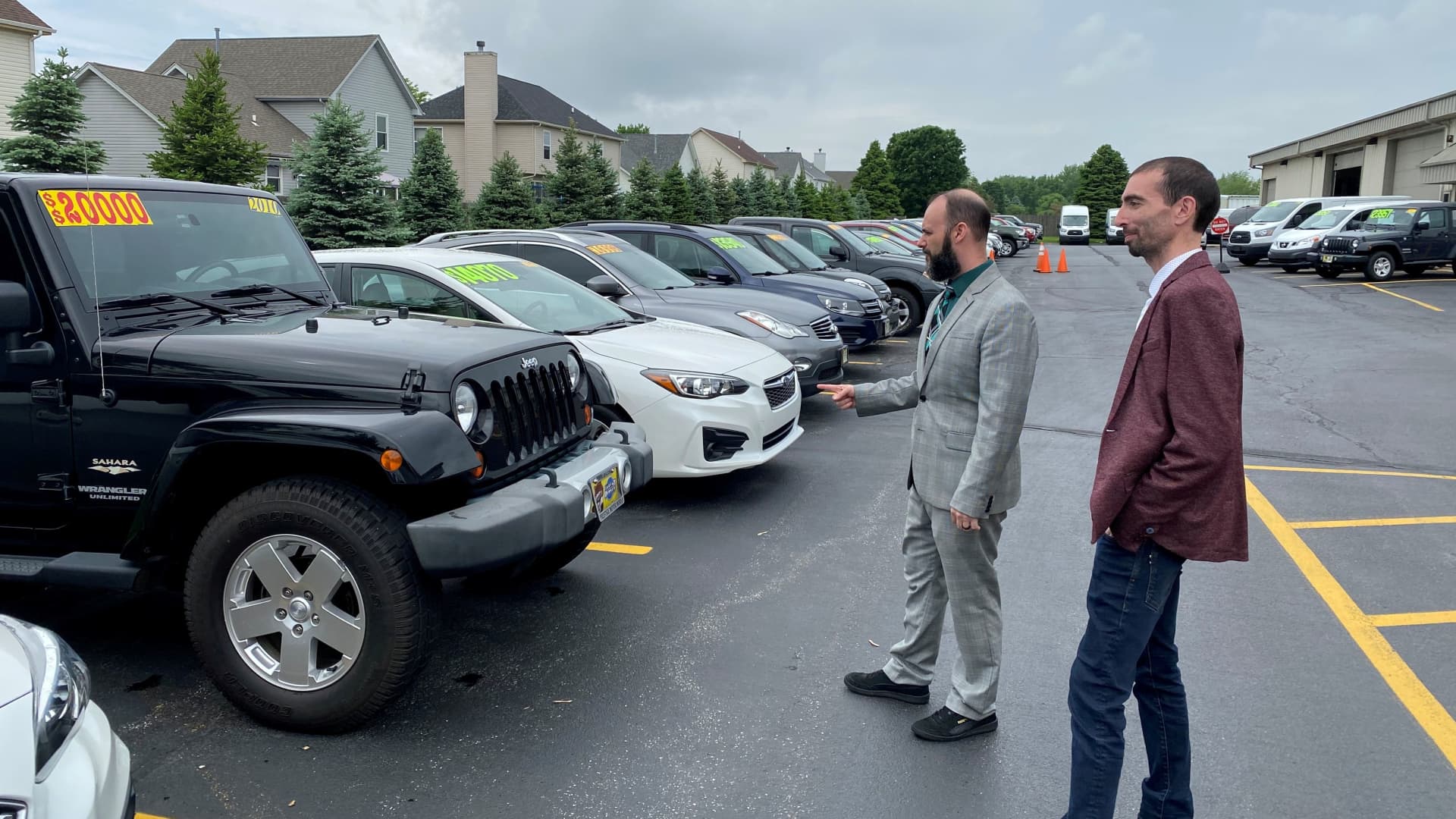
Alex Tovstanovsky, owner of used-car dealer Prestige Motor Works, checks on inventory with his general manager Ryan Caton in Naperville, Illinois, May 28, 2020.
Nick Carey | Reuters
DETROIT — The Federal Reserve’s decision to cut interest rates for the first time in more than four years is expected to eventually boost new vehicle sales, but not as quickly or by as much as some may expect.
The rate cut earlier this month by half a percentage point, or 50 basis points, will take time to trickle down to auto loan rates, which remain near decades-high levels of more than 9.61% for a new vehicle and nearly 14% for a used car or truck, according to Cox Automotive.
“If the Fed is accurate in their forecasts, we will be living with rates more than two and a half points higher than most of the last 24 years,” said Cox Automotive chief economist Jonathan Smoke. “In other words, conditions will be better than what we’ve endured for the last year, but affordability challenges will not be solved by this new path for rates.”
The biggest near-term improvement in auto loan rates isn’t expected until early next year, according to Smoke. He said that unlike the cost of home loans, which has come down in recent months, auto loan rate changes can be delayed because they’re really a function of longer-term bond yields that are based on loan performances.
Auto loan 30-day delinquency rates have risen considerably in recent years, according to a Thursday note from the Board of Governors of the Federal Reserve System. Although they remain below the peak levels of the Great Recession, as of the end of 2023, auto loan delinquency rates exceeded pre-pandemic levels by about 60 basis points.

In addition to the high interest rates, consumers continue to face near-record-high average new vehicle prices and inflated used vehicle prices. Both have fallen from peaks during the Covid pandemic and supply chain problems of recent years but remain elevated compared with historical levels.
Edmunds.com reports average financing for a new vehicle was more than $40,700 in August, with a payoff term of 68.8 months, or 5.7 years. That compares with average financing before the pandemic of roughly $33,000 over 69.7 months, or 5.8 years, in September 2019.
The difference in those payments over the terms of the deals is $3,162, or $178 more per month, according to Edmunds.
“New vehicle sales fell slightly in Q3 as affordability challenges continued to loom large for American car shoppers in the form of historically elevated prices and interest rates,” said Jessica Caldwell, Edmunds’ head of insights.
Should rates continue to decline, consumers will see some relief in monthly payments. BofA Securities estimates each point decrease in the Fed benchmark rate equates to a roughly $20 decrease in an average monthly payment for a new vehicle.
— CNBC’s Michael Bloom contributed to this report.


