


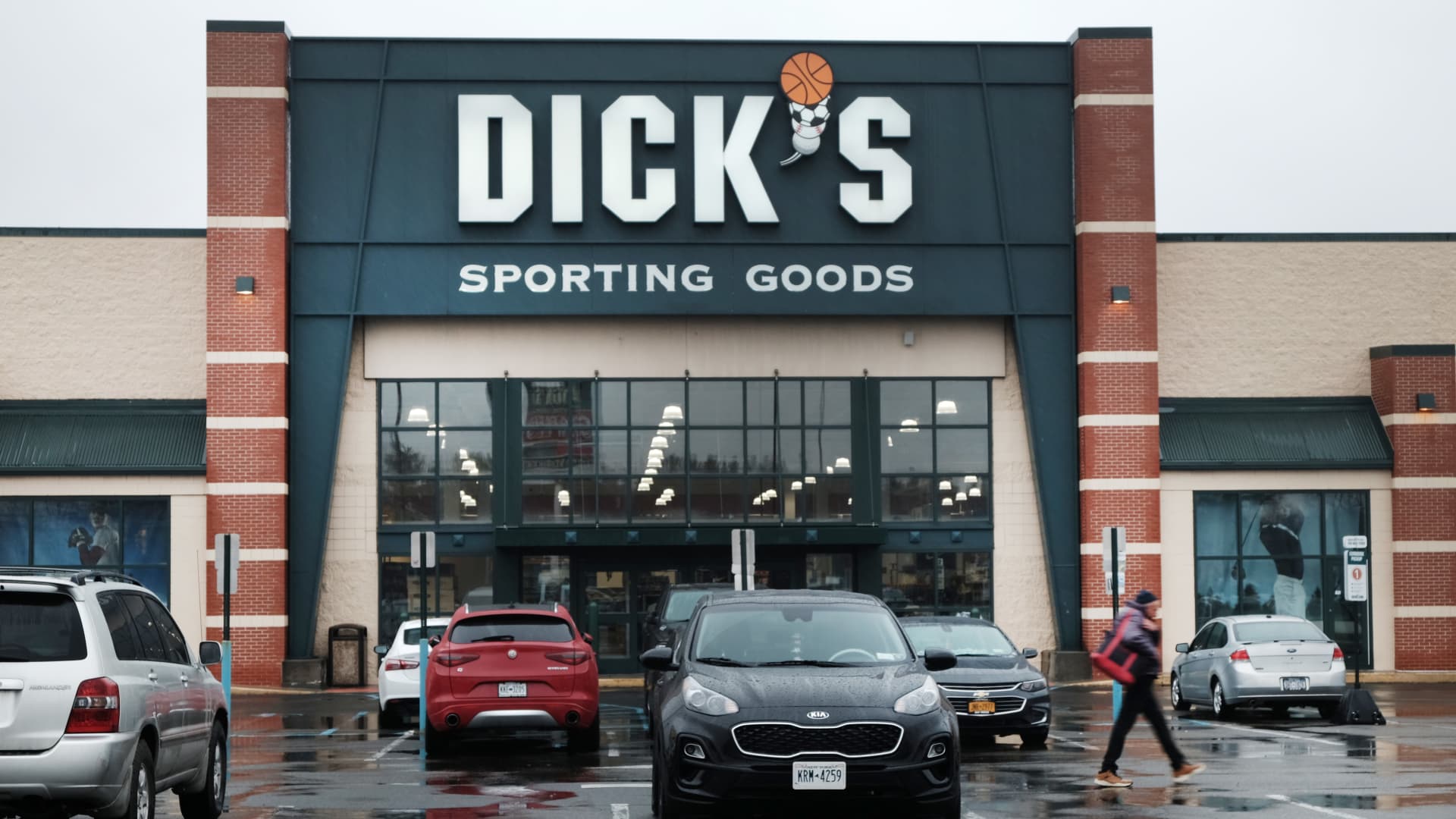
In 2022, the sporting goods business had an estimated market size of $67.2 billion and was enjoying its ranking as one of the fastest-growing industries in the U.S. since 2018. The most significant player in the space, Dick’s Sporting Goods, controls an estimated 14.2% of the market, the most by a single company.
In 2021, Dick’s posted a record annual revenue, hitting $12.3 billion, and its net income tripled as it pivoted its distribution strategy during the pandemic.
Dick’s looks to sustain its record growth under CEO Lauren Hobart, the first nonfamily business chief in the company’s history, with a focus on technology as it navigates tough competition in the sporting goods e-commerce space.
To compete, survive and thrive in today’s environment, technology is an important part for a retailer. If you haven’t invested in technology over the last 10 years, you’ll probably have a tough time.
Ed Stack
Executive Chairman
Dick’s Sporting Goods was founded in 1948 by 18-year-old Dick Stack who had just $300 in his pocket when he opened his first store. At the time, it was a simple bait and tackle shop that later expanded to work clothes, sportswear, equipment, camping gear and picnic supplies. Still, expansion was slow to take hold, with nearly two decades passing before the second Dick’s store opened.
It wasn’t until the 1970s and 1980s when business started to take off, when Ed Stack, Dick’s son, bought the company. In the 1990s, the company expanded its offerings to include more sports, outdoor equipment, apparel and footwear, and by 1996, there were 50 Dick’s Sporting Goods stores.
Dick’s went public in 2002, with 141 stores across 25 states. During the early 2000s, competitors like Sports Authority emerged as the sporting goods segment grew in popularity as sports participation became a big part of the business.
Sports Authority, it biggest rival at the time, had 221 more stores than Dick’s and generated more revenue. But Dick’s saw consistent revenue and net income growth as the company grew its reach with more stores.
Improving operating margins was vital to the company’s sustained success, and eventually, Dick’s topped Sports Authority in size — overtaking the once king of sporting goods retail in 2005.
Dick’s went on a spending spree from 2004 to 2007; it acquired Galyan’s Trading Company, Golf Galaxy, and Chick’s Sporting Goods. That expansion boosted the company’s footprint from 234 stores to nearly 487 in 2008. From 2008 to 2014, revenue jumped almost 65%.
While Dick’s Sporting Goods was expanding, its archrival Sports Authority was on the verge of collapse. The company began selling its assets to former competitors, primarily Dick’s, in 2016.
Dick’s purchased Sports Authority’s IP that year which proved to be a boon to its e-commerce business thanks to the 28.5 million loyalty program members associated with the IP, and an estimated 114 million customer files, including emails, addresses and transaction-history data.
Since 2017, Dick’s has prioritized its investments in e-commerce amid a changing landscape following the bankruptcy and closing of Sports Authority, and with the slowing of its own same-store sales. It launched dicks.com that year and saw sales jump 17% to $1.2 billion year over year.
Heavy investment into e-commerce has paid off in a big way for the company. In 2021, sales reached $12.3 billion, a 46% increase from 2018.
During the pandemic, nearly 70% of online orders were fulfilled directly by stores through curbside orders. A pioneer in the service, Dick’s made it possible for customers to place their orders online and drive to pick them up at a place outside the store. The practice also allowed the company to offload its massive inventory at a time when stores were subject to lockdowns.
In addition, Dick’s has invested in establishing itself as an omnichannel, which has enabled nearly 900 stores across the U.S. to operate as distribution centers for e-commerce and has made for more efficient stocking of customer orders.
Dick’s Sporting Goods’ momentum continued well into 2021 as the company set new records. Revenue grew nearly 30%, net income nearly tripled, and Wall Street was paying attention.
Share prices shot up to record heights, peaking at $145.19 on Oct. 30 that year. Then, in the third quarter of 2020, net sales increased 7.7% year over year — and were over 50% higher than in 2019.
Analysts noted that the company, under Hobart, the new CEO, was continuing its strong performance with high-quality product lineups, and a focus on the future that included expanding in-house brands, developing its e-commerce network, and widening margins.


