


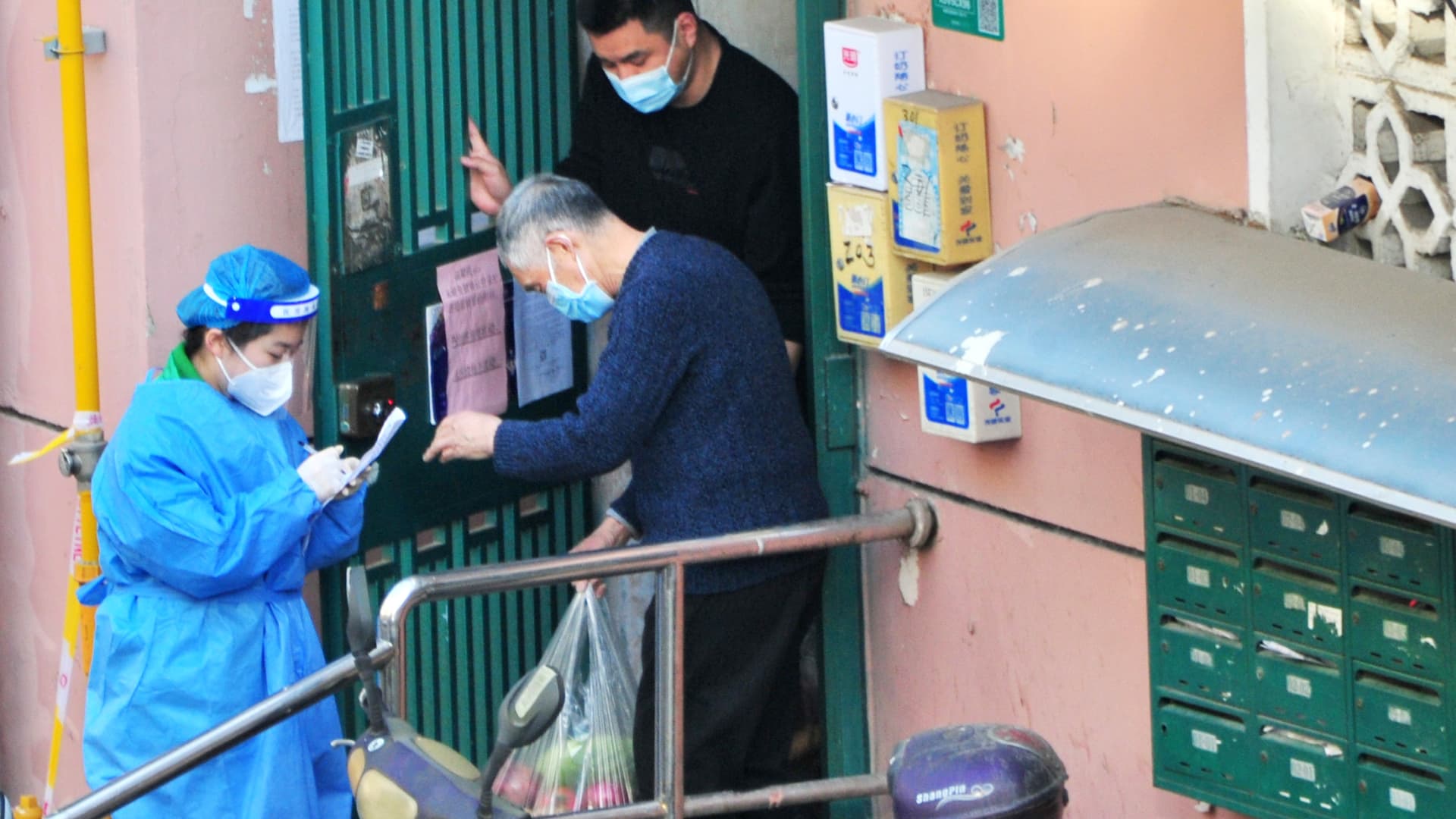
The World Health Organization on Monday said it is monitoring a major surge in Covid cases in mainland China, an outbreak that local officials have attributed to the more contagious omicron BA.2 subvariant.
Dr. Kate O’Brien, director of WHO’s immunization and vaccine program, said the agency is in contact with public health authorities in China about its Covid resurgence. WHO officials said they need to monitor the effectiveness of regional lockdowns and the country’s vaccines, but it doesn’t have enough information.
“We will continue to follow that situation as it continues to emerge and as they’re responding to the situation so that we can understand the nature of the cases, underlying vaccination status and other components there,” said during a press briefing from the organization’s Geneva headquarters.
The remarks come as China grapples with its worst Covid outbreak since the virus was first discovered in Wuhan over two years ago. Though low by most countries’ caseloads, mainland China reported 1,184 new, symptomatic and 26,411 asymptomatic Covid cases on Sunday — the most cases recorded in a single day so far, according to China’s National Health Commission.
To contain the outbreak, the nation has reinstituted lockdowns in some parts of the country and online learning for some students, especially in Shanghai where more than 26,000 cases were reported Sunday.
Almost all of Shanghai’s 26 million residents remain in lockdown about a week after a two-phase shutdown in the city was supposed to end. The citywide lockdown involves orders to work from home and the suspension of ride hailing and public transit.
It is a part of China’s zero-tolerance Covid policy of using regional lockdowns to contain outbreaks, which helped the country rebound from the initial wave of the pandemic in early 2020.
Dr. Alejandro Cravioto, chair of WHO’s Strategic Advisory Group of Experts on Immunization, said it “would be important” to see whether such lockdowns are fully effective in containing the latest outbreak, especially with BA.2 rapidly spreading throughout the country. He noted the new subvariant is more transmissible than the original Covid strain, though its infections are primarily mild or asymptomatic.
Cravioto added that WHO lacks sufficient information on the Covid vaccines being administered in China.
The group has most recently reviewed data on an mRNA vaccine developed by CanSino Biologics, a clinical-stage vaccine company in China, according to a WHO press release. However, Cravioto’s group “will not issue any recommendations until such time as the product is listed by WHO for emergency use,” the press release said.
“Until we really see the data coming out, we won’t be able to make any further comments,” Cravioto said, referring to the effectiveness of China’s “severe” lockdown measures.
CanSino Biologics has yet to be administered to Chinese citizens. The vaccine developer said last week its mRNA vaccine has been approved by China’s medical products regulator to enter clinical trials.
Covid vaccines already administered in China have been updated to fight against the omicron and other strains circulating, Chinese officials said last month, according to Bloomberg. China’s vaccines are inactivated, meaning that they work by using dead or weakened viruses to produce an immune response.
But preliminary lab studies found that vaccines developed by Chinese companies Sinovac Biotech and Sinopharm offer less protective antibodies against omicron than mRNA vaccines from Pfizer and Moderna, Bloomberg reported.
As of April 5, 88.5% of China’s population has received at least one dose of a Covid vaccine, according to Our World In Data.


