


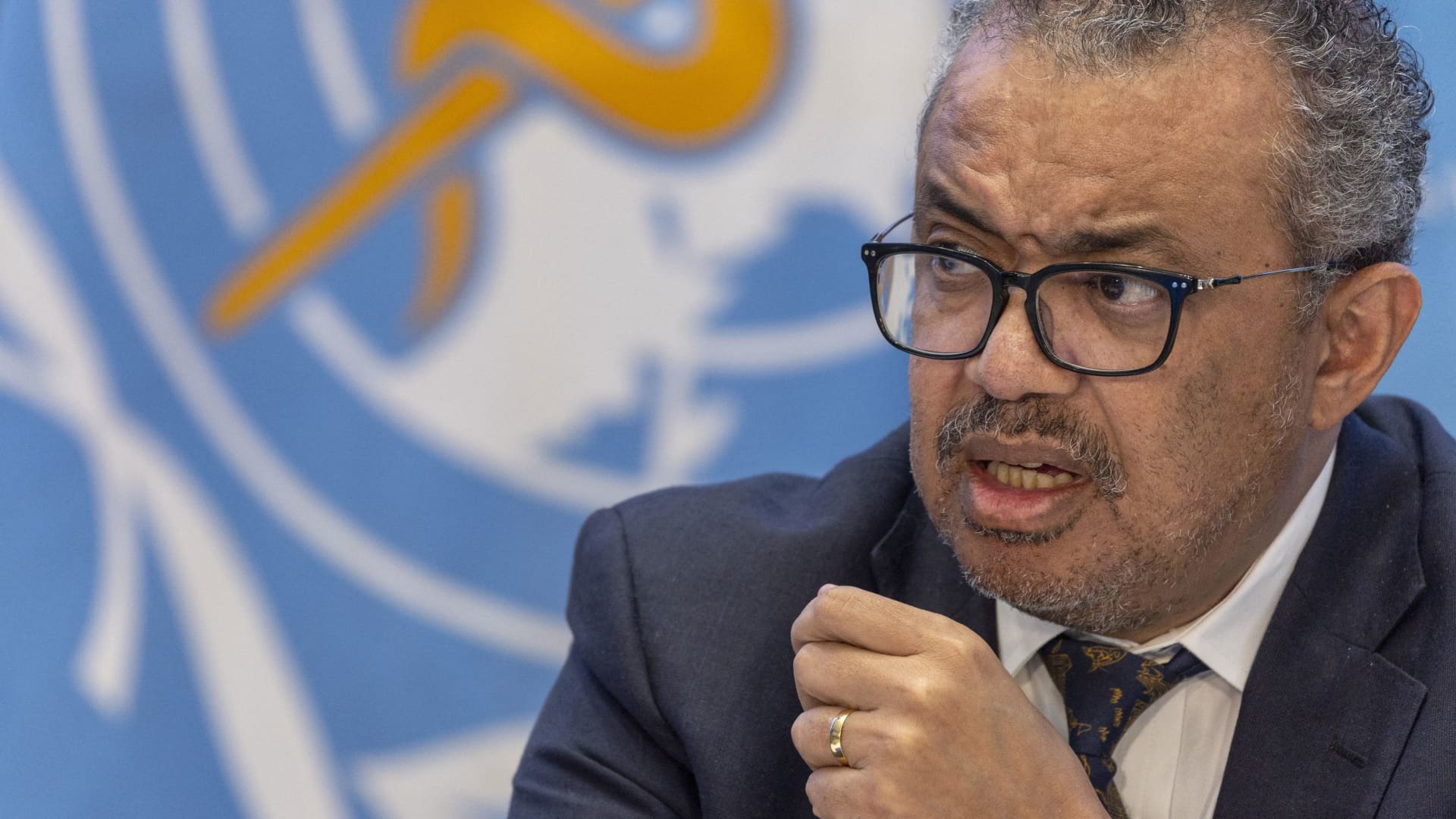
Director-General of the World Health Organisation (WHO) Dr. Tedros Adhanom Ghebreyesus attends an ACANU briefing on global health issues, including COVID-19 pandemic and war in Ukraine in Geneva, Switzerland, December 14, 2022.
Denis Balibouse | Reuters
The World Health Organization on Monday said Covid-19 remains an global health emergency as the world enters the fourth year of the pandemic.
But WHO Director-General Tedros Adhanom Ghebreyesus said he was hopeful that the world will transition out of the emergency phase of the pandemic this year.
“We remain hopeful that in the coming year, the world will transition to a new phase in which we reduce hospitalizations and deaths to the lowest possible level, and health systems are able to manage Covid-19 in an integrated and sustainable way,” Tedros said in a statement.
The WHO’s emergency committee met on Friday and advised Tedros that the virus, which was initially discovered in Wuhan, China in late 2019, remains a public health emergency of international concern, the U.N. agency’s highest alert level. The WHO first declared an emergency in January 2020.
The WHO decision comes after the U.S. earlier this month extended its public health emergency until April.
In his statement Monday, Tedros said the world is in a far better place than it was a year ago when the omicron variant first swept the globe. The WHO has estimated that at least 90% of the world’s population has some level of immunity to Covid due to vaccination or infection.
Weekly Covid deaths have dropped 70% since the peak of the first massive omicron wave in February of last year, according to WHO data. But deaths started increasing again in December as China, the world’s most populous country, has faced its largest wave of infection yet.
Tedros on Friday said surveillance and genetic sequencing has declined dramatically, making it difficult to track Covid variants and detect new ones. Too few older people are fully vaccinated and many people do not have access to antivirals, he said.
“Do not underestimate this virus,” Tedros told reporters at press conference in Geneva on Friday. “It has and will continue to surprise us, and it will continue to kill unless we do more to get health tools to people that need them and to comprehensively tackle misinformation.”
Last month, the WHO chief said the end of the emergency phase of the pandemic is closer than ever before. In the fall, Tedros said the end of the pandemic was in sight.
“We have never been in a better position to end the pandemic. We are not there yet but the end is in sight,” Tedros told reporters in Geneva last September.


