


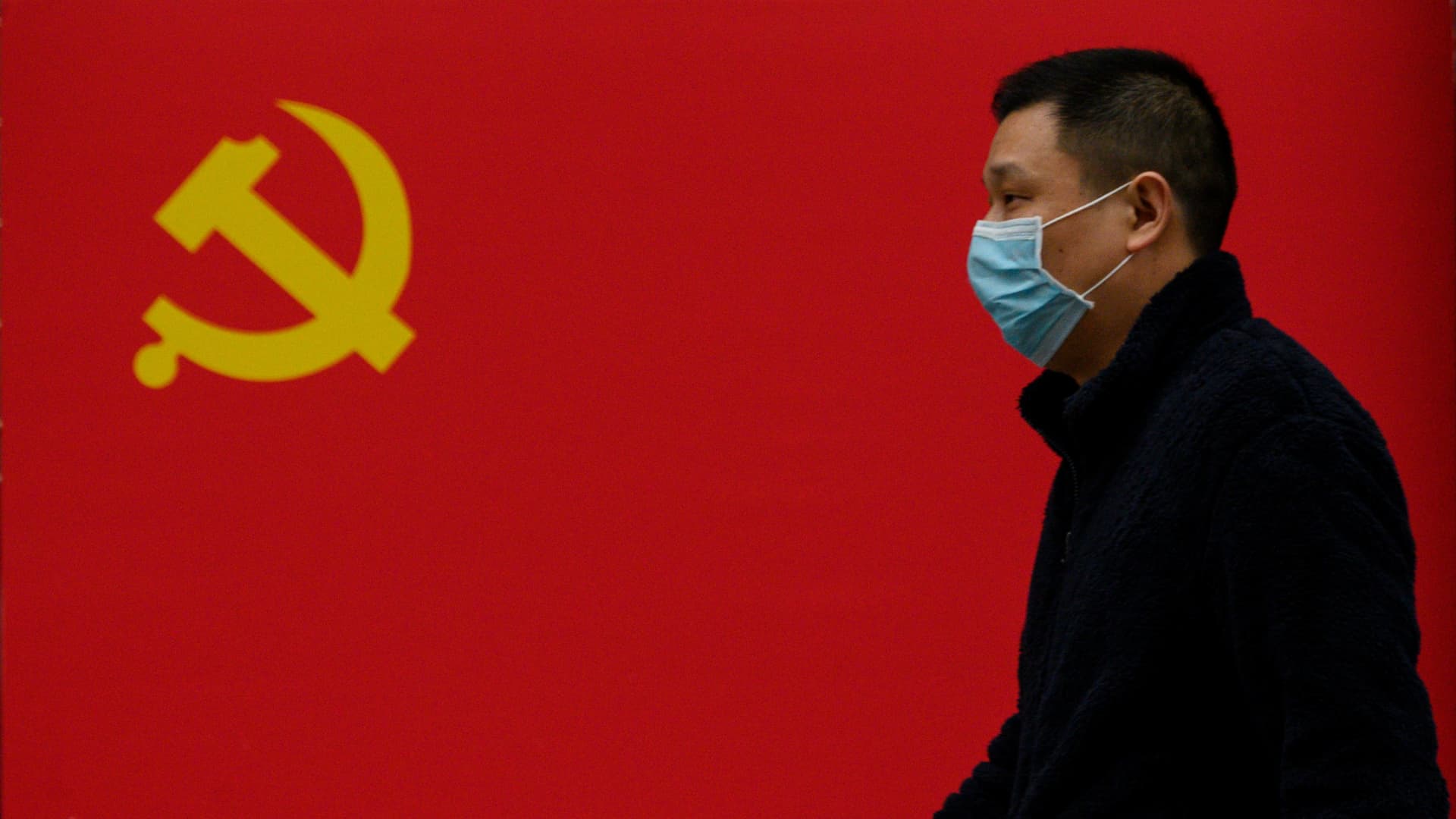
A man wearing a face mask as a preventive measure against Covid-19 walks past a Communist Party flag in Wuhan, China, on March 31, 2020.
Noel Celis | AFP | Getty Images
The World Health Organization on Friday called on China to release new data linking the Covid pandemic’s origins to animal samples at Wuhan Market after the country recently took down the research.
The agency said China’s Center for Disease Control and Prevention uploaded data to the public virus tracking database GISAID in late January relating to samples taken at the Huanan market in Wuhan in 2020.
Researchers from several countries downloaded and analyzed the data before it was removed, and presented their findings to the WHO last weekend. The researchers found molecular evidence that raccoon dogs and other animals susceptible to Covid were sold at the market, which is consistent with hypotheses about the virus spilling into humans from a wild animal.
The new data doesn’t provide a conclusive answer to how the pandemic began, “but it does provide more clues” about a potential host of the virus that spread it to humans, said Maria Van Kerkhove, the WHO’s Covid-19 technical lead. She called on China to publicly release the data so the WHO and other researchers can further analyze it and inch closer to understanding the origins of a pandemic that has killed millions of people worldwide.
“The big issue right now is that this data exists and that it is not readily available to the international community,” said Van Kerkhove. “This is first and foremost absolutely critical, not to mention that it should have been made available years earlier, but that data needs to be made accessible to individuals who can access it, who can analyze it and who can discuss it with each other.”
The WHO’s call comes as the debate over the origin of Covid intensifies. Researchers are clashing over competing theories and governments are staking out positions on what to do next.
The New York Times earlier reported on the new data on Thursday. Researchers told the Times that the molecular data was collected from swabs of walls, floors, metal cages and carts in and around the market starting in January 2020. At the time, the Chinese government had already shut down the market over suspicions that it was linked to the Covid outbreak.
Researchers added that large amounts of the data were a match for raccoon dogs.
Van Kerkhove emphasized that the data doesn’t necessarily prove that a raccoon dog or another animal was infected with the virus and spread it to people. But she said it does establish that animals who can carry Covid were sold at the market, which is “new information.”
It is unknown where the animals came from and whether they were wild or domestic, she added. The WHO is pushing for studies to be conducted in other markets in Wuhan and across China, according to Van Kerkhove. It is also seeking serology tests, which measure antibodies, for people who worked at the markets.
Van Kerkhove also noted that “all hypotheses” on how Covid entered the human population are still on the table. She said more research is needed on potential breaches in biosecurity from a lab or whether the virus originated in a bat before jumping to humans.
“We don’t have all of the information in front of us, and we need to be able to look at all of these different hypotheses. We need to look at all of the data that are needed to assess each one of these so that we can say this may have happened, this may not have happened,” she said.
She added that the WHO “won’t be able to remove different hypotheses” until China reuploads its data.
FBI Director Christopher Wray said earlier this month that the bureau believes Covid most likely originated in a Chinese government-controlled lab.
In February, the Department of Energy assessed “with low confidence” that Covid leaked from a lab.
Roughly 44% of U.S. adults believe the virus spilled from a virology lab in Wuhan, China, while 26% say it moved naturally from animals to humans, according to a Morning Consult poll released last month.


