


United Auto Workers members strike the General Motors Lansing Delta Assembly Plant on September 29, 2023 in Lansing, Michigan.
Bill Pugliano | Getty Images
DETROIT – A shift in strategy by the United Auto Workers union this week has some analysts wondering if the parties are — perhaps, counterintuitively — getting closer to a deal.
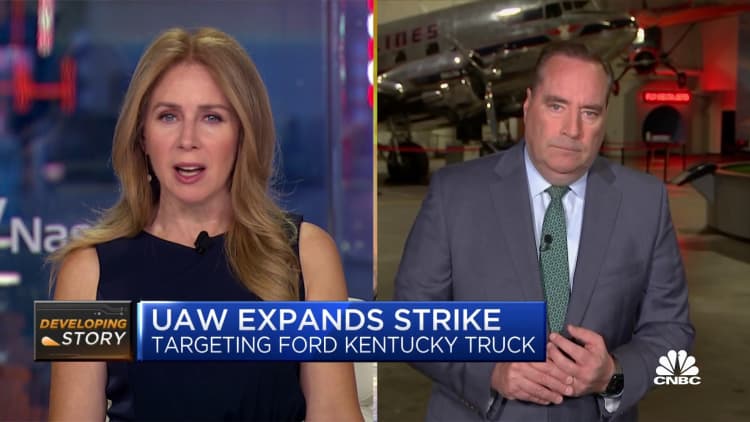
On Wednesday the union initiated a surprise work stoppage at Ford Motor’s Kentucky Truck Plant. The strike involves 8,700 workers and affects the most crucial plant, by far – responsible for $25 billion in revenue annually – that the union has walked out on since the strikes began Sept. 15. It’s expected to quickly have a ripple effect on other Ford plants and suppliers.
It also ushered in what UAW President Shawn Fain characterized as a “new phase” of strikes and contract negotiations with Ford, General Motors and Chrysler-parent Stellantis, giving the union the element of surprise to keep the automakers on edge during the ongoing negotiations, Fain told members in a Friday presentation.
“We’re entering a new phase of this fight and it demands a new approach,” Fain said Friday. “We’re done waiting until Fridays to escalate our strike.
“We are prepared at any time to call on more locals to stand up and walk out,” he said.
Until this week, Fain had announced all of the union’s new strikes on Fridays, during what has become a weekly livestreamed update for union members.
Some Wall Street analysts and industry experts think this week’s shift in strategy could be a sign that UAW leaders feel a deal with Ford is close, and that they’re increasing pressure as a tactic to get the deal over the finish line — and to help sell a potential tentative deal to their members.
“We continue to believe the escalation at [Ford] this week is a sign the talks may be coming to an end. KY Truck is likely Ford’s most profitable plant, and therefore the strike is the highest level of escalation, aside from a national strike,” Wells Fargo analyst Colin Langan wrote in a Friday note. “This escalation would likely be done to push for final terms.”
But the UAW’s leaders may be looking one more step ahead, to the process of selling a tentative deal with Ford to their members. The thinking is that to convince members to ratify a potential new contract, UAW President Shawn Fain and the union’s leadership will need to convince autoworkers that the union has fought as hard as possible to have their demands met. Striking Ford’s most profitable factory might be one way to do that.
Wolfe Research’s Rod Lache argued the Kentucky strike may allow UAW leadership to claim that they did all that could be done, especially if it leads to one or two more concessions from Ford.
“In another week or two, Fain should be able to credibly announce that he has forced Ford into one last capitulation (battery plants?), and that UAW members have secured the last few ounces of wage, benefits, and job protection concessions that they can get,” Lache wrote Thursday to investors.
Factory workers and UAW union members form a picket line outside the Ford Motor Co. Kentucky Truck Plant in the early morning hours on October 12, 2023 in Louisville, Kentucky.
Luke Sharrett | Getty Images
Winning over workers
Only about 34,000 U.S. automakers with the companies, or roughly 23% of UAW members covered by the expired contracts with the Detroit automakers, are currently on strike.
“Hitting a very high-dollar, high-profitable plant, it certainly gets Ford’s attention very quickly,” said Art Wheaton, a labor professor at the Worker Institute at Cornell University. “It also sends a huge message to Stellantis and General Motors.”
Wheaton argues the escalation in Kentucky may just be the beginning. There are plenty more plants the union could hit for each of the automakers, including the full-size pickup truck plants owned by all three and large SUV plants at GM and Stellantis.
GM avoided a strike at its most profitable SUV plant in Texas last week with a last-minute offer to include battery cell plant workers under the company’s national agreement, however details regarding how that will be done are believed to be still being negotiated.
While Fain declined to expand strikes against GM and Stellantis Friday, Wells Fargo’s Langan thinks that doesn’t necessarily mean they’re spared.
“The lack of GM & STLA strike today, even though both have not matched F’s offer, would be consistent with the UAW holding out the most profitable plants for a final push,” he wrote in a Friday note.
Other outcomes?
All of that tea-leaf reading aside, rapid escalation-turned-resolution is just one potential outcome.
Another includes the automakers holding out for the union to deplete its resources, specifically its strike and defense fund. Or, the UAW could continue rotating strikes or filing additional unfair labor practice charges against the companies. Yet another outcome could see the sides seeking mediation or legal resources.
“I think they’ve got to be getting close to some sort of an agreement, or you just have to conclude a reasonable deal is not in the making — and that this is really more a matter of a test of will than anything else,” said Marick Masters, a business professor at Wayne State University in Detroit who specializes in labor issues.
An automaker also could submit what’s known as a “last, best and final offer,” which, as it states, is typically a final proposal when bargainers have reached an impasse.
Ford may be close to that point. An executive said Thursday the automaker was “at the limit” of what it can offer UAW in terms of economic concessions.
The Detroit automakers have largely given into many of the union’s demands, but not all of them.
The companies haven’t waved the white flag on demands for a 32-hour workweek — which was always a nonstarter for the companies and which has largely fallen out of union talking points — and a 40% wage increase.
Ford was up to a record 23% wage increase in its recent contract proposal, with the others not far behind.
Then there’s the outstanding issues of benefits for retirees as well as a return to traditional pension plans and future battery plant jobs and workers.
Industry experts and sources familiar with the talks believe regardless of the outcome, the contracts will have ripple effects on the companies potentially in the way of reorganizations, cost cuts and future investments and jobs.
A former high-ranking bargainer for one of the automakers told CNBC that it’s nearly guaranteed that the companies will cut union jobs through product allocation, plant closures or other means to offset increased labor costs once the contracts are set.
“They’re going to have to pay up. The question is how much,” said the longtime bargainer, who agreed to speak on the condition of anonymity. “This ends up with fewer jobs. That’s how the automakers cut costs.”


