


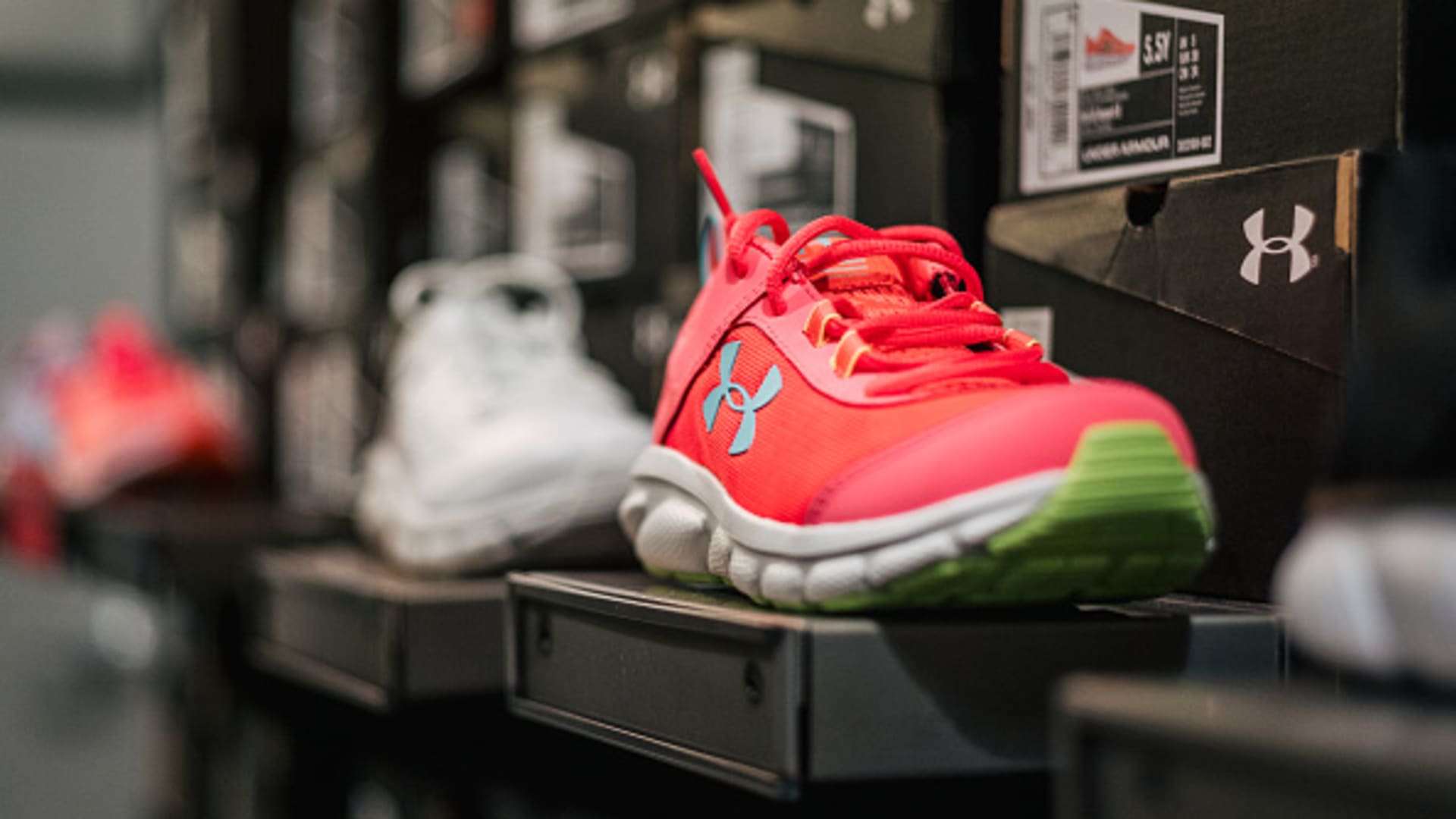
Under Armour shoes are seen inside of a store on November 03, 2021 in Houston, Texas.
Brandon Bell | Getty Images
Under Armour reported holiday quarter earnings Wednesday that beat Wall Street’s expectations, but the retailer is contending with a growing inventory glut that heavy promotions and discounting failed to alleviate.
The company’s stock rose in light pre-market trading.
Despite the inventory challenges, the athletic apparel company raised its earnings outlook for the fiscal year. It now expects to see per share earnings 52 cents to 56 cents, compared to the previously expected range of 44 cents to 48 cents.
Here’s how Under Armour did in its fiscal third quarter compared with what Wall Street was anticipating, based on a survey of analysts by Refinitiv:
- Earnings per share: 16 cents adjusted vs. 9 cents expected
- Revenue: $1.58 billion vs. $1.55 billion expected
The company’s reported net income for the three-month period that ended Dec. 31 was $121.62 million, compared with $109.66 million a year earlier. Sales rose to $1.58 billion, compared to $1.53 billion a year earlier.
Like other retailers, the athletic apparel company has been grappling with an inventory glut brought on by supply chain woes and shifting trends in consumer demand. During its fiscal third quarter, Under Armour’s inventory was up 50% year-over-year. Despite heavy promotions and discounting during its crucial holiday quarter, inventory was up slightly from its previous quarter.
Promotions and discounts continued to cut into Under Armour’s margins, which declined 6.5% compared to the prior year period.
The company saw a 7% jump in wholesale revenue and a decline in its direct-to-consumer sales.
While sales were down 9% in Asia, Under Armour saw big gains internationally. Revenue increased 45% in Latin America and 32% in Europe, the Middle East and Africa.
A 2% decline in apparel, which accounts for the majority of Under Armour’s sales, was offset by a 25% jump in footwear revenue.
In December, the company announced former Marriott executive Stephanie Linnartz would be taking over as CEO and starting in the role on Feb. 27. Colin Browne has been serving as interim CEO since June after the retailer’s previous top executive, Patrik Frisk, unexpectedly resigned in May.
Under Armour has been working to build out its e-commerce operations and is banking on Linnartz’s experience leading Marriott’s multibillion-dollar digital transformation to accelerate the company’s digital initiatives.
E-commerce sales increased 7% in the most recent quarter and accounted for 45% of Under Armour’s total DTC revenue.
Read the full earnings release here.
Correction: This story was updated to reflect the correct e-commerce results for the quarter.

