


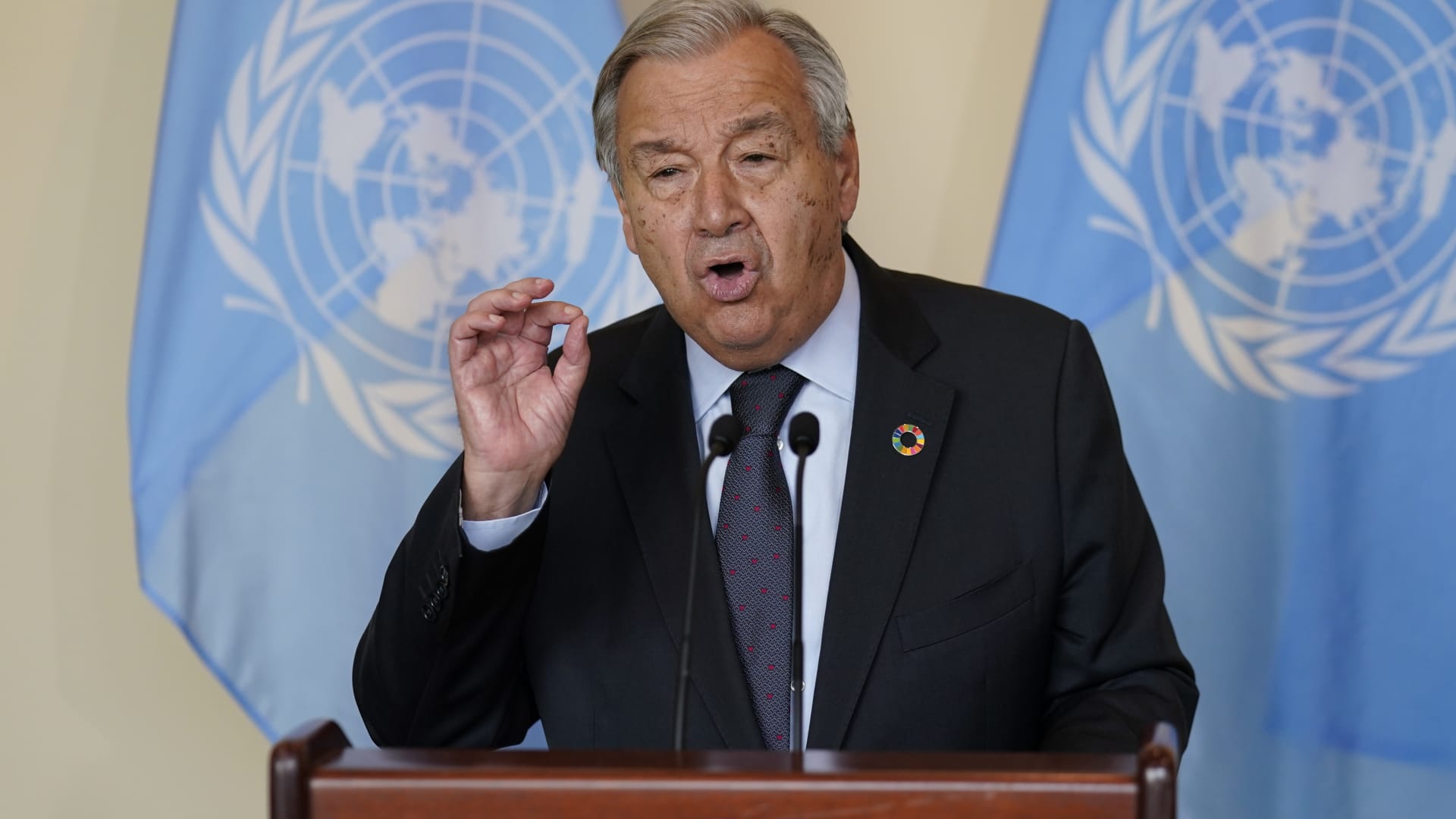
Antonio Guterres photographed in New York last September. On Tuesday, he said fossil fuel firms and their “enablers” needed to be held to account.
John Minchillo | Pool | Getty Images News | Getty Images
The U.N. secretary general said Tuesday that developed economies should impose an extra tax on the profits of fossil fuel firms, with the funds diverted to countries affected by climate change and households struggling with the cost-of-living crisis.
In a wide-ranging address to the U.N. General Assembly in New York, Antonio Guterres described the fossil fuel industry as “feasting on hundreds of billions of dollars in subsidies and windfall profits while households’ budgets shrink and our planet burns.”
Fossil fuel firms and their “enablers” needed to be held to account, he went on to state. “That includes the banks, private equity, asset managers and other financial institutions that continue to invest and underwrite carbon pollution.”
It also included what he called “the massive public relations machine raking in billions to shield the fossil fuel industry from scrutiny.”
Despite the remarks, Guterres appeared to acknowledge the reality of the current situation, in which coal, oil and gas continue to play a crucial role in the modern world, in both developed and emerging economies.
“Of course, fossil fuels cannot be shut down overnight,” he said. “A just transition means leaving no person or country behind. But it’s high time to put fossil fuel producers, investors and enablers on notice.”
“Polluters must pay. And today, I am calling on all developed economies to tax the windfall profits of fossil fuel companies.”
Guterres said that these funds should be re-directed to “countries suffering loss and damage caused by the climate crisis; and to people struggling with rising food and energy prices.”
Guterres’ speech on Tuesday reinforced comments he made back in August, when he said it was “immoral for oil and gas companies to be making record profits from this energy crisis on the back of the poorest people and communities and at a massive cost to the climate.”
“The combined profits of the largest energy companies in the first quarter of this year are close to 100 billion U.S. dollars,” he added. “I urge all governments to tax these excessive profits and use the funds to support the most vulnerable people through these difficult times.”
The notion of imposing a windfall, or one-off, tax on energy companies has gained traction in some quarters over the past few months, with the sector recording huge profits amid a spike in commodity prices, while many homes and businesses struggle with rising energy bills and a wider cost-of-living crisis.
Back in May, for example, the U.K.’s former finance minister, Rishi Sunak, announced details of what he called a “temporary, targeted energy profits levy” on oil and gas firms.
Last week, European Commission President Ursula von der Leyen said it was proposing “a cap on the revenues of companies that produce electricity at low costs.” These businesses, she argued, were “making revenues they never accounted for, they never even dreamt of.”
“And don’t get me wrong: In our social market economy, profits are OK, they are good,” von der Leyen added. “But in these times, it is wrong to receive extraordinary, record revenues and profits benefitting from war and on the back of our consumers.”
“In these times, profits must be shared and channeled to those who need it most. And therefore, our proposal also includes the fossil fuel electricity producers, who have to give a crisis contribution.”
Overall, von der Leyen said the proposal would raise over 140 billion euros, or around $140.1 billion.
While such actions and initiatives have backers, there is also opposition. After Sunak announced his plans, for example, Offshore Energies UK said the levy would “discourage UK offshore energy investments, meaning declines in oil and gas exploration and production, and so force an increase in imports.”
The debate and discussion about the role fossil fuels play in the planet’s energy mix is a live one, and looks set to continue over the coming years.
Earlier this year, Standard Chartered CEO Bill Winters acknowledged most people would subscribe to what he called a “just transition.”
“Those are two really important words … just means fair, it also means implementable,” Winters, who was speaking to CNBC’s Geoff Cutmore at the City Week forum in London, said. “And transition means transition — it means it takes some time.”
“The idea that we can turn off the taps and end fossil fuels tomorrow, it’s obviously ridiculous and naive,” Winters said. “Well, first of all, it’s not going to happen and secondly, it would be very disruptive.”
It would be good for climate change, Winters went on to state, but “bad for wars, revolutions and human life because you’d have … havoc.” The “ultimate divestment option” needed to be taken off the table, he argued.


