


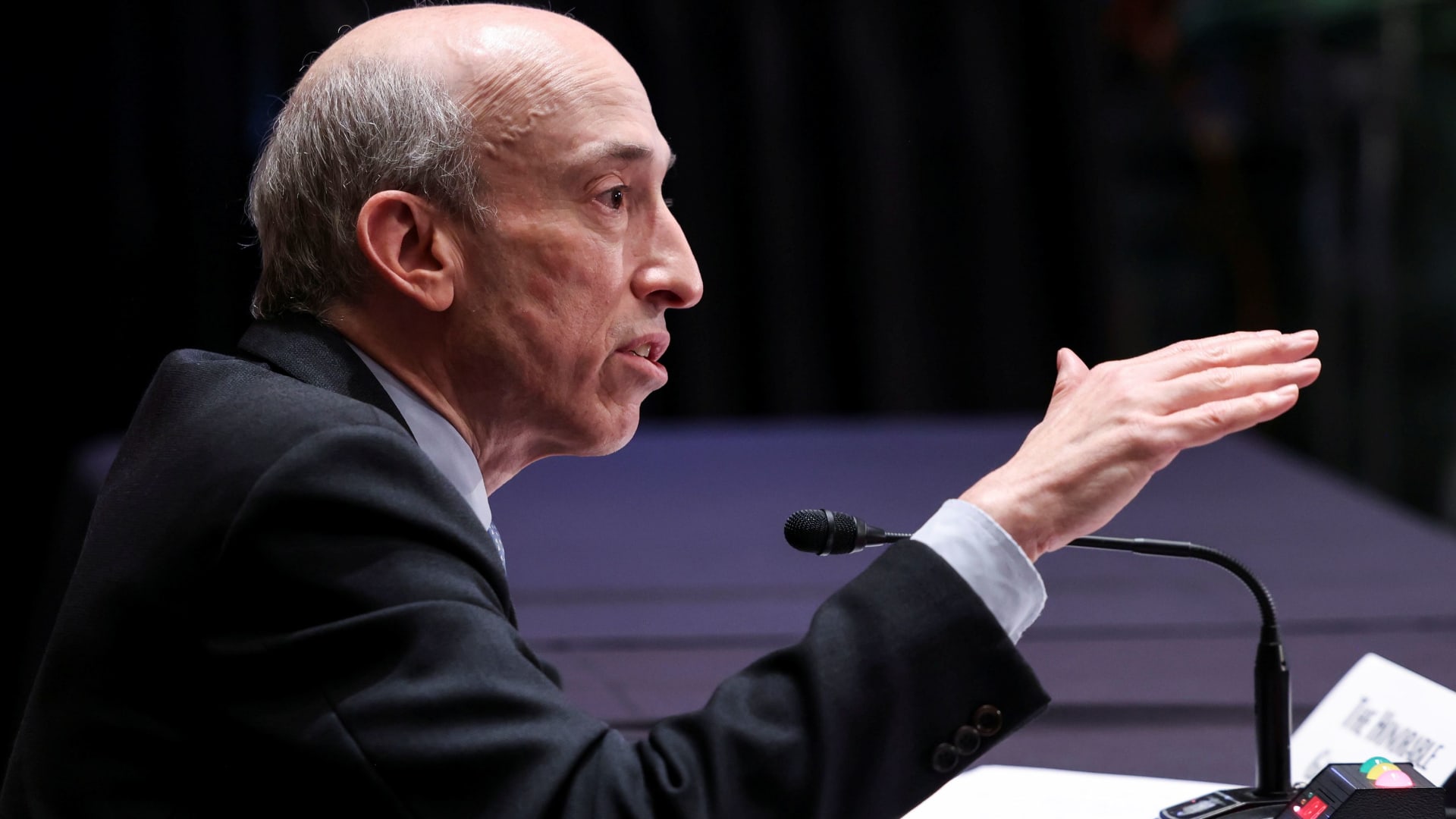
U.S. Securities and Exchange Commission (SEC) Chair Gary Gensler testifies before a Senate Banking, Housing, and Urban Affairs Committee oversight hearing on the SEC on Capitol Hill in Washington, September 14, 2021.
Evelyn Hockstein | Pool | Reuters
The top U.S. securities regulator on Wednesday proposed rule changes to transform how Wall Street handles retail stock trades after the meme stock mania last year raised questions about whether mom-and-pop investors were getting the best price.
The plan, unveiled by U.S. Securities and Exchange Commission chair Gary Gensler, would require trading firms to directly compete to execute trades from retail investors to boost competition.
The Wall Street watchdog plans to scrutinize the controversial payment for order flow, or PFOF, practice, in which some brokers, like TD Ameritrade, Robinhood Markets and E*Trade, are paid by wholesale market makers for orders.
“I asked staff to take a holistic, crossmarket view of how we could update our rules and drive greater efficiencies in our equity markets, particularly for retail investors,” Gensler told an industry audience on Wednesday.
He said the new SEC rules would mandate market makers disclose more data around the fees these firms earn and the timing of trades for the benefit of investors.
Gensler’s announcement, the biggest shake-up of U.S. equity market rules in over a decade, will likely lead to formal proposals this fall. The public can then weigh in on them ahead of an SEC vote to adopt them.
The intended changes would fundamentally alter the business model of wholesalers. They could also affect brokers’ ability to offer commission-free trading to retail investors. Reuters first flagged the reforms in March.
PFOF came under regulatory scrutiny last year when an army of retail investors went on a buying spree of “meme stocks” like GameStop and AMC, squeezing hedge funds that had shorted the shares. Many investors purchased shares using commission-free brokers such as Robinhood.
The new rules would enhance order-by-order competition, including via potential “open and transparent” auctions, aimed at providing investors better prices. They would include an agency-specific definition of so-called best execution for equities and other securities to ensure broker-dealers and investors benefit from more detail around the procedural standards brokers must meet when handling and executing customer orders.
They would require broker dealers and market centers to disclose more data around order execution quality to benefit investors, including a monthly summary of price improvement and other statistics, Gensler said.
The rules would also seek to shrink the minimum pricing increment or so-called tick size to better align with off-exchange activity and harmonize the tick size to ensure all trading occurs in the minimum increment.
Wholesale overhaul
The proposed rule changes will include an SEC definition of “best execution” requirements that would force retail brokers to send their customers’ orders to auctions, run by exchanges or off-exchange trading venues, which would allow market participants to compete to trade against the orders, the sources said.
Currently, retail brokerages can send customer orders directly to a wholesale broker to be executed, as long as the broker is matching or bettering the best price available on U.S. exchanges. Large market-makers typically improve on the best price by a fraction of a cent. Gensler has criticized this model as limiting competition for retail orders.
The rules would require retail brokers to send PFOF customer orders to the wholesaler offering the best deal, rather than the one that pays the most.
This would fundamentally alter the business model of wholesalers, which can make more money by executing retail investor orders internally than they do on public exchanges, where they might find themselves trading with other sophisticated trading firms or institutional investors.
Gensler told Reuters in March he wants to ensure brokers execute orders at the best possible price for investors – the highest price for when an investor is selling, or the lowest price if they are buying.
“It’s great to see the SEC taking a holistic approach to this problem – there’s not a single answer, we need changes to different parts of the market,” said Dave Lauer, CEO of financial platform Urvin Finance.
“We need an order-by-order standard for best execution and open competition for order flow in order to provide the best outcomes for retail investors. This will force greater competition, and could help to end the off-exchange oligopoly that has controlled that market for too long,” he added.
Investor advocates want to boost exchanges’ competitiveness to improve the reliability of the national pricing benchmark, known as the National Best Bid and Offer (NBBO).
