


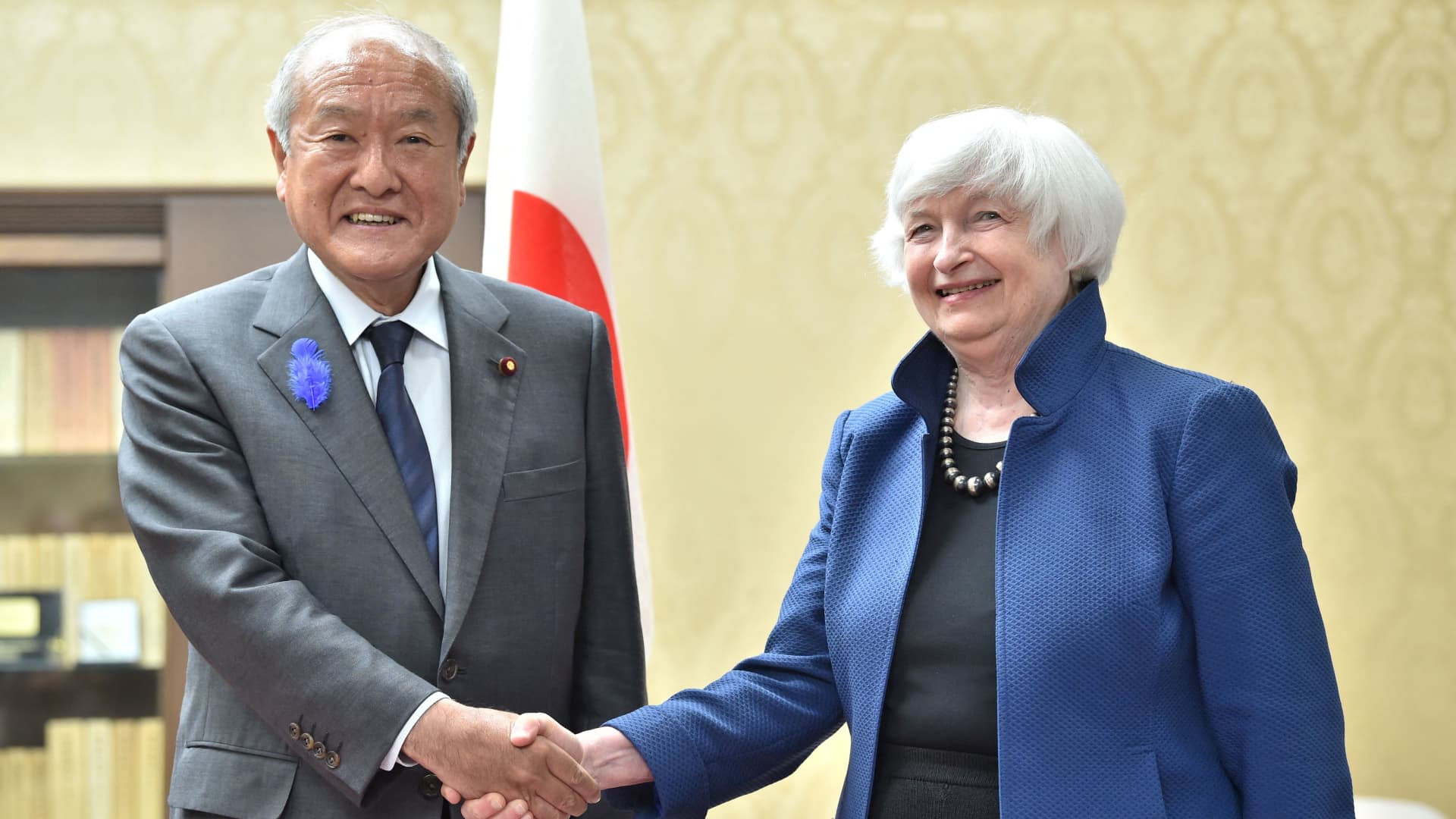
Japanese Finance Minister Shunichi Suzuki shaking hands with US Treasury Secretary Janet Yellen at the latter’ office in Tokyo on July 12, 2022. U.S. Treasury Secretary Janet Yellen and Japanese Finance Minister Shunichi Suzuki agreed on Tuesday to further strengthen bilateral ties and work together to address rising food and energy prices exacerbated by Russia’s war in Ukraine.
Kazuhiro Nogi | Afp | Getty Images
U.S. Treasury Secretary Janet Yellen and Japanese Finance Minister Shunichi Suzuki agreed on Tuesday to further strengthen bilateral ties and work together to address rising food and energy prices exacerbated by Russia’s war in Ukraine.
They said the war had increased exchange rate volatility, which could have adverse implications for economic and financial stability, and pledged to “cooperate as appropriate” on currency issues in line with their commitments as part of the Group of Seven (G7) and Group of 20 economies.
“We will continue to consult closely on exchange markets and cooperate as appropriate on currency issues, in line with our G7 and G20 commitments,” the two sides said in a joint statement following their meeting.
The two leaders also said they were united in their “strong condemnation of Russia’s unprovoked, unjustifiable, and illegal war against Ukraine,” adding they continued to increase Russia’s cost of its war by implementing economic and financial sanctions.
Russia has described the invasion of Ukraine “a special military operation.”
Yellen and Suzuki also urged China and other non-Paris Club creditors to cooperate “constructively” in working out debt treatments for low-income countries facing debt distress, while also touching on issues such as climate change and global tax reforms.
Russian oil price cap
Their joint statement also referred to a price cap on Russian oil that the United States has proposed to prevent Moscow from benefiting from using higher oil prices to fund its war in Ukraine, but stopped short of laying out any concrete agreement on a scheme.
“We welcome G7 efforts to continue exploring ways to curb rising energy prices, including the feasibility of price caps where appropriate, while considering mitigation mechanisms to ensure that most vulnerable and impacted countries maintain access to energy markets,” the two leaders said in the statement.
The global price of oil could surge by 40% to around $140 per barrel if a proposed price cap on Russian oil is not adopted, along with sanction exemptions that would allow shipments below that price, a senior U.S. Treasury official said earlier.
The U.S. official said the goal was to set the price at a level that covered Russia’s marginal cost of production so Moscow is incentivized to continue exporting oil, but not high enough to allow it to fund its war against Ukraine.
Yen concerns
The Japanese finance minister fired off a fresh warning shot against the renewed yen weakness earlier on Tuesday, after the currency had hit a fresh 24-year low beyond 137 yen to the dollar the previous day.
“There are various global problems. We’d like to make maximum use of today’s meeting to deepen our coordination to resolve them,” Suzuki told reporters.
“A sharp yen weakening is seen in recent currency market trading. I’m concerned,” he said, “The government will watch the currency market even more closely while liaising with the Bank of Japan.”
Meanwhile, the U.S. Treasury secretary paid her respects to slain former Prime Minister Shinzo Abe, Japan’s longest serving modern leader at a private wake on Monday evening, lauding his work to increase Japan’s prosperity and advance the status of women.
She canceled a public speech at the Port of Yokohama out of deference to Abe’s death, but will still meet privately with Japanese business leaders to discuss how improved supply chain resiliency and greater use of “friend-shoring” can help ease inflationary pressures and address the bottlenecks.
On Wednesday, Yellen will travel to Indonesia to meet with Suzuki and other Group of 20 finance officials for their July 15-16 gatherings.

