


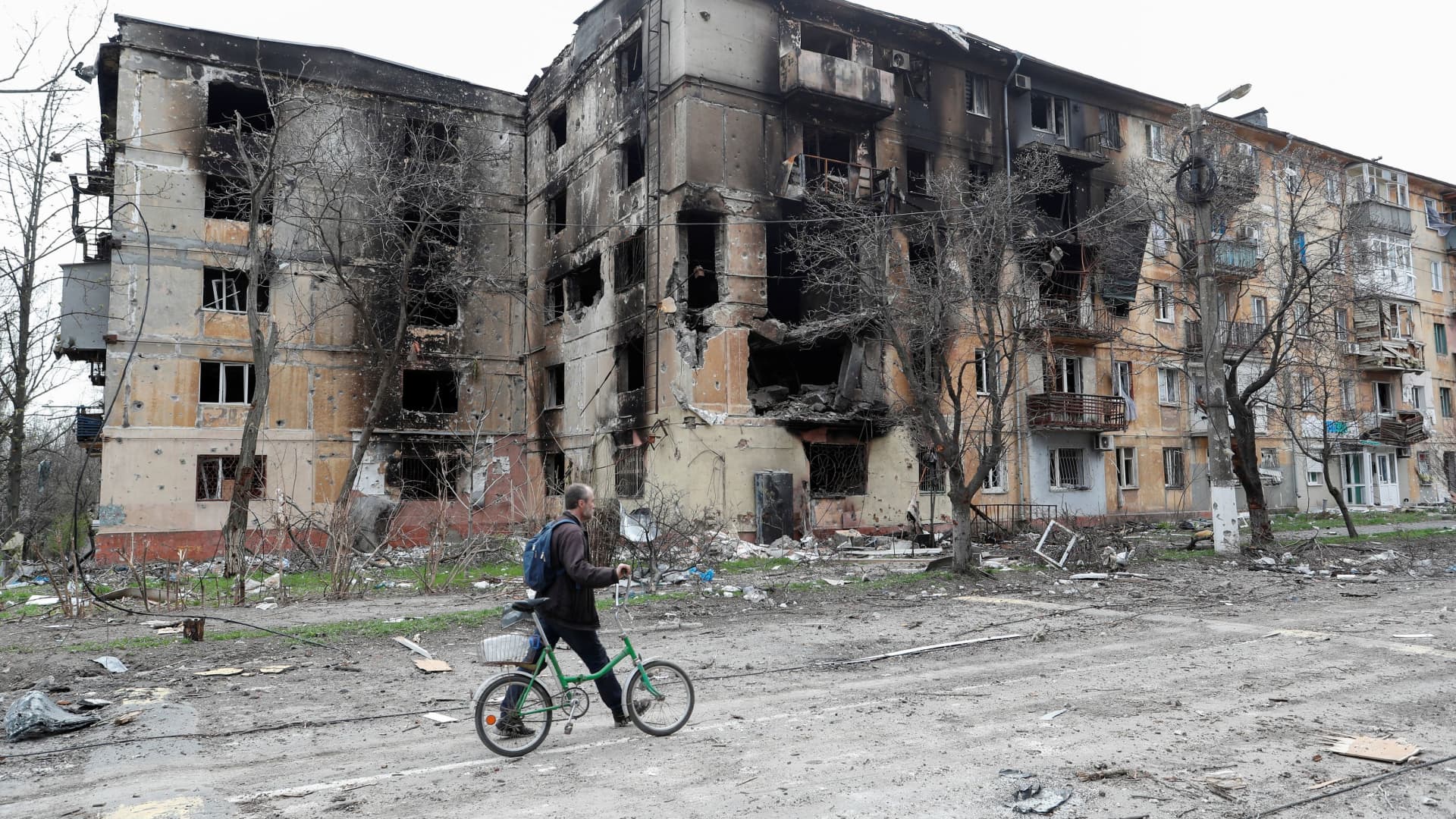
WASHINGTON — As the international community seeks new ways to increase economic pressure on the Kremlin for its brutal war against Ukraine, the idea of labeling Russia a state sponsor of terrorism has recently gained attention within the Biden administration.
Ukrainian President Volodymyr Zelenskyy asked U.S. President Joe Biden to designate Russia a state sponsor of terrorism during a recent phone call between the two leaders. Biden didn’t commit to Zelenskyy’s request, The Washington Post reported, but he didn’t deny it either.
Since then, both State Department and White House officials have publicly said the United States is looking closely at the rules around designating Russia a state sponsor of terrorism.
But they have also stressed that the specific sanctions triggered by the state sponsor of terror label, like arms embargoes, trade restrictions and foreign aid suspensions, have already been imposed upon Russia, raising doubts about what the terror designation could actually accomplish at this point.
“The sanctions we have in place and have taken are the same steps that would be entailed by the designation of a state sponsor of terrorism,” said State Department spokesman Ned Price on Monday. Nonetheless, he said, “We’ll take a close look at all potential authorities. This is one of them.”
The state sponsor of terrorism label is one of the most far reaching sanctions in the U.S. diplomatic arsenal, typically reserved for the worst of the worst — countries that sponsor non-state actors outside their borders who commit acts of terrorism against civilians.
To qualify as a state sponsor of terrorism, a country must have “repeatedly provided support for acts of international terrorism,” according to the State Department’s official description of the law.
Currently, only North Korea, Cuba, Syria and Iran are on the list. Four more countries were previously listed but got the label removed following regime changes: Iraq, Libya, South Yemen (now part of Yemen) and Sudan.
If Russia were to be added to the list, the move would be done as part of the broader international campaign to punish Russian President Vladimir Putin and his government for the brutal war they are waging against Ukraine.
But ironically, Russia’s current actions in Ukraine would almost certainly not qualify as the acts of state sponsorship of terrorism that would merit a formal designation by the United States.
“State sponsorship of terrorism is a particular state supporting some group outside the state that is engaging in terrorist activities,” said Alexander Motyl, a professor of political science at Rutgers University and the author of 10 books on the history of Russia and Ukraine.
“The designation would have clearly applied to Russia in 2014, when the Kremlin was supporting separatists in the Donbas and they were engaging in acts of violence,” Motyl said in an interview Tuesday. “But today, the people who are doing the killing are Russian soldiers in uniform, so they are, essentially, the state.”
This is not to say American diplomats would have to look very far to find instances of Russian state sponsorship of terrorism, he noted, pointing to the well publicized poisonings of Russian dissidents outside of Russia.
If the U.S. were to formally designate Russia as a state sponsor of terrorism, said Motyl, “the primary value could be in potential negotiations, where the label could be used as a bargaining chip.”
Initial talks between Ukraine and Russia never reached a serious level, and they have completely stalled in recent weeks. Russia claims Ukraine has shifted its demands, but Ukraine insists Russian participation in the talks was only ever a ruse to buy goodwill in the West while the Kremlin bombed Ukraine.
With talks all but dead, it’s hard to see what adding Russia to the list of state sponsors of terrorism at this point in the conflict could actually do.
“Now that they’ve been accused of genocide and war crimes, and Putin has been accused of being a war criminal, accusing him of [sponsoring terrorism] won’t make much of a difference. Certainly not to him,” said Motyl.

