


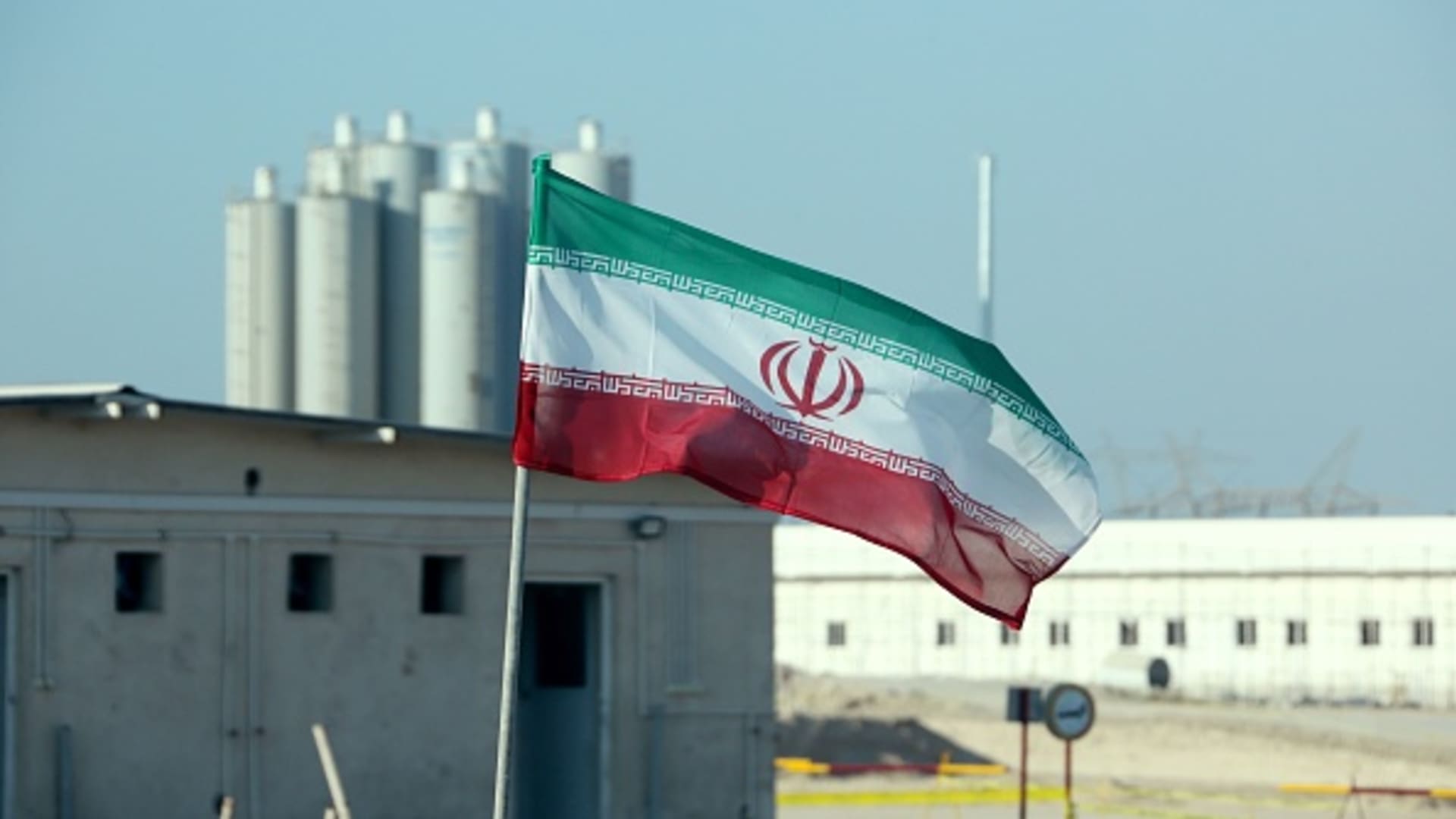
A picture taken on November 10, 2019, shows an Iranian flag in Iran’s Bushehr nuclear power plant, during an official ceremony to kick-start works on a second reactor at the facility.
ATTA KENARE | AFP via Getty Images
U.S. Special Envoy for Iran Robert Malley said on Sunday he was not confident that a nuclear deal between world powers and Iran was imminent, dampening expectations after 11 months of talks in Vienna that have stalled.
The failure of efforts to restore the pact, which would curb Tehran’s nuclear programme in exchange for lifting tough sanctions, could carry the risk of a regional war, or lead to more harsh Western sanctions and further rises in world oil prices, analysts say.
“I can’t be confident it is imminent.. a few months ago we thought we were pretty close as well,” Malley said at the Doha Forum international conference.
“In any negotiations, when there’s issues that remain open for so long, it tells you something about how hard it is to bridge the gap.”
His assessment of the negotiations in Vienna to revive a 2015 nuclear accord came after Kamal Kharrazi, a senior advisor to Iran’s Supreme Leader Ayatollah Ali Khamenei, said a deal could come soon.
“Yes, it’s imminent. It depends on the political will of the United States,” Kharrazi told the conference.
Then-U.S. President Donald Trump abandoned the nuclear pact in 2018, prompting Tehran to start violating nuclear limits set under the deal about a year later, and months of on-and-off talks to revive it paused earlier this month after Russia presented a new obstacle.
Russia later said it had received written guarantees that it would be able to carry out its work as a party to the deal, suggesting Moscow could allow it to be resuscitated.
Kharrazi said in order for the deal to be revived it was vital for Washington to remove the foreign terrorist organisation (FTO) designation against Iran’s Islamic Revolutionary Guard Corps (IRGC), an elite unit which reports to Khamenei.
The IRGC, created by the Islamic Republic’s late founder Ayatollah Ruhollah Khomeini during the 1979 revolution, is more than just a military force.
It is also an industrial empire with enormous political clout. It was listed by Washington as a specially designated global terrorist (SDGT) and sanctioned under the Countering America’s Adversaries Through Sanctions Act (CAATSA) in 2017.
The IRGC’s foreign operations arm, the Quds Force, was labelled an SDGT in 2007. The Trump administration put the IRGC organization on the FTO list in April of 2019.
The Quds Force helps Iran spread its influence in the Middle East through proxies.
“IRGC is a national army and a national army being listed as a terrorist group certainly is not acceptable,” said Kharrazi.
Asked about any potential redesignation, Malley said: “Regardless of what happens to the IRGC issue that you raise, our view of the IRGC is many other sanctions on the IRGC will remain. This is not a deal that intends to resolve that issue.”
Tehran has also been pushing for guarantees that any future U.S. president would not withdraw from the deal, which would curb Tehran’s nuclear programme in exchange for lifting tough sanctions which have hammered Iran’s economy.
The extent to which sanctions would be rolled back is another sensitive subject.
The United States’ allies in the Gulf and Israel view the nuclear talks with misgivings and see Tehran as a security threat.
Israel and the United States will cooperate in preventing a nuclear-armed Iran despite differences over any nuclear deal, Israel’s foreign minister said on Sunday.
“We have disagreements about a nuclear agreement and its consequences, but open and honest dialogue is part of the strength of our friendship,” Yair Lapid said in Jerusalem during a joint press conference with visiting U.S. Secretary of State Antony Blinken.