


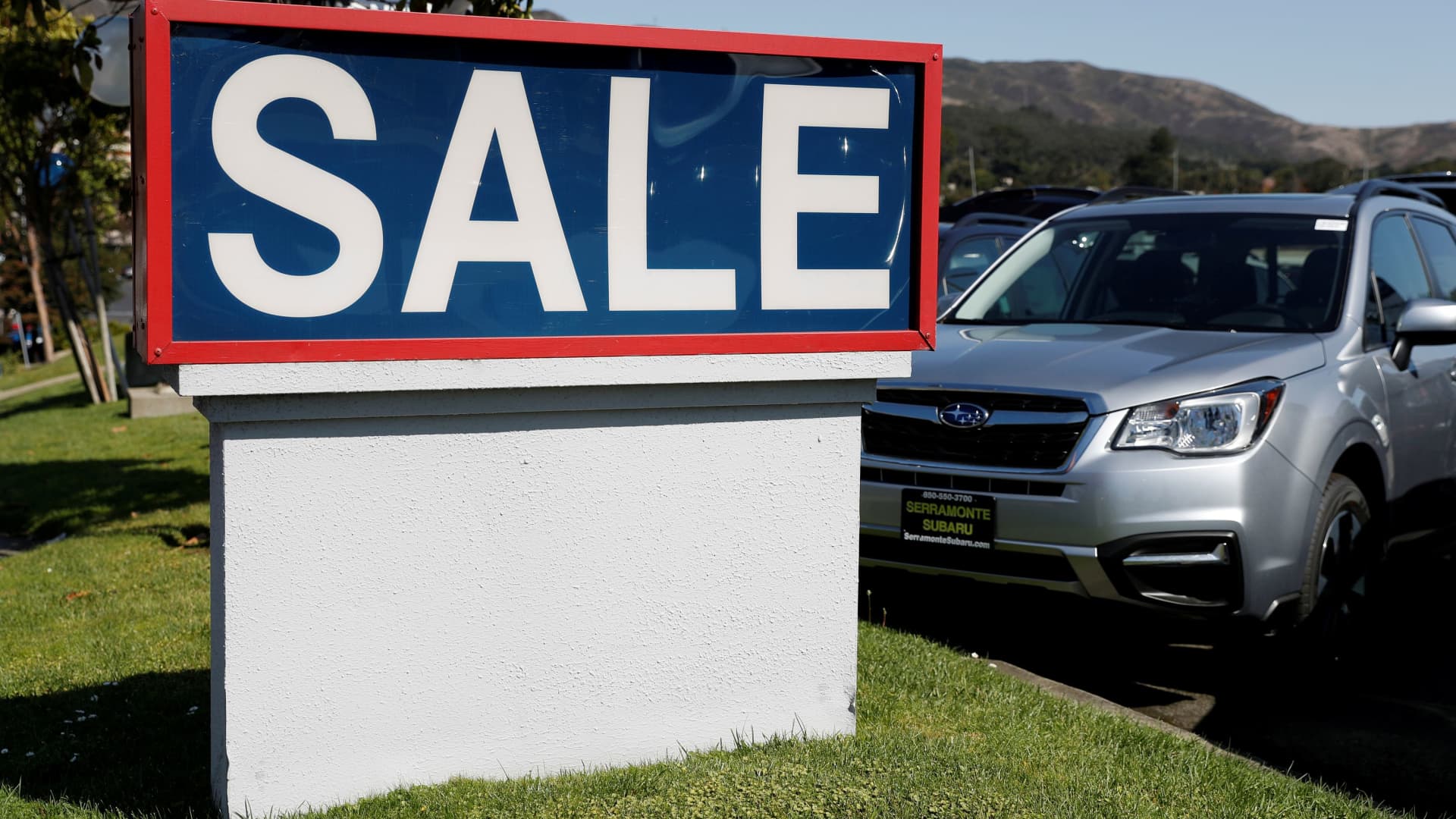
A sale sign is seen at car dealer Serramonte Subaru in Colma, California.
Stephen Lam | Reuters
DETROIT — U.S. new vehicle sales are expected to rise next year to their highest level since 2019, led by lower interest rates and improving affordability, according to industry analysts.
Cox Automotive expects new light-duty vehicle sales to hit 16.3 million in 2025, slightly higher than forecasts by S&P Global Mobility and Edmunds of roughly 16.2 million sales next year. Such sales would be up from expectations of 15.9 million to 16 million this year and mark the highest results since roughly 17 million in 2019.
That would equate to a forecasted sales gain in new cars and trucks of 2.5% or less. The increase is expected to be driven by a continuing “normalization” of vehicle inventories, incentives/discounts from automakers, and easing financing and loan rates.
“Consumers are still feeling the pinch, but the market has become a slightly friendlier place for car shoppers than it was at the start of the year,” Jessica Caldwell, Edmunds’ head of insights, said in a Tuesday release.
One of the largest growth markets is expected to be entry-level and less expensive vehicles. The industry has been dealing with years of elevated prices and lower inventories since the coronavirus pandemic.
Edmunds reports the average transaction price for new vehicles was $47,465 in 2024, a 0.8% decrease compared with $47,851 in 2023, and a 27.2% increase compared with $37,310 in 2019.
EVs
Another expected growth area remains electrified vehicles, including hybrids, plug-in hybrid and all-electric models, according to analysts.
All-electric vehicle sales in the U.S. are forecast to set another record in 2024, with a total sales volume near 1.3 million, according to Cox. That would mark a roughly 8% market share, up from 7.6% compared with last year but lower than expectations of 10% earlier this year.
That’s despite a forecasted year-over-year decline in U.S. EV leader Tesla‘s sales for the first time since 2014.
“The top three manufacturers are Tesla, Hyundai Motor Group and General Motors, with GM having the largest increase in market share year over year at 2.7% at the brand level. Even though Tesla’s market share has declined below 50%, the Model Y and Model 3 continue to hold the top two spots,” said Stephanie Valdez Streaty, Cox director of industry insights, on Tuesday. “Various other models are collectively taking away share from Tesla.”
Cox expects roughly 25% of new vehicle sales to be electrified in 2025, including a more than 10% penetration for all-electric models.
Valdez Streaty and others cautioned EV sales could be weaker if there’s an end to federal consumer credits for purchasing the vehicles of up to $7,500, which the Trump administration has vowed to kill.
‘Radical disruption’?
Analysts warned that regulatory uncertainty ahead of President-elect Donald Trump’s inauguration could impact new U.S. vehicle sales. Most notably, Trump’s tariff threats could affect vehicle production in Canada and Mexico.
Cox Automotive chief economist Jonathan Smoke said tariffs on those countries, which Trump has said could be 25%, would be “a radical disruption” to the U.S. new vehicle market.
U.S. President-elect Donald Trump delivers remarks at Mar-a-Lago in Palm Beach, Florida, U.S., December 16, 2024.
Brian Snyder | Reuters
“We know that there are twists that could be coming with policy shifts, but some key assumptions that we’re making are that most of those shifts are likely to take time, and ahead of when they’re implemented, will actually likely drive demand to be pulled forward,” Smoke said Tuesday during a virtual briefing. “As it relates to tariffs, specifically, we are not making any assumptions that major new tariffs will be implemented.”
The expected increase in U.S. new vehicle sales could actually be counterintuitive for some automakers’ earnings next year due to higher incentive rates and an expected decline in pricing, according to Wall Street analysts.
“We continue to see signs that pricing is not sustainable,” Wells Fargo analyst Colin Langan said in an investor note Monday, citing rising inventories, increasing incentives, falling dealer profits per vehicle and other overall less pricing power for automakers.
Pricing remains near-record highs but the growth has slowed, which is good for car buyers but bad for companies.

