


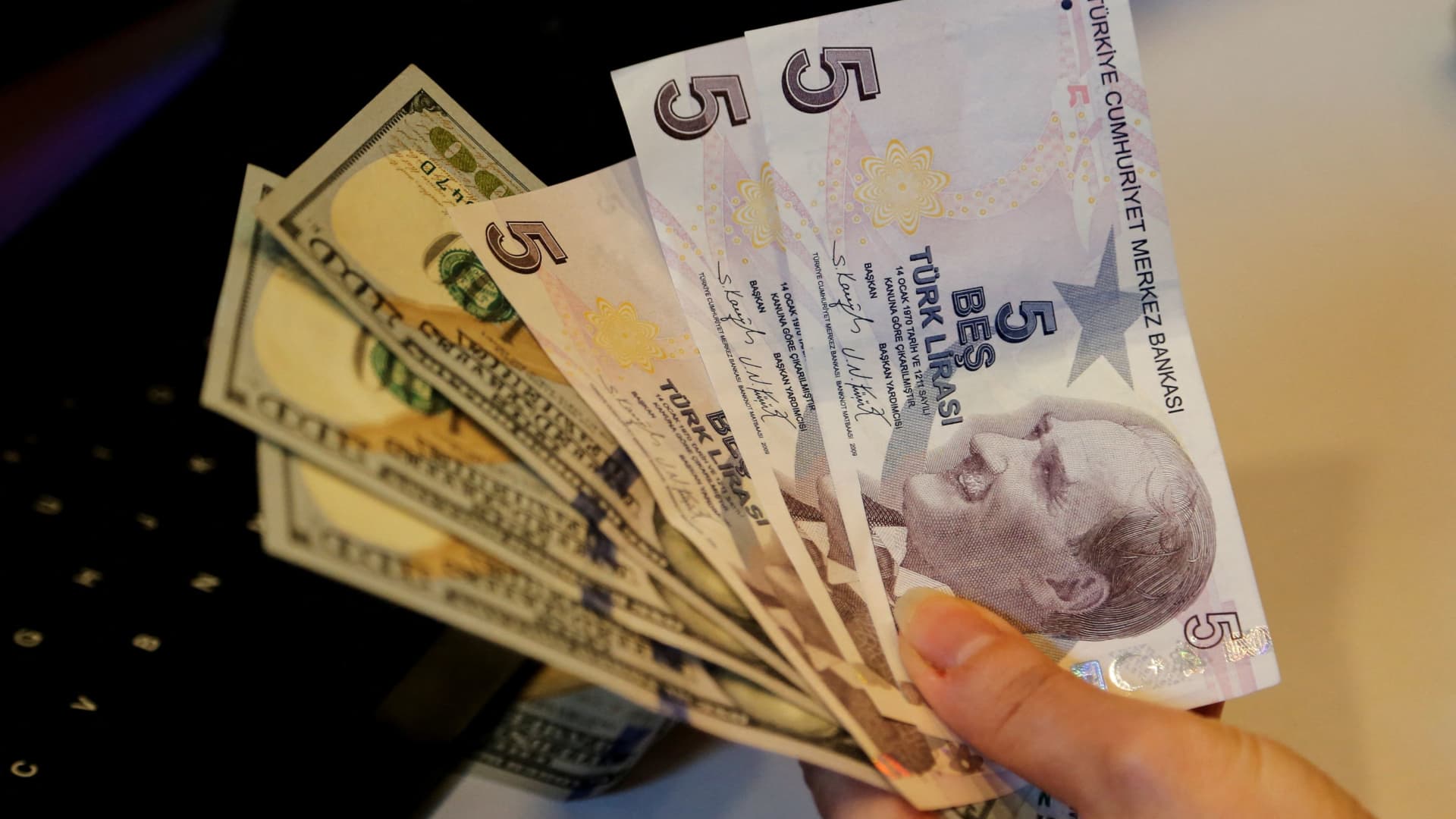
A money changer holds Turkish lira and U.S. dollar banknotes at a currency exchange office in Ankara, Turkey December 16, 2021.
Cagla Gurdogan | Reuters
Turkey’s currency, the lira, enjoyed a much-welcomed boost on Monday and the preceding Friday after the country’s banking regulator announced a ban on lira loans to companies holding what it deemed to be too much foreign currency.
By Monday morning in Istanbul, the lira had notched a roughly 8% gain in two days, trading at 16.01 to the greenback, up from Thursday’s close of 17.35.
But by late afternoon on Monday, it had pared some of those gains, decreasing slightly to 16.5 against the dollar, after whipsawing within the 16 to 17 lira per dollar range.
The moves reflect mixed feelings by investors over the new loan ban, which says that if corporates in Turkey want to get commercial lira loans, they have to sell a sufficient amount of their FX to buy lira instead, which helps support the beleaguered currency that’s lost some half of its value in the last year.
The new rule states that firms holding the equivalent of 15 million lira in foreign currency (roughly $910,000 as of 3 p.m. in Istanbul) cannot borrow lira if their FX funds exceed 10% of their assets or yearly sales. An exception for smaller businesses that can’t borrow in FX allows those to still borrow lira as long as their FX position is net short.
The new rule is meant to shore up the lira, which has dramatically weakened over the past few years as Turkey’s central bank, at the behest of President Recep Tayyip Erdogan, largely refused to raise interest rates to curb rising inflation. Now for the country of 84 million, inflation has reached a staggering 73%, severely crippling Turks’ purchasing power.
A man sells slippers in Eminonu on May 5, 2022, in Istanbul, Turkey. The country has enjoyed rapid growth for years, but President Erdogan has for years refused to meaningfully raise rates to cool the resulting inflation. The result has been a plummeting Turkish lira and far less spending power for the average Turk.
Burak Kara | Getty Images News | Getty Images
Turkey’s move is “potentially affecting thousands of companies,” analysts at Saxobank wrote Monday. “These companies might be prompted to dump their foreign currency holdings if they want to continue accessing credit in TRY.”
Deutsche Bank wrote in a note that the impact of the rule will be “severe,” but the benefits to the lira may be short-lived after large corporates reduce their FX holdings.
Some analysts watching the change are not impressed.
“Bad policy. Desperate really. Short termism and actually capital controls, whichever way you look at it,” Timothy Ash, an emerging markets strategist at Bluebay Asset Management, wrote in an email note.
“It over-complicates things for business and banks when what everyone knows Turkey needs is plain and simple interest rate increases.”
He added that any boost to the lira is likely not sustainable, and that the rule won’t change Turkish companies’ demand for FX.
“Might provide short term boost for the lira but does not change the underlying story — arguably it makes it worse long term by driving trade and business underground and likely out of the system,” he said.
Ercan Erguzel, an economist at Barclays, says this poses a fresh risk to liquidity in the market as Turkey is already running low on its foreign currency reserves.
“We might see further pressure on already tight system-wide FX liquidity,” he wrote in a note, adding that “additionally, some firms might consider delaying investments until they have a better picture in terms of their FX and TRY (lira) liquidity.”
