


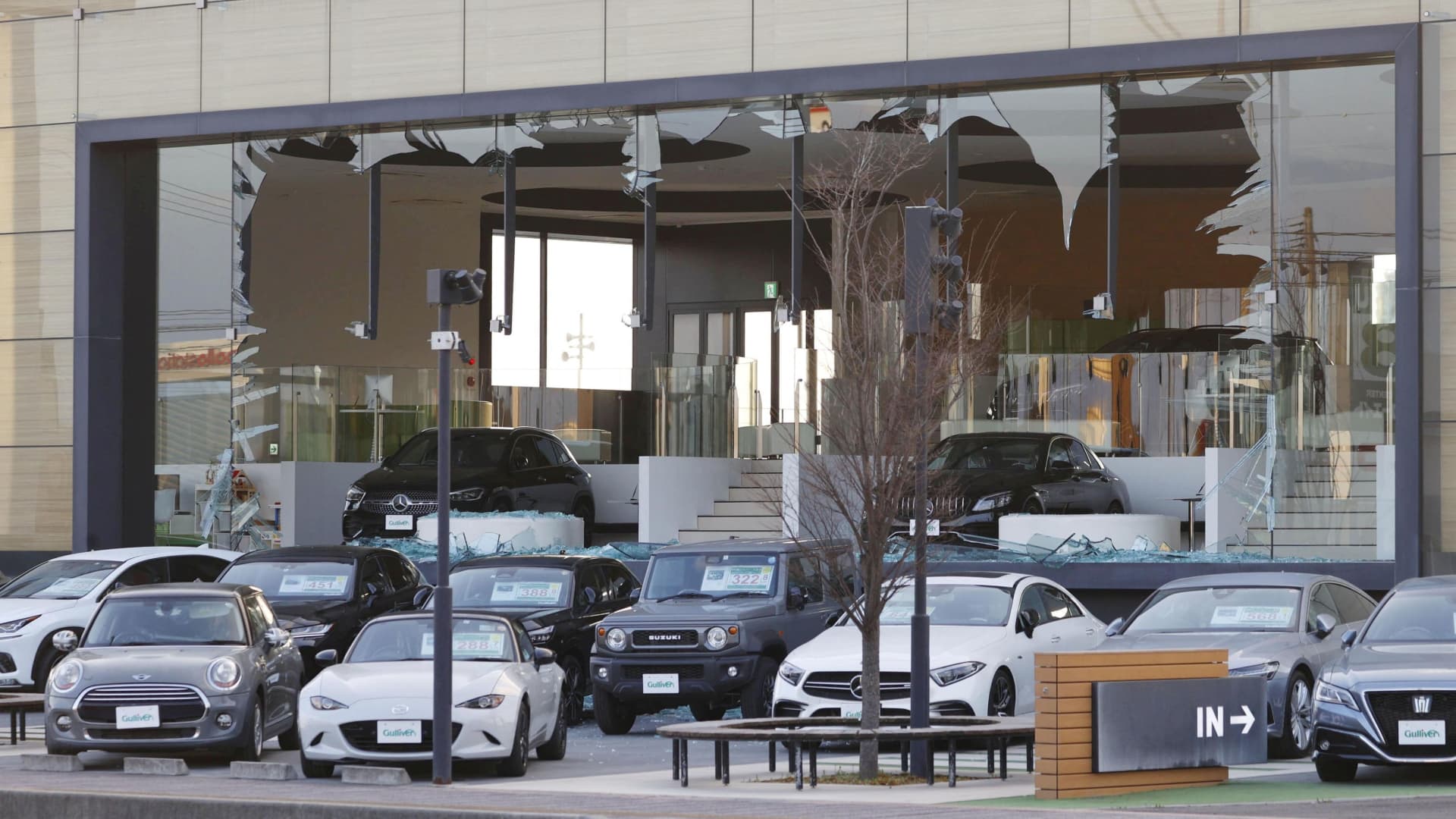
A car dealership’s window is broken following a strong earthquake in Koriyama, Fukushima prefecture, Japan in this photo taken by Kyodo on March 17, 2022.
Kyodo| via Reuters
DETROIT – A major earthquake this week in Japan is causing additional problems for the already constrained global automotive supply chain, which continues to manage through problems caused by the coronavirus pandemic and Russia’s ongoing invasion of Ukraine.
As companies monitor and assess potential residual impacts of Wednesday’s 7.4 magnitude earthquake on their supply chains, auto companies most immediately impacted included Toyota Motor and Renesas Electronics, a major supplier of semiconductor chips for the automotive industry.
Research firm LMC Automotive expects the earthquake to lead to lower vehicle production this year of between 25,000 and 35,000 cars and trucks, adding to already-decreased expectations due to an ongoing shortage of semiconductor chips and the war in Ukraine.
“This is just another layer on top of an already fragile system where we’re seeing a lot of pressure on the manufacturing side of the business,” said Jeff Schuster, LMC’s president of the Americas. “It’s certainly something the industry didn’t need at this point.”
Toyota on Friday said it would suspend operations at more than half its plants across Japan. The world’s largest automaker by volume said 18 production lines at 11 plants (out of 28 lines at 14 plants) would be down for three days next week due to supply problems caused by the earthquake.
“Due to the parts shortage resulting from suppliers affected by the earthquakes, additional adjustments will be made to production operations in some plants in Japan as follows,” Toyota said in a statement.
The shutdowns were announced a day after Toyota cut production output by 150,000 units from April to June due to growing supply chain uncertainty.
For more than a year now, the global automotive industry has been dealing with a global shortage of semiconductor chips caused by plant shutdowns at the beginning of the coronavirus pandemic. The chips are the most notable issue amid global supply chain problems caused by the pandemic, rising costs, inflation and Russia’s invasion of Ukraine.
“The top line for this is it’s another impact on an already constrained system,” said Stephanie Brinley, principal automotive analyst at S&P Global Mobility, formerly IHS Markit. “It does appear to be a short-term impact … but it’s just not industry needs to deal with right now.”
Renesas, which reportedly makes nearly a third of the microcontroller chips used in cars globally, operates three plants close to the earthquake’s epicenter in northeast Japan, according to the company.
The Tokyo-based semiconductor supplier said it’s attempting to restart the plants and return them to pre-earthquake production volumes by Wednesday, including one as early as Sunday.
The importance of Renesas in the global automotive semiconductor supply chain was highlighted last year following a fire at one of the plants caused automakers such as Ford Motor to significantly cut production at facilities, including many in North America.
Ford teams “have been monitoring the situation very closely and actively working to determine what, if any, impact this might have on our operations,” a company spokesperson said Friday. General Motors released a similar statement.
Smaller Japanese automaker Subaru on Friday said it would suspend production Friday and Monday at two auto assembly plants and an engine and transmission plant due to the earthquake.
“Subaru Corporation will temporarily suspend production at its automobile manufacturing facilities due to interruptions in the supply of certain parts, as operations of the supplier factories for those parts have been affected by the earthquake,” Subaru said in a statement.
Spokespeople for Japanese automakers Honda Motor and Nissan Motor said there were little to no impacts to their operations due to the earthquake. A Honda spokesperson said the company suspended a night shift at one Japanese plant when the earthquake occurred.

