


The Routing Company powers on-demand bus and shuttle service for public transit agencies.
Courtesy: The Routing Company
The Routing Company is rolling out apps that bring the convenience of on-demand ride-hailing to public transit.
Led by CEO James Cox, formerly the global head of product operations at Uber, the 40-person Boston startup has developed rider, driver and fleet management software to rapidly assess where riders want to be picked up, and how to gather them into a shared bus or shuttle efficiently.
Unlike carpool-style services such as Lyft Line and Uber Pool, which only place two to several riders into a driver’s vehicle, The Routing Company can group 18 people into a bus or shuttle with the vehicles arriving to pick up a passenger between 2 and 12 minutes from the time they hail their ride.
Riders can be picked up where they are, rather than walking to a stop on a fixed route.
Cox told CNBC that, because about half of buses and shuttle services are run by public transit agencies and half by private sector companies in the US, the startup works with both. But The Routing Company hopes its apps will make bus- or shuttle-hailing a standard offering by public transit agencies around the world.
Cox says he helped start the company, in part, to solve environmental problems that can’t be addressed by replacing gas and diesel vehicles with electric models. Besides his work with Uber, he also served as a product leader at EV startup Canoo.
“Battery electric buses are good for the world – they’re a net benefit,” the CEO said. “But buying them doesn’t solve the problem of twenty to forty percent of buses driving around with low utilization or even empty. You need multiple solutions to get to lower or zero carbon emissions.”
There are also a huge number of internal combustion engine vehicles in the world’s fleets that will drive around on gas for years to come. The Routing Company aims to make the use of these more efficient before transit agencies and transportation companies move to electric vehicles powered by renewable energy.
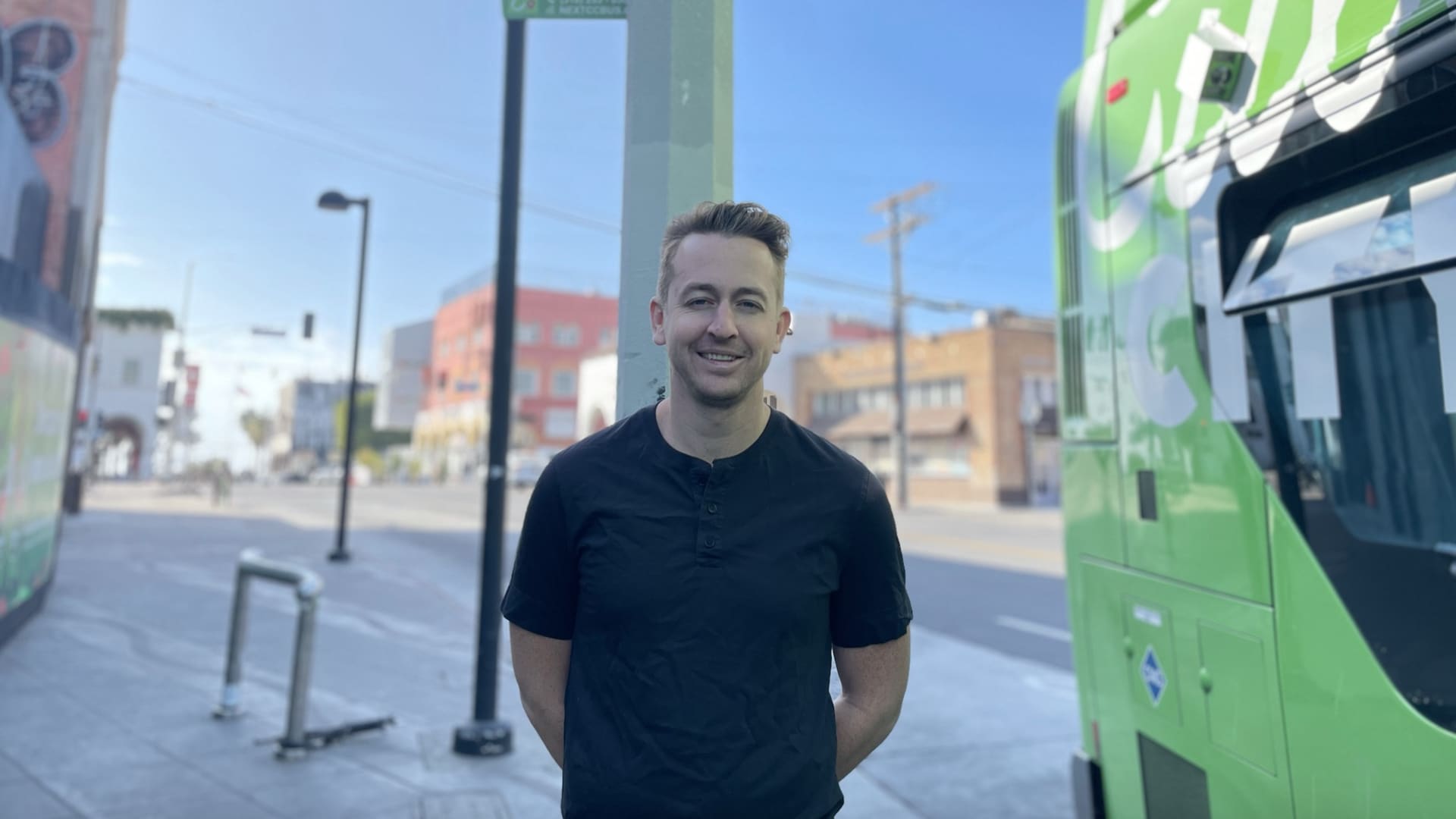
The Routing Company CEO James Cox
Courtesy: The Routing Company
As NBC News previously reported, public transportation ridership plummeted during the pandemic as a significant portion of workers arranged to work remotely, or opted to drive when they could — and as public health requirements limited business operations.
Adding the convenience of on-demand service may attract new riders and bring lapsed riders back, Cox said.
The company has helped deliver more than 75,000 rides to date in pilot and commercial programs around the world, including in Houston and Seattle in the U.S., multiple smaller towns on the West coast of Scotland and in Andorra, a principality between Spain and France.
To grow beyond these locations, The Routing Company raised $15 million in a Series A round of venture funding led by Galvanize Climate Solutions, a new $1 billion environment-focused fund led by Tom Steyer and Katie Hall.
Earlier investors also joined the round including The Engine, Systemiq.Earth, Animal Capital and angel investors including Coupang CTO and former Uber CTO Thuan Q. Pham who is also an advisor to The Routing Company.
Pham said in an e-mail to CNBC that he backed the company because he sees it bringing significant benefits to cities and transit riders around the world.
With The Routing Company’s technology, he said, “Cities can augment and supplement their transit services that deliver more convenience to riders with point-to-point, on-demand high-capacity (18-seats) vehicles.”
“Why run a mostly empty massive bus line during late evenings and weekends while you can deploy just the right number of mini-buses to meet the ridership demands during those times?”
Pham noted that his former colleague James Cox and The Routing Company are bringing transit agencies advanced technology that they aren’t able to develop themselves.
Pham expects the company to use its funding to hire more engineers and to partner with more transit agencies and private sector companies. CEO James Cox says the startup is already in talks with large tech companies and universities to help run their campus shuttle services.

