


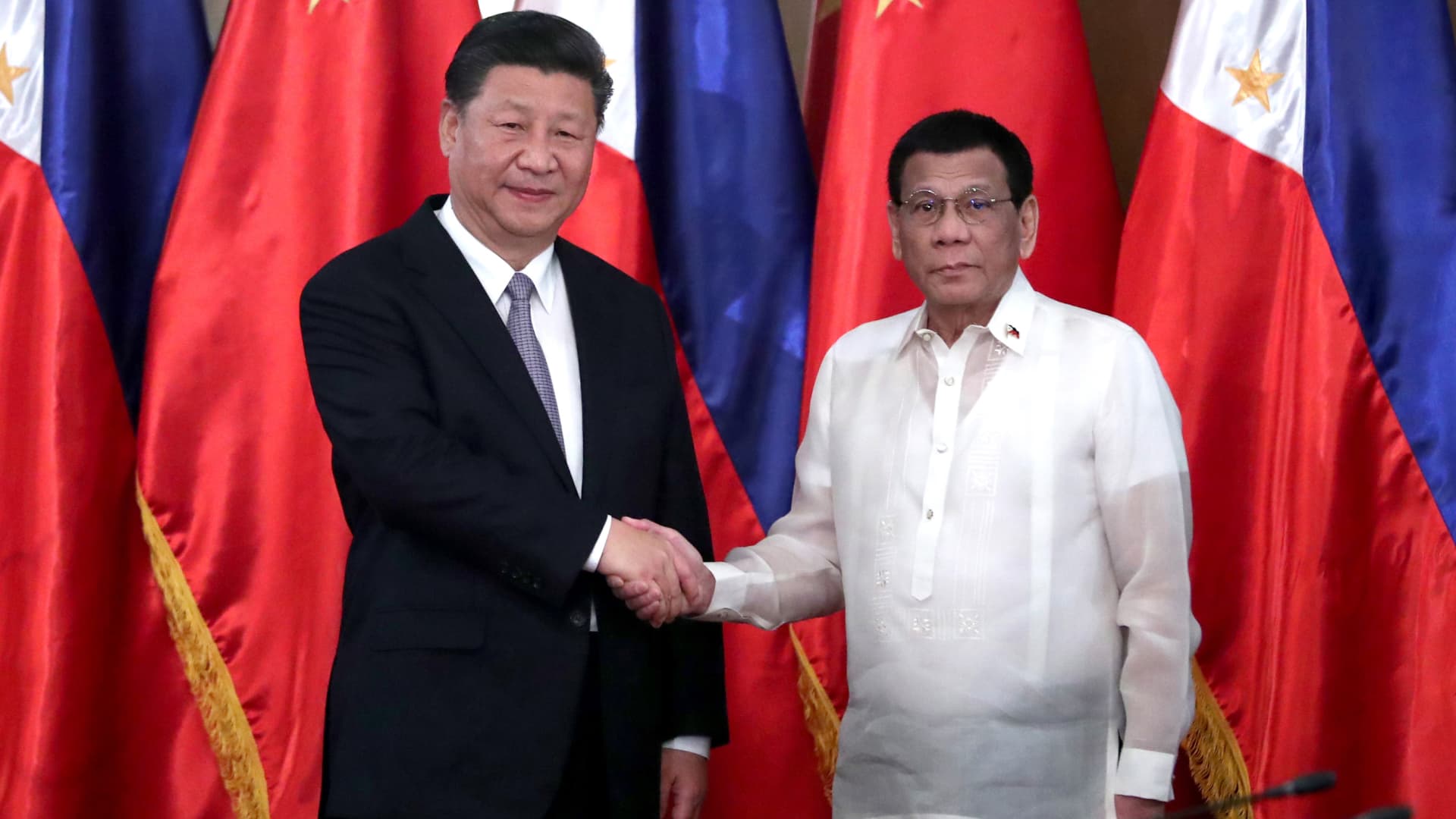
Chinese President Xi Jinping holds talks with his Philippine counterpart Rodrigo Duterte in Manila, the Philippines on Nov. 20, 2018.
Xinhua News Agency | Getty Images
The Philippines has been warming up to China since President Rodrigo Duterte was elected in 2016.
As Filipinos head to the polls on May 9 to elect a new leader, observers will be watching closely to see what the new leadership could mean for the Philippines’ growing ties with Beijing.
Foreign policy is typically not a hot button issue in Philippines elections, but there are good reasons why it should be this time, said Charmaine Misalucha-Willoughby, associate professor of international studies at De La Salle University in the Philippine capital city of Manila.
“There are compelling reasons why the 2022 candidates should articulate a China policy, not least because a president’s preference for a particular country at the expense of other partners has ramifications extending beyond one administration,” she said in a report published by Singapore-based think tank, ISEAS-Yusof Ishak Institute.
Duterte’s presidency marked a dramatic shift in the Philippines’ foreign policy when in 2016, he declared his country’s “separation” from the U.S. — a military ally. Instead, he sought closer ties with China.
But he has had little to show for his China pivot, as much of Beijing’s pledged infrastructure investments have not materialized.
Meanwhile, tensions in the South China Sea — where the two countries have overlapping territorial claims — have persisted with China’s continued incursions into parts of the sea that are internationally recognized as belonging to the Philippines.
Anti-China rhetoric within Durterte’s own government has grown louder, while opinion polls showed that the Philippine public remains skeptical of Beijing. Analysts said such sentiment could push the next president to shift away from Duterte’s China-pivot.
Based on their comments on the campaign trail, CNBC looked at where the top Philippine presidential candidates stand on the issue of China.
The top contenders right now include: Ferdinand “Bongbong” Marcos Jr. — who is the son and namesake of late dictator Ferdinand Marcos — and Leni Robredo, the sitting vice president and de facto opposition leader. The current mayor of Manila, Francisco Domagoso, is also among the leading contenders.
Marcos: China-friendly candidate
Among the top Philippine presidential candidates, Marcos is seen as the most China-friendly candidate. Opinion polls currently placed him as the frontrunner in the presidential race: The latest survey by independent pollster Pulse Asia found that 60% of respondents favored Marcos.
One contentious issue in the relationship between China and the Philippines is the 2016 ruling on their South China Sea dispute. The international tribunal in the Hague dismissed China’s claims in the sea and ruled that specific portions claimed by both countries belonged to the Philippines alone.
China rejected that ruling. Duterte, in pursuit of closer ties with Beijing, was criticized for not doing more to demand Beijing’s compliance to the arbitration outcome.
In a series of media interviews in January, Marcos reportedly suggested he was willing to set aside the 2016 ruling to engage with China.
But the former senator and congressman appeared to have moderated his stance in a televised debate last month. He said he wants the Philippines to have a military presence in the South China Sea “to show China that we are defending what we consider our territorial waters,” reported Reuters.
Still, Marcos said he would not prioritize a military resolution to his country’s dispute with China and plans to continue the “correct approach” of pursuing engagement with China, while having to “walk a very, very fine line” between China and the U.S., reported Reuters.
Robredo: Departure from Duterte’s policy
Meanwhile, opposition leader Leni Robredo, who is also vice president, has been more steadfast in advocating a tougher stance against China.
The president and vice president are elected separately in the Philippines. Robredo, a staunch critic of Duterte’s deadly drug war, resigned from the Duterte cabinet in 2016.
Seen as the anti-Duterte candidate, she placed second in the Pulse Asia poll behind Marcos with 15% of respondents picking her as their favored presidential candidate.
Robredo reportedly said she would pursue an “inclusive and independent” foreign policy that doesn’t favor any countries.
On the South China Sea dispute, she emphasized the need to recognize the 2016 arbitration ruling before the Philippines and China can proceed to explore any joint oil and gas exploration projects in the resource-rich sea.
The vice president also reportedly said she favors stronger ties with the U.S. and other countries, such as Philippines’ Southeast Asian neighbors, the European Union and Australia.
Domagoso: Centrist candidate
Currently placed third in the Pulse Asia poll is Francisco Domagoso, a former actor and current mayor of the Philippine capital city of Manila.
Domagoso, better known by his screen name Isko Moreno, is seen by political analysts as a centrist candidate that has sought a middle ground on issues including foreign policy.
The Manila mayor reportedly shares Robredo’s sentiment on the need to assert the 2016 arbitration ruling.
However, local media has also reported Domagoso as saying China is not an “enemy” and that he would back joint oil and gas exploration deals in the South China Sea with China if contracts are awarded by the Philippine government.
