




Subsea cables are the backbone of the internet, carrying 99% of the world’s data traffic.
Serg Myshkovsky | Photodisc | Getty Images
U.S.-Chinese tensions surrounding technology have have sunk to sea lows.
Subsea cables hit the headlines earlier this year after four out of 15 critical submarine cables in the Red Sea were cut amid attacks by Yemen’s Iran-backed Houthi rebels on Israeli U.S., and U.K. ships.
Public awareness of submarine cables has grown as a result — and these networks of cables are becoming a new source of strain in international relations, amid heating geopolitical engagements between the U.S. and China.
What are subsea cables?
Buried deep underwater are hundreds of massive telecommunications cables spanning a length of nearly 1.4 million kilometers, according the telecom market research firm TeleGeometry.
Some of these cables are shorter, such as the 131-kilometer CeltixConnect cable linking Ireland to the U.K., for example. Others, however, run for far longer distances — like the 20,000-kilometer Asia America Gateway cable.
The number of subsea cables around the planet is expected to increase in the coming years, reflecting growing demand for data traffic prompted by the spread of video streaming and cloud services.
As of early 2024, TeleGeometry said its data tracked 574 active and planned submarine cables.
Why are they important?
Subsea cables are the backbone of the global internet, carrying 99% of the world’s intercontinental data traffic.
“If you have e-mailed, texted, or video chatted with someone on another continent, you’ve used a subsea cable — likely without giving it a second thought,” Andy Champagne, chief technology officer of Akamai Labs, told CNBC via email.
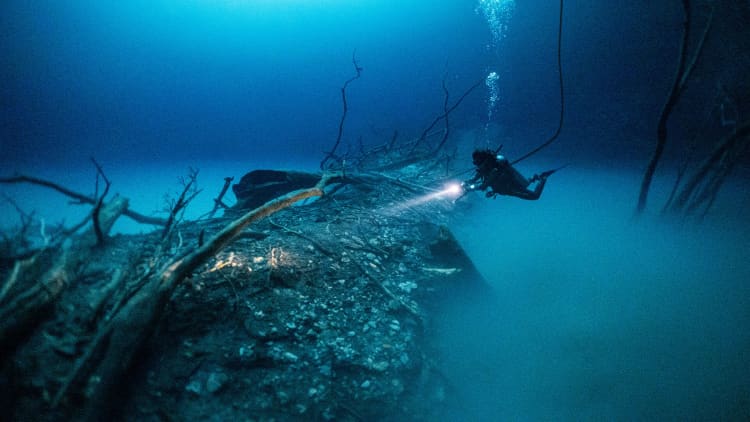
“While we’re linked together with a complex physical web of fiber optic cables over land, the topology becomes more challenging once we plunge into the oceans,” Champagne added.
“It’s really complex to install subsea cables. And, when there is an issue with a subsea cable, repairing it is a non-trivial job.”
A key thing that makes subsea cables important is the impact they have when disrupted, according to Joe Vaccaro, vice president and general manager of Cisco-owned internet monitoring firm ThousandEyes.
“Individual people like you and I, we don’t say undersea cable cut. What we find is that the application we’re trying to access all of a sudden became really slow, or unavailable,” Vaccaro told CNBC in an interview.
“When those cuts happen, ultimately, the underlying providers that are carrying that traffic have to then try to dynamically shift the traffic into different routes,” Vaccaro added. “What happens when you do that? You see a level of congestion happen.”
A growing security risk
Subsea cables were traditionally owned and operated by telecom carriers. More recently, U.S. tech giants including Meta, Google, Microsoft, and Amazon have invested significant sums to lay down their own cables.

In 2021, Meta and Google announced plans to lay two huge subsea cables linking the U.S. West Coast to Singapore and Indonesia. The Echo and Bifrost trans-Pacific cables are expected to increase data capacity between the regions by 70% and improve internet reliability.
Meta is investing in both cables, while Google is only backing Echo. Meta previously announced plans to build a 37,000-kilometer long undersea cable around Africa to provide it with better internet access, while Google is also working on a subsea cable called Equiano that aims to connect Africa with Europe.
Citing unnamed sources in the State Department, the Wall Street Journal reported in May that U.S. officials privately warned tech firms including Google and Meta that undersea cables in the Pacific region could be vulnerable to spying by Chinese repair ships.
S.B. Submarine Systems, a state-controlled Chinese company that helps repair international cables, appeared to be hiding its vessels’ locations from radio and satellite tracking systems, according to the WSJ.
S.B. Submarine Systems, Google, Meta, and the State Department were not immediately available for comment when contacted by CNBC.
Estonia, meanwhile, said that China was yet to respond to a six-month-old request to help the country with its investigation into a Chinese ship it suspects cut two of its subsea cables. China’s foreign ministry has since said it stands ready to work with Estonia to cooperate on the investigation.
These developments highlight how underwater cables are becoming a source of contention in matters of national security. The data these networks send can involve high-stakes communications, including coordinating diplomatic missions, security operations and intelligence gathering.
The U.S. government’s concerns aren’t new and have been widely documented.
In March 2023, a Reuters report said that an interagency committee called Team Telecom was working to prevent any subsea cable from directly connecting U.S. territory with mainland China or Hong Kong due to fears about Chinese espionage.
Many international subsea cable projects are reportedly circumventing China today due to concerns over data security and Beijing’s expanding geopolitical influence. China has invested hundreds of millions of dollars to make its own underwater cable infrastructure to rival that of the U.S.
Central points of vulnerability
A key issue with the way subsea cables are currently set up is that connections linking entire parts of the world affect massive portions of internet infrastructure.
“If it’s critical for your business to be able to provide connectivity to between those two points in the world, you just have to be aware that a single cable cut in that location could have massive effects for every major cloud provider,” ThousandEye’s Vaccaro told CNBC.
In times when such critical connections encounter disruptions, a “blame game” can ensue, where consumers tend to faulting the services they’re using in the event of an outage or traffic congestion.
In certain regions, Vaccaro added, it can actually make sense from a “performance and visibility” perspective” for firms to use a different cloud provider from the one they’re using in a different part of the world to ensure consistency of network quality.
“The critical thing to remember with subsea cables is that there are specific requirements around where they can make the transition from subsea to land … and there are a limited number of geographic spots that meet these requirements,” Akamai’s Champagne said.
“The result of these constraints is that the loss of a single subsea cable can have a domino effect on the land-based networks that depend on it,” he added. “The impact of a disrupted subsea cable is often much greater than the loss of a land-based cable.”