Aaron Rodgers, #8 of the New York Jets, warms up prior to the game against the New York Giants at MetLife Stadium in East Rutherford, New Jersey, Aug. 26, 2023.
Mike Stobe | Getty Images
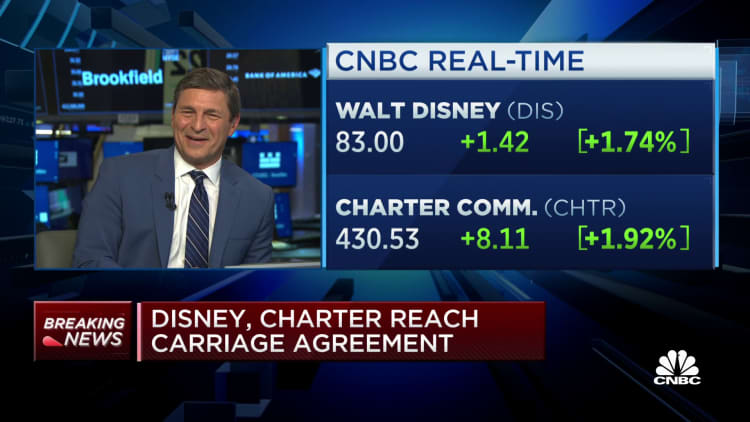
Charter and Disney have reached a rights deal, and the media industry was duped.
The Wall Street Journal ran a story Friday with the headline: “Disney Fight Marks Cable TV’s Last Stand.” Slate’s headline the same day honed in further: “Disney Is in a Fight That Might Change TV Forever.” Analysts appearing on CNBC weighed in on the future of the cable bundle.
“Mutually assured destruction is a good way of thinking about it,” said Michael Morris, Guggenheim Securities entertainment and media analyst, about how both Disney and Charter would be at existential risk if they didn’t reach a carriage deal for networks including ESPN and owned ABC television stations.
For the past 10 days, Charter Chief Executive Chris Winfrey has been putting the business on notice, telling reporters and investors that its decision to drop Disney’s networks wasn’t a normal carriage fight. After decades of agreeing to programming increases which have caused tens of millions of Americans to cancel cable, seeing it as a too-expensive, bloated product, a pay-TV operator had reached its “No Mas” point.
“We had to say, enough is enough,” Winfrey said Thursday at a Goldman Sachs investor conference.
But the details of Charter’s pact with Disney, announced in a press release Monday, don’t really suggest enough was enough. Disney will receive a higher programming fee increase as part of the deal, CNBC’s David Faber first reported. Charter will be able to include ad-supported Disney+ and ESPN+ for no additional charge to certain consumers of its cable TV programming.
That’s kind of it. Including Disney’s streaming packages for cable subscribers is a significant and unprecedented give. But this is not a groundbreaking deal. It’s an incremental deal suggestive of a slow-moving landscape where media companies aren’t yet ready to let go of cable, a declining multibillion dollar cash generating behemoth.
The sides got a deal done in time for cable customers to watch “Monday Night Football” on ESPN for Week 1, which has always been the primary deadline on carriage deals for decades. Charter customers didn’t get to watch the U.S. Open tennis finals this weekend. But, in the end, Charter wouldn’t risk losing millions of customers if it didn’t offer “Monday Night Football” — especially to New York area fans, as the New York Jets (and new quarterback Aaron Rodgers) play the Buffalo Bills — and Disney wouldn’t risk the revenue losses of blacking out football.
Instead, media executive rhetoric won the day. Carriage disputes between pay-TV providers and networks are old hat. It’s become standard procedure for executives of pay-TV companies and programmers to rage at each other in strongly worded statements where distributors talk about the rising cost of cable and media companies counter with the importance of their content. In recent years, media journalists have largely caught on and haven’t taken the bait.
This deal was different because Winfrey said it was different. He held an investor call the day after Charter and Disney didn’t reach a deal, an unusual move signaling that maybe Charter was content to start moving away from the linear cable TV business – something that then-Cablevision CEO Jim Dolan talked about as a possibility 10 years ago.
But there’s a reason why Dolan discussed this concept a decade ago and still linear cable TV exists. Charter still makes money by offering linear cable TV. Comcast, the largest U.S. cable TV provider, owns a slew of cable networks. DirecTV and Dish don’t have robust broadband businesses so both companies are reliant on staying in the business, no matter how dominant streaming becomes.
It’s a happy ending for cable consumers, who get to watch what they’re already paying for. But it’s not a transformative deal — and the media should remember this conflict’s resolution when the inevitable next channel blackout occurs.
Disclosure: Comcast is the parent company of NBCUniversal, which owns CNBC.
WATCH: Disney and Charter reach carriage agreement.