


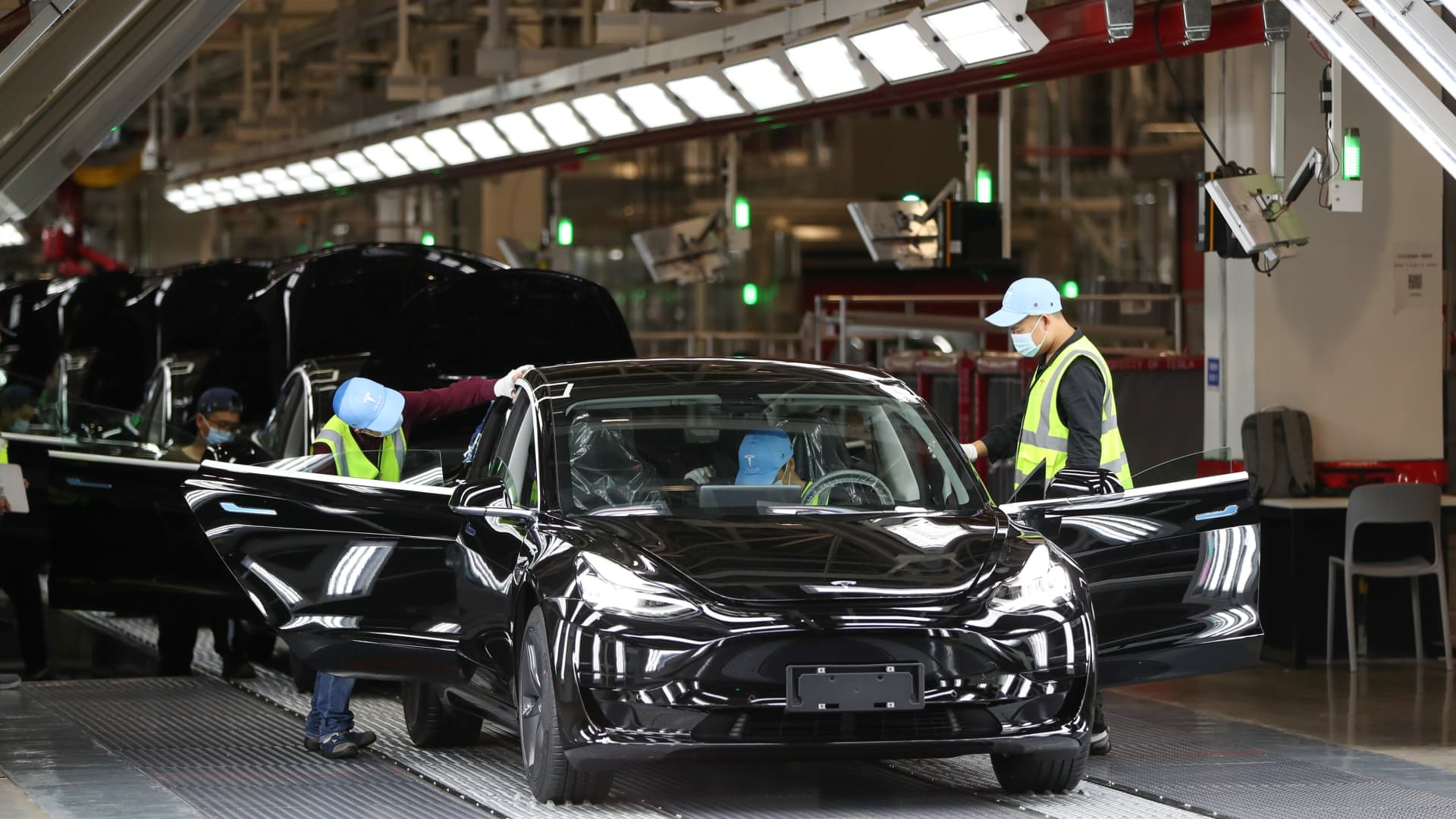
Employees work at the Tesla Gigafactory in Shanghai, east China, Nov. 20, 2020. U.S. electric car company Tesla in 2019 built its first Gigafactory outside the United States in the new Lingang area, with a designed annual production capacity of 500,000 units.
Ding Ting | Xinhua News Agency | Getty Images
Tesla reduced vehicle production at its Shanghai factory this week due to parts shortages caused in part by a supplier’s Covid lockdown.
According to JL Warren Capital CEO and Director of Research Junheng Li, a Covid case detected at an Aptiv factory in the Jiading district of Shanghai led authorities to temporarily close that facility. Aptiv makes a cable harness used in Tesla’s battery electric crossover, the Model Y, at that plant.
Tesla then temporarily shut down some of its production lines for Model Y at its Shanghai Gigafactory, JL Warren researchers confirmed.
Reuters first reported on the production issues at Tesla in Shanghai.
Last week, Chinese President Xi Jinping held a meeting with top leaders of the country where he emphasized that China should stick to its “dynamic zero-Covid” policy. He called on the country to rally behind central committee decisions of the Chinese Communist Party and “resolutely fight” against all questioning of virus control policies.
JL Warren’s Li said, “This statement set the mandate for all local authorities to prioritize zero-Covid over regional economies. So automakers are planning day by day, week by week.” Her firm expects parts shortages, supply chain issues and production shutdowns to be recurring into the foreseeable future. JL Warren Capital specializes in market research on companies operating in China, with more than 200 consultants on the ground there.
Covid lockdowns dramatically impacted Tesla’s production in China last month, as well.
According to China Passenger Car Association numbers out Tuesday, Tesla sold 1,512 China-made electric vehicles in the country in April, a drop of more than 95% from the month before. It produced an estimated 10,757 electric cars at its Shanghai plant in April, but did not export any to Europe or points in Asia beyond mainland China as it had done in prior months.
In the first four months of 2022, Tesla sold 183,686 of its China-made electric vehicles, CPCA estimates, 73,874 of which it exported out of the country.
On Tuesday, Tesla CEO Elon Musk said during an interview with the Financial Times, “I’ve had some conversations with the Chinese government in recent days, and it’s clear that the lockdowns are being lifted rapidly, so I would not expect this to be a significant issue in the coming weeks.”
During a first-quarter earnings call last month Tesla CFO Zachary Kirkhorn said, “We’ve lost about a month of build volume out of our factory in Shanghai due to Covid-related shutdowns. Production is resuming at limited levels, and we’re working to get back to full production as quickly as possible. This will impact total build and delivery volume in Q2.”
Aptiv and Tesla did not respond to requests for comment on the CPCA numbers or China production issues.