


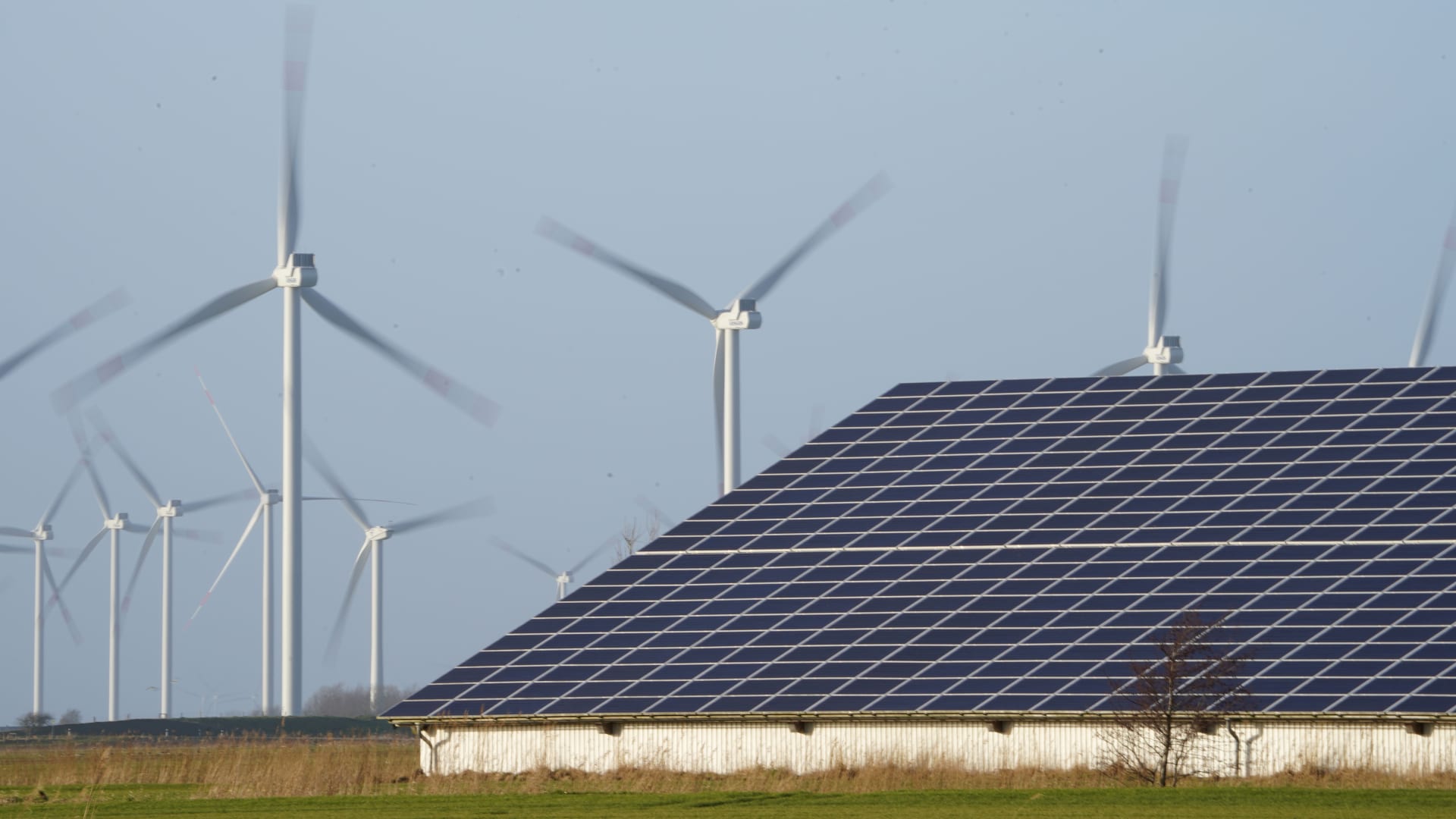
Concerns related to both the energy transition and energy security have been thrown into sharp relief by Russia’s invasion of Ukraine. At the same time, recent months have also seen commodity prices jump.
Marcus Brandt | Picture Alliance | Getty Images
The world’s governments have pledged more than $710 billion to “sustainable recovery measures” by the year 2030 since the beginning of the Covid-19 pandemic, the International Energy Agency has said.
This is a 50% increase compared to the figure in Oct. 2021 and represents “the largest ever clean energy fiscal recovery effort,” according to the IEA.
Despite this growth, the IEA’s latest update to its Sustainable Recovery Tracker cautioned that regional imbalances, compounded by rising commodity prices following the Russia-Ukraine war, were a cause for concern.
In a statement earlier this week, the Paris-based organization said advanced economies were intending to spend over $370 billion before the end of 2023.
It described this as a “level of short-term government spending that would help keep the door open for the IEA’s global pathway to net zero emissions by 2050.”
For other parts of the world, however, the story is different. Emerging and developing economies, according to the IEA, have made plans for roughly $52 billion of “sustainable recovery spending” before the end of 2023. It said this was “well short” of what was required for the pathway to net zero emissions by the middle of this century.
“The gap is unlikely to narrow in the near term,” the IEA said, “as governments with already limited fiscal means now face the challenge of maintaining food and fuel affordability for their citizens amid the surge in commodity prices following Russia’s invasion of Ukraine.”
The IEA’s view of what constitutes “clean energy and sustainable recovery measures” is wide-ranging. It includes everything from investments in nuclear, wind, solar photovoltaic and hydro to retrofitting, electric vehicles, transit infrastructure and recycling.
Commodity concerns
Concerns related to both the energy transition and energy security have been thrown into sharp relief by Russia’s invasion of Ukraine.
Russia is a major supplier of oil and gas, and over the past few weeks a number of major economies have laid out plans to reduce their reliance on its hydrocarbons.
At the same time, recent months have also seen commodity prices jump. According to the UN, its Food and Agriculture Organization (FAO) Food Price Index in March averaged 159.3 points, a 12.6% increase compared to February.
In a statement last week, Qu Dongyu, the FAO’s Director-General laid bare the challenges the world was facing. Food prices as measured by the index, he said, had “reached a new all-time high.”
“Particularly, prices for staple foodstuffs such as wheat and vegetable oils have been soaring lately, imposing extraordinary costs on global consumers, particularly the poorest,” Dongyu added, going on to state that the war in Ukraine had “made matters even worse.”
A huge task
According to the UN, for global warming to be kept “to no more than 1.5°C … emissions need to be reduced by 45% by 2030 and reach net zero by 2050.”
The 1.5 figure refers to the Paris Agreement, which aims to limit global warming “to well below 2, preferably to 1.5 degrees Celsius, compared to pre-industrial levels” and was adopted in Dec. 2015.
The task is huge and the stakes are high, with the UN noting that 1.5 degrees Celsius is considered to be “the upper limit” when it comes to avoiding the worst consequences from climate change.
“Countries where clean energy is at the heart of recovery plans are keeping alive the possibility of reaching net zero emissions by 2050, but challenging financial and economic conditions have undermined public resources in much of the rest of the world,” Fatih Birol, the IEA’s executive director, said Tuesday.
Birol added that international cooperation would be “essential to change these clean energy investment trends, especially in emerging and developing economies where the need is greatest.”
While the picture for advanced economies may seem rosier than emerging and developing ones, the IEA pointed to a number of potential issues going forward, stating that “some of the earmarked funds risk not reaching the market within their envisaged timelines.”
Project pipelines, it claimed, had been “clogged” by delays in the establishment of government programs, financial uncertainty, labor shortages and continued supply chain disruptions.
On top of this, “consumer-facing measures” like incentives related to retrofits and electric vehicles were “struggling to reach a wider audience because of issues including red tape and lack of information.”
Looking at the overall picture, the IEA said “public spending on sustainable energy” remained a “small proportion” of the $18.1 trillion in fiscal outflows focused on mitigating the economic effects of the pandemic.


