


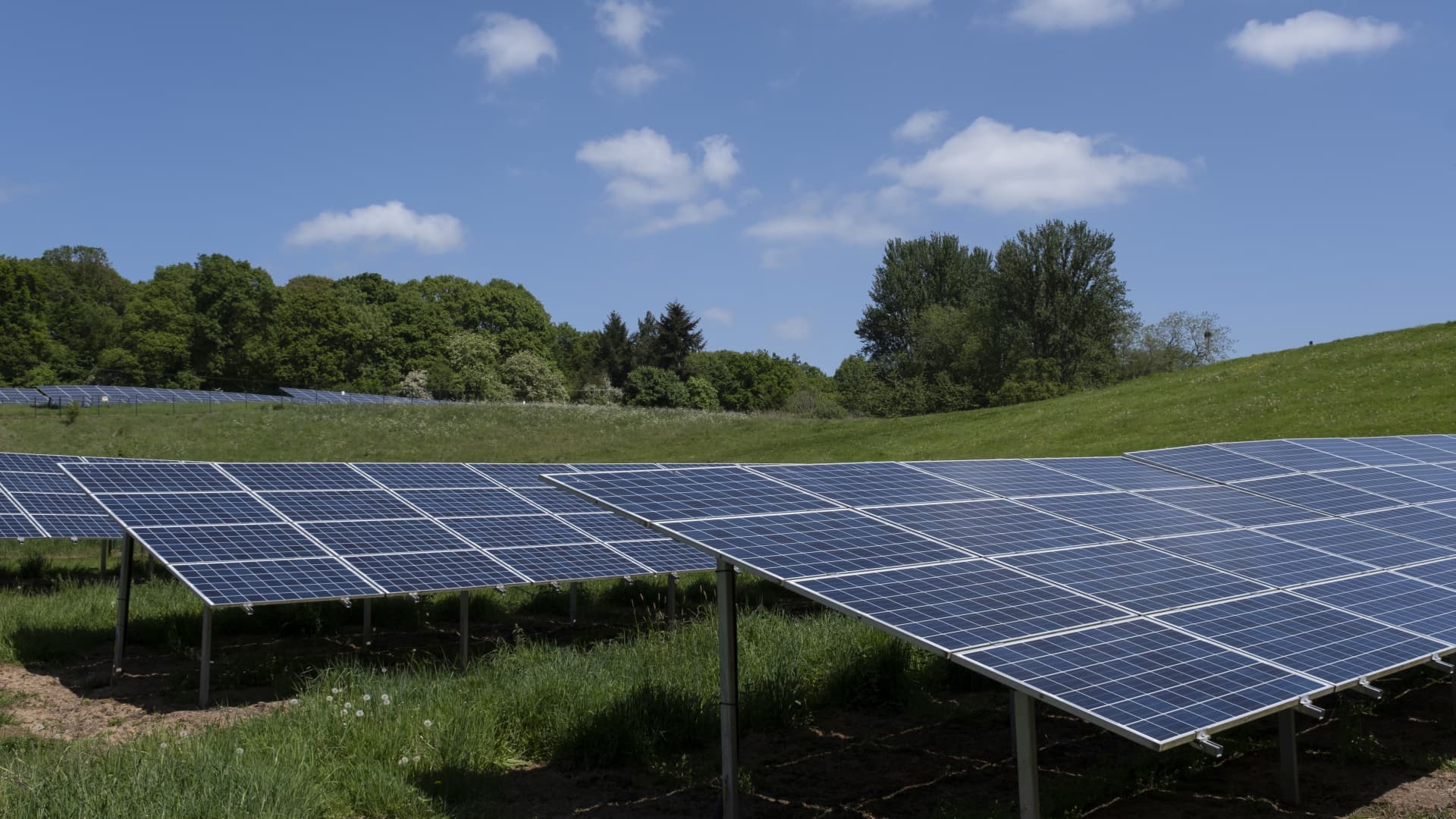
This image, from May 2022, shows solar panels in Worcestershire, England. The recent hot weather in the U.K. has led to a discussion about the optimum conditions for solar power.
Mike Kemp | In Pictures | Getty Images
Last week saw temperatures in the U.K. surge, with highs of over 40 degrees Celsius (104 degrees Fahrenheit) recorded for the first time ever.
The news out of the U.K. — which experienced a number of significant weather-related disruptions — came as other parts of Europe grappled with a heatwave that caused fires, delays to travel, and death.
On July 20, Solar Energy UK, citing data from Sheffield Solar’s PV Live site, said the country’s solar power output had “met up to a quarter of the UK’s power demand.” The trade association added that, across 24 hours, solar had “provided an estimated 66.9 gigawatt-hours, or 8.6% of the UK’s power needs.”
Many would think the scorching heat of the past few days would represent the ultimate sweet spot for solar photovoltaic systems, which directly convert light from the sun into electricity.
The reality is a bit more complex. According to Solar Energy UK, the U.K.’s solar capacity reaches an optimum level of output at temperatures measuring roughly 25C.
“For every degree either side of that, it is lowered by about only 0.5%, though newer modules have improved performance,” it says.
In a statement, Alastair Buckley, who is professor of organic electronics at the University of Sheffield and leads Sheffield Solar, said this was “why we never see peak output in midsummer — peak national output is always in April and May when it’s cool and sunny.” Sheffield Solar is part of the university’s Grantham Centre for Sustainable Futures.
Buckley’s argument is borne out by the current record for solar generation in the U.K. It stands at 9.89 GW and was reached on April 22, 2021, according to data from Sheffield Solar.
The temperatures of last week were far higher than 25C, but the overall effect was, it would seem, not too disruptive. A significant ramp up would be required for major issues to arise, according to Solar Energy UK.
It says panel temperatures are determined by a range of factors: what it calls “radiative heating from the sun,” ambient temperature and the cooling effects of wind. “Losing 20% efficiency, considered a significant amount, would require them to reach a huge 65°C.”
There is clearly some breathing space for solar panels, then, but the prospect of hotter summer temperatures occurring on a more regular basis is something that does not seem to perturb Chris Hewett, the chief executive of Solar Energy UK.
“It’s marginally better for efficiency in the spring but essentially, if you have more light, you produce more solar power,” he said last week.
“You have to remember that solar panels work all over the world. The same technology we put on our roofs is used in solar farms in the Saudi Arabian desert.”
Solar power is not alone in being affected by the rising temperatures Europe has experienced.
Last week, it was reported that a nuclear power plant in Switzerland was lowering its output in order to prevent the river that cools it from hitting temperature levels dangerous to marine life.
On July 18, the Swiss Broadcasting Corporation’s international unit, citing the country’s public broadcaster SRF, said the Beznau nuclear power plant had “temporarily scaled back operations” to stop the temperature of the River Aare from rising “to levels that are dangerous for fish.”
More broadly, a number of companies involved in renewables have highlighted how weather conditions can affect their output. Lower wind speeds, for example, can hit operations.

