


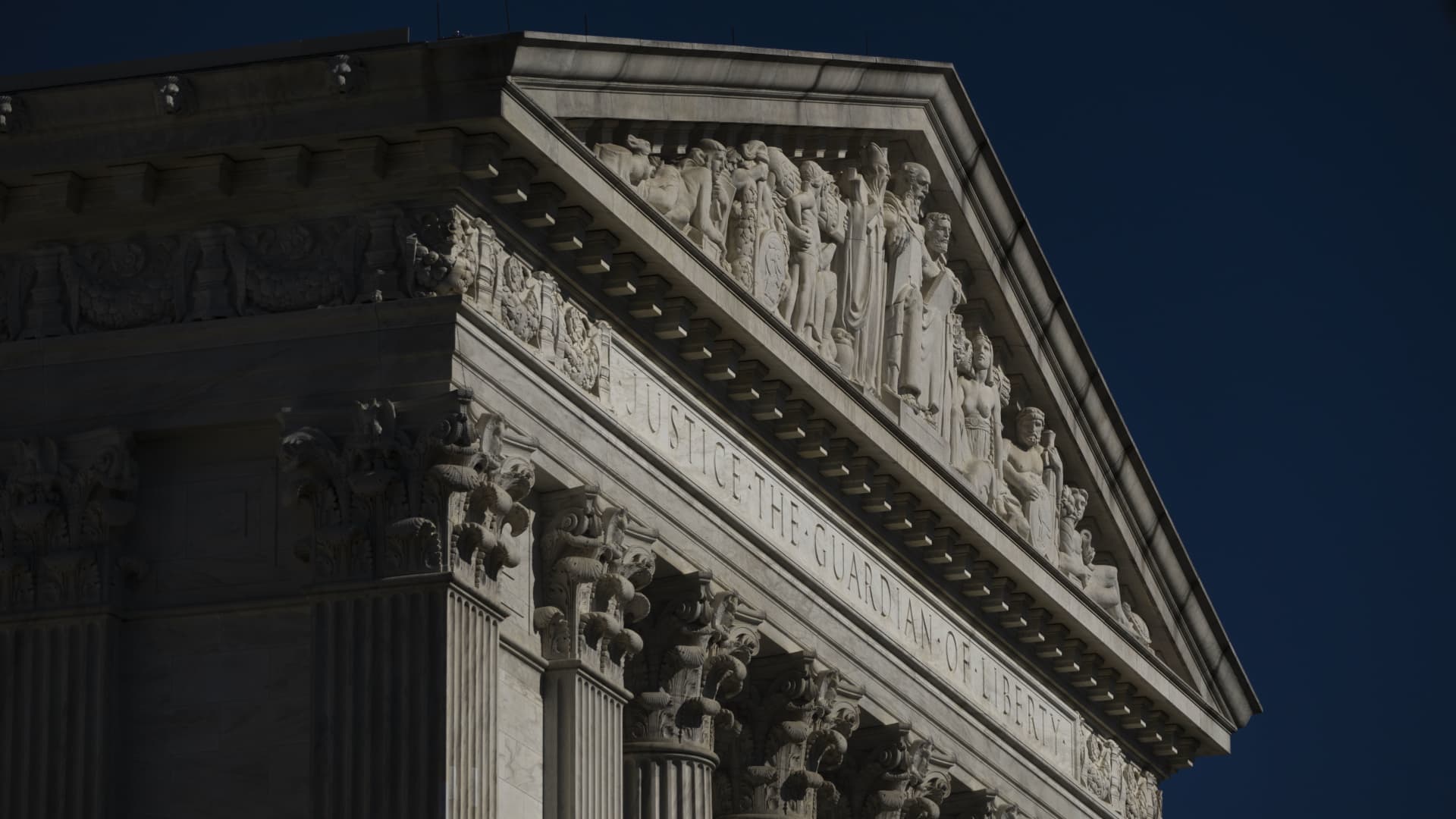
A view of the backside of the U.S. Supreme Court on June 6, 2022 in Washington, DC. According to media reports,
Drew Angerer | Getty Images
The Supreme Court on Thursday ruled the EPA does not have authority to set standards on climate-changing greenhouse gas emissions for existing power plants.
The 6-3 ruling said that Congress, not the Environmental Protection Agency, has that power.
The court’s ruling on the case affects the federal government’s authority to set standards for planet-warming pollutants like carbon dioxide from existing power plants under the landmark Clean Air Act.
The decision is a major setback for the Biden administration’s agenda to combat climate change, specifically the goal to zero out carbon emissions from power plants by 2035 and halve the country’s emissions by the end of the decade.
Chief Justice John Roberts wrote the majority opinion, in the case, known as West Virginia v. the Environmental Protection Agency, which was joined by the Supreme Court’s other five conservative members.
Roberts wrote, “There is little reason to think Congress assigned such decisions” about the regulations in question to the EPA, despite the agency’s belief that “Congress implicitly tasked it, and it alone, with balancing the many vital considerations of national policy implicated in deciding how Americans will get their energy.”
“Capping carbon dioxide emissions at a level that will force a nationwide transition away from the use of coal to generate electricity may be a sensible ‘solution to the crisis of the day,” Roberts wrote, But it is not plausible that Congress gave EPA the authority to adopt on its own such a regulatory scheme.”
He added: “A decision of such magnitude and consequence rests with Congress itself, or an agency acting pursuant to a clear delegation from that representative body.”
Justice Elena Kagan wrote a dissent, which was joined by the court’s two other liberals.
“Today, the Court strips the Environmental Protection Agency (EPA) of the power Congress gave it to respond to ‘the most pressing environmental challenge of our time, ” Kagan wrote in that dissent.
“The Court appoints itself — instead of Congress or the expert agency—the decisionmaker on climate policy. I cannot think of many things more frightening,” Kagan wrote.
The case stems from the EPA’s directive in 2015 to coal power plants to either reduce production or subsidize alternate forms of energy. That order was never implemented because it was immediately challenged in court.
Fossil fuel-fired power plants are the second-largest source of pollution in the U.S. behind transportation, according to the EPA. The U.S. is also the second-largest producer of greenhouse gases behind China, making it a key player in global efforts to combat climate change.
The court’s six-justice conservative majority has been skeptical of the federal agency’s authority to set national standards.
The legal fighting over the EPA’s authority began several years ago when the Obama administration set strict carbon limits for each state in an effort to reduce emissions from power plants, and urged states to meet limits by shifting to cleaner energy alternatives like wind and solar.
The Obama administration’s Clean Power Plan was temporarily blocked in 2016 by the Supreme Court and then repealed in 2019 by the Trump administration, which argued that the plan exceeded the EPA’s authority under the Clean Air Act. It argued that the act only allowed the agency to set standards on the physical premises of a power plant — or “inside the fenceline.”
The Trump administration proposed more lenient standards to regulate emissions only from existing coal-fired steam plants, a policy called the Affordable Clean Energy Rule. The revision was challenged by states and environmental groups and ultimately struck down by the U.S. Court of Appeals for the District of Columbia Circuit.
Since then, there hasn’t been an EPA standard with respect to carbon pollution from existing power plants.
Republican attorneys general led by West Virginia, a major coal producer, along with coal companies and industry groups, pursued the case, arguing that the EPA doesn’t have the authority to transition the country to cleaner energy sources and that such authority belongs to Congress.
Lawyers representing the EPA and U.S. utility industry lobby groups pushed back on arguments restricting the agency’s authority, arguing that doing so would prompt lawsuits against power providers.
Under the Biden administration, the EPA has indicated that it will not attempt to resurrect the Clean Power Plan, but rather create its own rules to regulate power plant emissions.
This is breaking news. Check back for updates.

