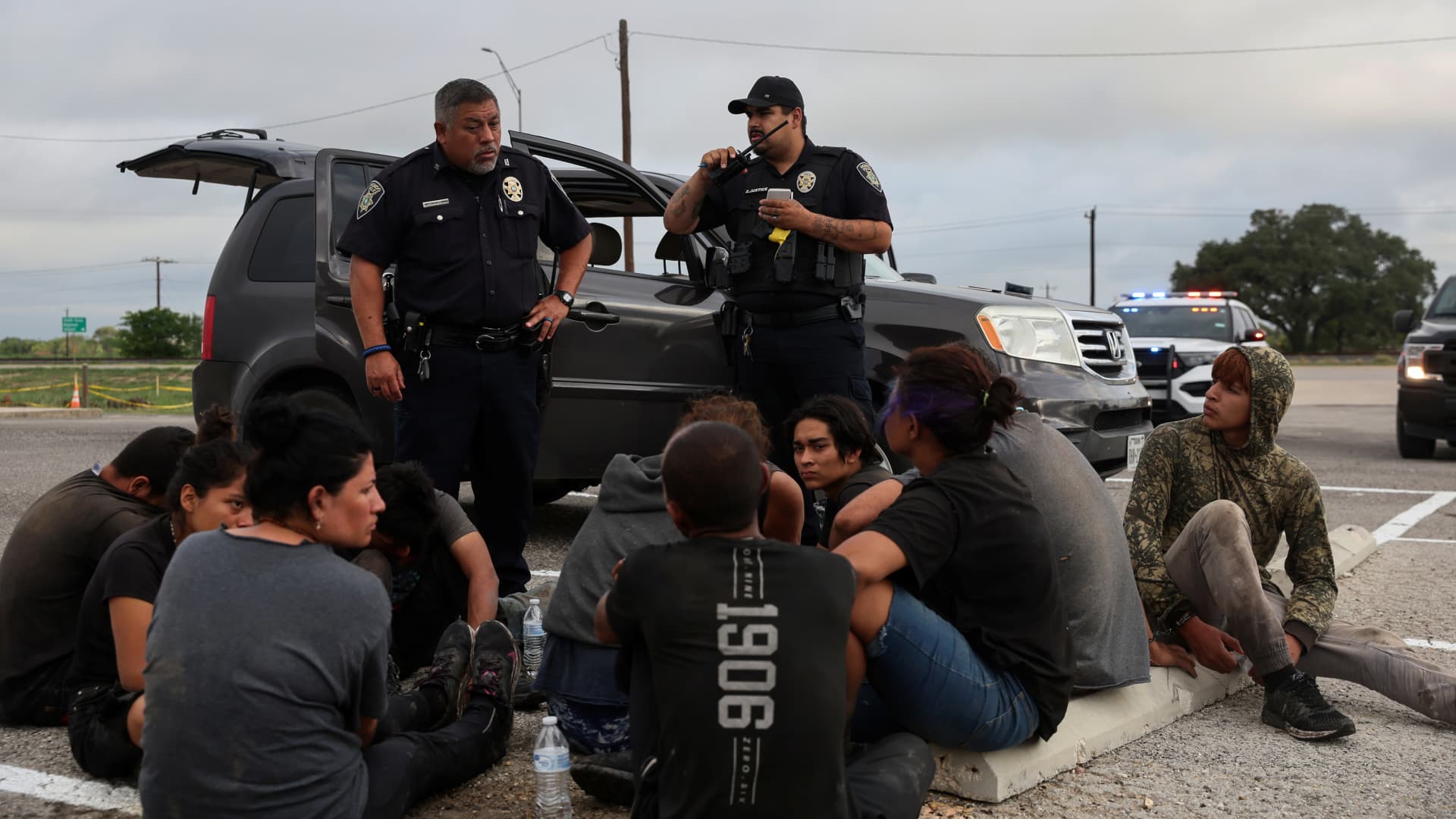
Asylum seeking migrants from Central America sit next to a vehicle that was stopped by police after crossing the Rio Grande into Eagle Pass, Texas from Mexico along U.S. Route 90, in Hondo, Texas, U.S., June 1, 2022.
Shannon Stapleton | Reuters
The Supreme Court ruled Tuesday to keep in place a controversial Trump-era rule that allows Customs and Border Patrol officials to deport migrants at the U.S. southern border as a public health measure in response to the pandemic.
Supreme Court Chief Justice John Roberts temporarily blocked the Biden administration earlier this month from ending the controversial policy, called Title 42.
More than 2 million people have been deported at the southern border under the policy since 2020.
In November, a federal district court in D.C. had ordered the Department of Homeland Security to end the policy Dec. 21, criticizing the deportations as arbitrary. But Republican-led states intervened in the case and successfully petitioned the Supreme Court last week to block that lower court ruling.
The deportation policy originated with the Trump administration. In March 2020, the Centers for Disease Control and Prevention used a provision under the Public Health Services Act, or Title 42, to prohibit migrants from crossing into the U.S. from Mexico or Canada due the risk of them spreading Covid. The deportation policy is often referred to simply as Title 42.
But human rights groups and dozens of health experts fiercely criticized the policy as a way for the federal government to carry out arbitrary mass deportations at the U.S. southern border under the guise of public health.
The Biden administration continued the policy until April 2022, when the CDC said it was longer necessary to prevent the spread of Covid. The CDC and DHS had planned for the policy to end in May, but Republican states sued and got a federal court in Louisiana to block the Biden administration from ending the deportations at that time as well.
Republicans and some Democrats argue that ending the policy will lead to a major increase in migration at the southern border that communities there are unequipped to deal with. El Paso, Texas declared a state of emergency on Saturday in response to a recent increase in migrants crossing the border.