


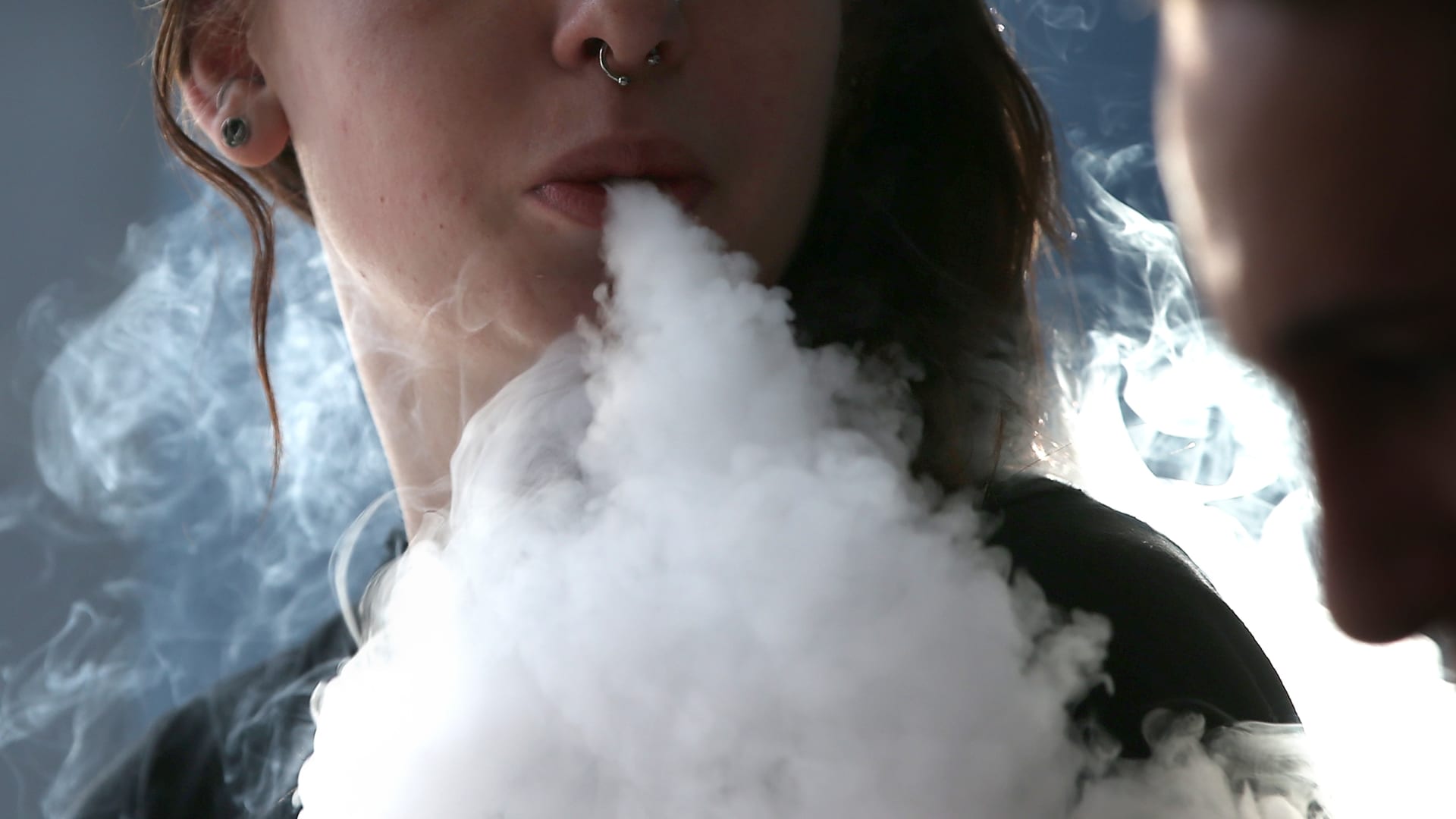
A woman smokes an E-Cigarette at Digital Ciggz in San Rafael, California.
Justin Sullivan | Getty Images
The Supreme Court on Tuesday declined to hear arguments in a case challenging the Food and Drug Administration’s authority to reject approvals of flavored electronic cigarettes.
The case is one of several challenges to the FDA’s regulation of the vaping industry, which has hooked members of a new generation on nicotine, and ballooned into an $8.2 billion market in less than a decade.
The 4th Circuit U.S. Court of Appeals in December ruled that the FDA has the power to deny applications for flavored e-cigarette products because of its mandate to protect public health by discouraging younger people from smoking.
The lower court ruling rebuffed an appeal by Avail Vapor, a vape retailer, which argues that the FDA unfairly denied its product applications based on requirements the agency “secretly” changed without notifying companies.
In 2016, the FDA determined that e-cigarettes were subject to its regulation, like traditional tobacco products. E-cigarettes are handheld devices used to inhale a vapor, which usually contains nicotine, flavoring and other chemicals.
The agency gave companies until September 2020 to submit applications for approval of each of their vape products, even if they were already on the market.
The FDA in March said nearly seven million applications were submitted by that deadline, but the agency has rejected more than 1 million of them.
Why did the FDA reject the e-cigarette applications?
The case is related to the FDA’s 2021 decision to reject all of Avail Vapor’s applications for its fruit- and dessert-flavored e-cigarettes.
The FDA said Avail did not present long-term studies demonstrating that its sweet-flavored vapes were more effective at helping adult smokers quit than tobacco-flavored e-cigarettes.
The agency said those studies are necessary to demonstrate that the benefits of Avail’s products to adults outweigh their risks to youth. Children, teens and young adults are more attracted to e-cigarettes that mimic the taste of sweet treats, according to the FDA.
Avail’s applications included four studies that surveyed patients on the safety and usability of a few of the company’s products and e-cigarettes overall, but that research did not make any comparisons to tobacco-flavored vapes. The company also outlined its marketing measures, including age verification for online sales, designed to prevent underage use of its flavored e-cigarettes.
Avail in its appeal to the 4th Circuit had argued that the FDA had not said it would need to see long-term studies comparing the company’s fruit and dessert-flavored e-cigarettes with tobacco-flavored vapes.
“The FDA says Avail and other retailers should have known what they were going to be looking for. Well, virtually nobody in the industry knew,” Avail’s attorney, Eric Heyer, told CNBC.
“The lack of those comparative efficacy studies was one of the main reasons why the FDA denied these applications,” he added. “The FDA had five years to communicate this to applicants and they never did. Not a single word.”
Avail also argued that the FDA was obligated to consider the marketing plan included in its applications.
What are the implications for the vaping industry?
But 4th Circuit Judge J. Harvie Wilkinson wrote in December that Avail “encourages us to neglect the forest for the trees” by focusing on procedural objections rather than the FDA’s mandate to “ensure that another generation of Americans does not become addicted to nicotine and tobacco products.”
Wilkinson said the FDA did not reject the applications due to their lack of specific long-term studies. He said the agency followed its mandate by requiring strong, product-specific evidence to evaluate the benefit of new e-cigarette products to adults, which Avail did not provide.
Avail exited the retail business after selling all of its 100 brick-and-mortar stores in October 2021, a month after the FDA rejected its applications.
JUUL advertising outside a vape shot in New York.
Melissa Fares | Reuters
Avail is not the only company to challenge application rejections from the FDA.
Last year, Juul Labs lost in its appeal of the FDA’s ban on its vaping products. The e-cigarette giant, which slashed nearly a third of its workforce in a bid to avoid bankruptcy, said the FDA conducted an incorrect and incomplete assessment of its data.
Upon review of the appeal and a temporary reprieve that allowed some of Juul’s products to come back to market, the agency determined Juul’s products still pose a risk to public health.
However, in some cases, the FDA has rescinded, or partially rescinded, rejections following the appeal process. To date, the FDA has authorized 23 tobacco-flavored e-cigarette products and devices.
Efforts to restrict e-cigarette flavors favored by teens may have fallen flat as new brands hit the market. E-cigarette unit sales rose nearly 47% between January 2020 and December 2022. Many popular brands of disposable e-cigarettes on the market are not FDA-approved and are illegal.


