


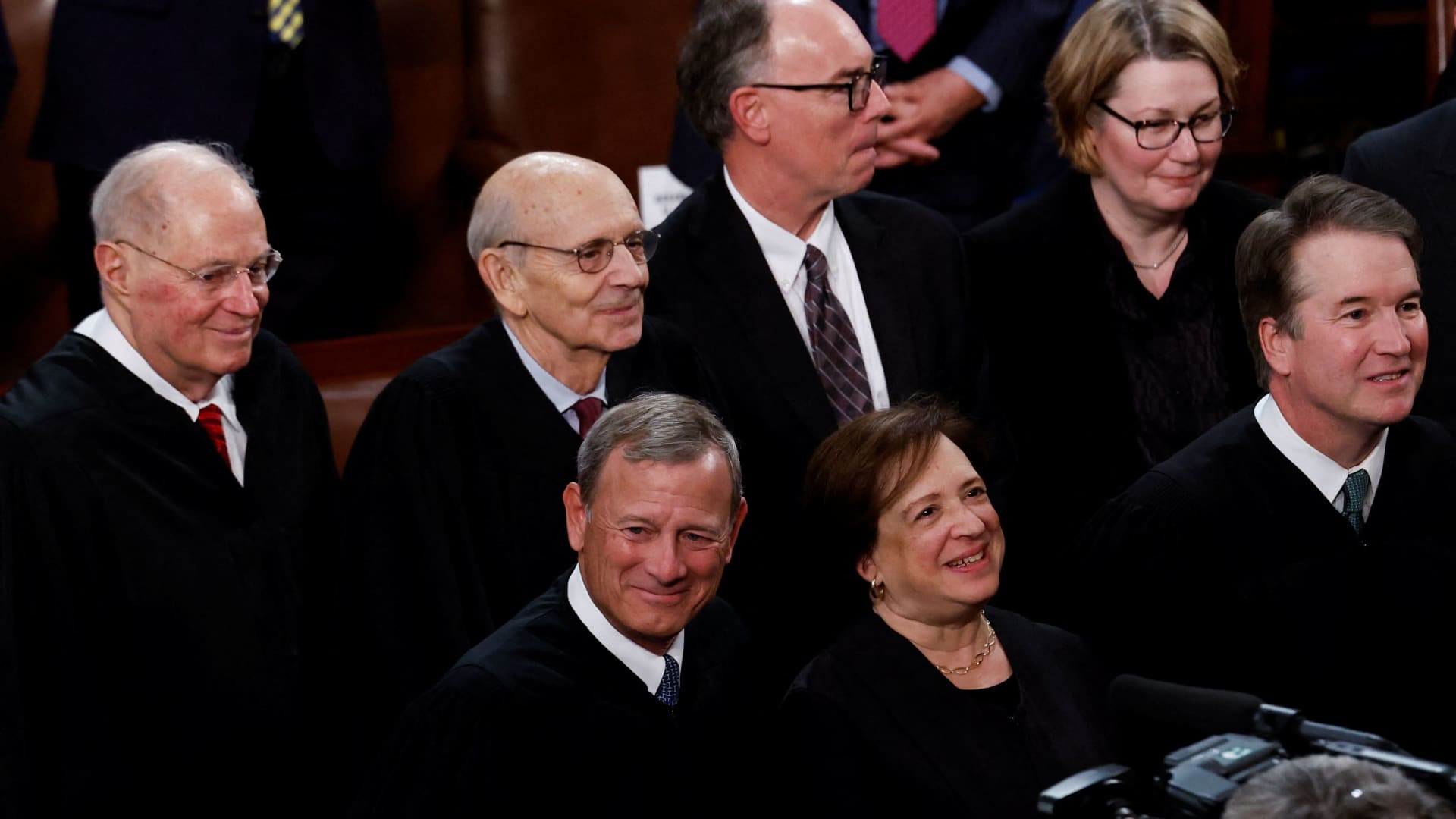
The Supreme Courtroom heard arguments Wednesday in a scenario that will support establish whether social media platforms can be held liable for aiding and abetting terrorism for failing to remove material and accounts promoting it.
The arguments in Twitter v. Taamneh follow these in a situation with related facts, Gonzalez v. Google, that explores whether tech platforms can be held responsible for advertising terrorist posts via their recommendation algorithms. In that case, the justices appeared reluctant to overhaul the essential legal liability protect in concern, Section 230 of the Communications Decency Act, which shields platforms from currently being held accountable for hosting their users’ posts. Whilst several appeared sympathetic to a narrower looking through of the law, many also appeared to desire kicking the responsibility around to Congress.
In Wednesday’s circumstance, these kinds of a consensus was more elusive, as justices analyzed a range of hypotheticals on lawyers for possibly facet as well as a consultant for the U.S. government, which typically argued in favor of Twitter. U.S. Deputy Solicitor Basic Edwin Kneedler represented the U.S. government.
The query in the scenario is whether Twitter can be held accountable for aiding and abetting a unique global terrorist act for the reason that it did not just take much more intense motion versus terrorist written content on its provider, given that it generally performs to average and take away terrorist written content below its guidelines.
Twitter’s lawyer Seth Waxman argued that the organization really should not be held accountable for aiding and abetting terrorism in cases where it is not straight aware of the specific publish or account in question. He explained that to fulfill the anti-terrorism law’s common for legal responsibility, Twitter would have had to provide substantial help to the act of terrorism and know their actions would present this sort of help.
Waxman tried to attract a difference in between an open up and extensively employed assistance like Twitter and a lender that presents revenue to a terrorist, given Know Your Buyer laws that would require a bank to collect additional data just before furnishing its providers, creating a larger amount of knowledge than Twitter would have.
Justice Samuel Alito claimed he could see two various arguments for how Twitter could acquire, but it truly is complicated to say in just about every wherever to attract the line. The initial argument would be that Twitter did not know its solutions would be made use of to carry out a specific assault and the 2nd would be that Twitter didn’t significantly assist in the attack.
Justice Sonia Sotomayor mentioned that basing a gain for Twitter on the recognizing common would be complicated “because willful blindness is a thing we have claimed can constitute know-how.”
Justice Elena Kagan at 1 point asked Waxman no matter whether Twitter could be held liable if it in fact failed to implement any policy from terrorist content on its web-site. Waxman stated he isn’t going to feel it could until it also offered “affirmative help” to the terrorists.
Kagan appeared to disagree with that interpretation, saying it would be apparent in that state of affairs that Twitter was delivering sizeable aid to terrorist exercise, asking, “how could it be normally?”
Justice Amy Coney Barrett laid out a possible framework for a ruling in favor of Twitter in her questioning of Kneedler. Coney Barrett said these types of an viewpoint may possibly say that in order to locate Twitter liable for aiding and abetting the terrorist act, the criticism would have to establish that Twitter’s support was straight made use of toward the terrorist assault, not just general recruitment or radicalizing.
Coney Barrett also hypothesized that the justices could say there wants to be an allegation of distinct understanding of a terrorist act in get to uncover a assistance that is “open to all comers” liable.
Kneedler mentioned it would be essential to clarify that some companies that are theoretically open to all, like banks, would have a more “individualized come across” with their consumers in the course of doing enterprise, granting them additional knowledge than a platform like Twitter.
Eric Schnapper, the legal professional for Taamneh, conceded that they were not alleging unique techniques Twitter was used to have out the terrorist assault, but alternatively typical recruitment. Justice Ketanji Brown Jackson asked if it would be illegal to sell Osama bin Laden a phone devoid of realizing it would be used for a terrorist certain terrorist act.
Schnapper stated it would not be essential to verify the cellular phone was applied for a particular terrorist act, simply because it “aids the terrorist company.” He afterwards conceded that alleging bin Laden did in point use the telephone to additional his terrorist action “would be the improved way to plea it.” Continue to, he mentioned, the opportunity terrorist steps “would be relatively implicit in his name,” he mentioned.
The Supreme Court docket is predicted to make a conclusion on the situation by June.
Subscribe to CNBC on YouTube.
View: Why the Supreme Court’s Portion 230 case could reshape the web

