


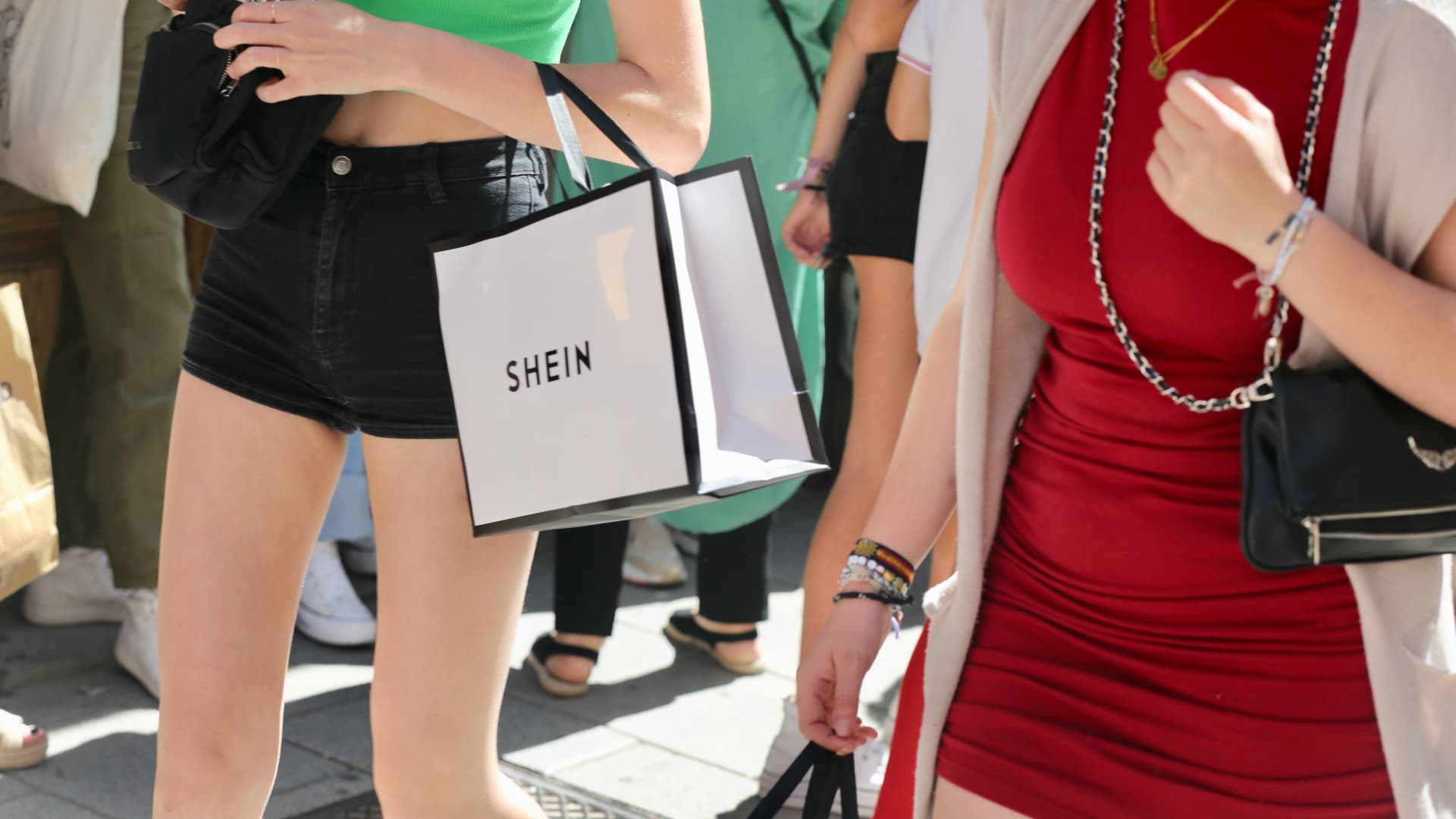
A woman with a Shein bag after entering its first physical store in Madrid, June 2, 2022.
Europa Press News / Contributor
Fast-fashion juggernaut Shein is facing more scrutiny from elected officials in the U.S. who want the company to prove it doesn’t use forced labor before it files for a widely rumored initial public offering.
Attorneys general from 16 states sent U.S. Securities and Exchange Commission Chair Gary Gensler a letter last week asking the agency to ensure Shein and other foreign companies are following U.S. law before they’re permitted to trade on American exchanges.
“It is apparent that SHEIN is attempting to launch an IPO before the end of this calendar year. An IPO of this magnitude—involving a foreign-owned company that is facing credible concerns about its core business practices—cannot move forward on self-certification alone,” the missive, written by Montana’s Attorney General Austin Knudsen and signed by 15 other Republican attorney generals, stated.
“We urge you to require, as a condition of being listed on a U.S. based securities exchange, that any foreign-owned company certify via a truly independent process that it is compliant with Section 307 of the Tariff Act of 1930, which prohibits the import of any product manufactured wholly or in part by forced labor.”
The letter was sent Thursday, the same day the company announced it was taking a stake in Forever 21’s parent company Sparc Group.
Shein has faced accusations that it used forced labor from the Xinjiang region in China to fuel its meteoric rise as rumors swirl that it is preparing to go public. The company’s supply chain has a large presence in China, where it was founded, but U.S. law prohibits imports from Xinjiang because of widespread human rights abuses against Uyghurs in the region.
The company is currently under investigation by the House Select Committee on the Chinese Communist Party, which has also accused Shein of evading U.S. tariff law. The probe comes as U.S. lawmakers from both parties increasingly scrutinize companies from China or those with potential ties to its government.
The letter cited a Bloomberg story published last year that showed, via independent testing, that some Shein clothes were made with cotton from the Xinjiang region.
Shein has faced enormous blowback from the report. The accusations have become a major hurdle the retailer must overcome before it can grow its presence in the U.S. and go public.
At the time of the Bloomberg report, Shein and its executives rarely spoke publicly. But since then, it has become more open to press, and has acknowledged to CNBC that some of its cotton supply has been found to come from the Xinjiang region.
To test its cotton, it contracted the supply chain tracing firm Oritain, which says it’s able to track the origin of cotton fibers down to specific farms. Between June 2022 and July 2023, it has conducted 2,111 tests, which resulted in 46 positive results, or a rate of 2.1%, from banned regions, Peter Pernot-Day, Shein’s head of strategy and corporate affairs, told CNBC.
“These are in raw materials so when we have a raw material positive test, that means that raw material is removed from production,” Pernot-Day said.
Oritain, which bills itself as an independent firm, previously confirmed those results to Politico and said Shein has fared better than the fashion industry on average.
Each year, the company tests more than 1,000 cotton samples. During a recent testing round across the industry, Oritain found 12% of samples came up positive for an “unapproved region,” Politico previously reported.
Pernot-Day said one of Shein’s primary objectives at the moment is to get its positive test results down to zero. To do that, it is conducting testing from all 40 of its mills each month, and stopped buying cotton from China altogether, Pernot-Day said.

