An Impulse employee works on assembling a Mira vehicle.
Impulse Space
Los Angeles-based space startup Impulse, which is led by renowned rocket specialist Tom Mueller, has raised $150 million in a new fundraising round led by venture capital firm Founders Fund.
Impulse is scaling a product line of orbital transfer vehicles — colloquially known as “space tugs” — and so far is building two, the smaller Mira and the larger Helios.
While rockets get satellites and payloads into orbit, like an airplane carrying passengers to a metro area, space tugs deliver them to specific destinations, like taxis taking those passengers home from the airport.
Mueller, the first employee of SpaceX who spent nearly two decades developing engines for CEO Elon Musk, told CNBC that the funds will secure Impulse Space’s future. Mueller founded Impulse three years ago after leaving SpaceX and leads the company as CEO.
“This means that we’re sufficiently funded through the development of Helios and the upgraded version Mira and out past the first flights of both of these products,” Mueller said.
Tom Mueller delivering the commencement speech at the University of Idaho in 2018.
University of Idaho
Impulse flew its first mission, called LEO Express-1, with a Mira vehicle carrying and deploying a small satellite. Launched in November, Impulse declared full mission success in July after a variety of additional demonstrations, with Mueller arguing it was “probably the most successful orbital transfer vehicle debut in history.”
“That success really helped with this raise, as well as all the customer engagement that we’re getting,” Mueller said.
The company has a backlog of contracts from both commercial and government customers — ranging from standard satellite deliveries to building the propulsion system for a private space station to demonstrating the capabilities of its Helios vehicle in the distant geosynchronous orbit for the U.S. Space Force.
A wide swath of venture investors joined the company’s $150 million round including: Airbus Ventures, Alumni Ventures, Balerion Space Ventures, Lux Capital, RTX Ventures, Spring Tide, Tamarack Global, 137 Ventures, DCVC, Elysium, First Principles Group, Island Green, Overmatch and Trousdale Ventures. The new round brings Impulse’s total fundraising to $225 million to date, the company said.
A Mira vehicle in orbit during the LEO Express-1 mission that launched November 2023, with several pairs of its Saiph thrusters visible.
Impulse Space
Impulse’s next mission, LEO Express-2, is set to launch later this year. Then it plans to launch an updated version of its Mira vehicle in late 2025, perform a demo mission with Helios by mid-2026 and debut its “GEO Rideshare” missions by 2027, according to the company.
Tapping reusable rockets, Starship or not
In Mueller’s view, while SpaceX reduced the cost to launch mass to orbit, the in-space delivery systems on the market are lacking. And there’s more launch capacity coming, with large reusable rockets in development by Rocket Lab, Blue Origin, Relativity and others.
“There’s a lot of cost and efficiency to be gained … [with] a reliable solution for any customer who wants to move things around in space,” Mueller said.
A Mira vehicle at the company’s Redondo Beach headquarters.
Impulse Space
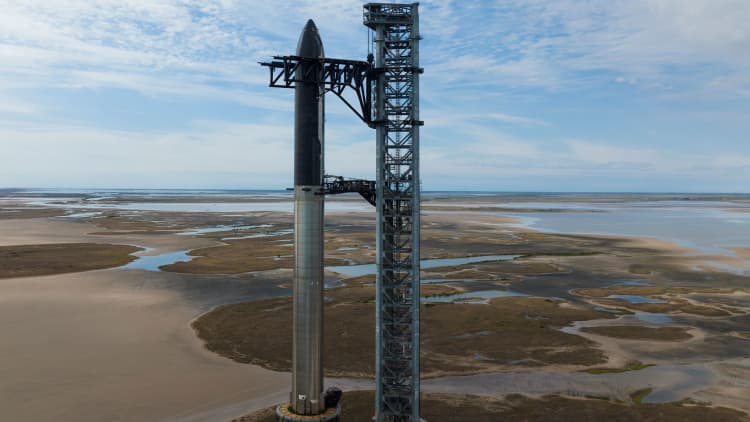
While he said he started Impulse “really based on what I thought Starship could do commercially,” Mueller noted that “now we’re finding out that [SpaceX is] probably not going to fly commercially for maybe another five years and there’s not a lot of information yet on what the arrangements will be.”
SpaceX continues to develop its monstrous Starship rocket system, with increasingly ambitious test flights by prototypes. The rocket is crucial for the company’s future, whether that’s deploying its own Starlink satellites or flying high-profile moon missions for NASA.
“For now, [we’ll be] flying on Falcon 9 and the medium launch vehicles,” Mueller added.
Headquartered in Redondo Beach, California, Impulse currently has about 140 employees and plans to expand to more than 200 next year as it scales Mira and Helios production. The company does most of its design, manufacturing, assembly and even engine test firing at its 60,000-square-foot facility.
Mueller noted that the current Impulse facility allows the company to scale to producing at least 10 of its Mira spacecraft a year before it needs to expand.
“We feel good right now. Got that [fundraising] behind us, so it’s head down and make progress now,” Mueller said.