


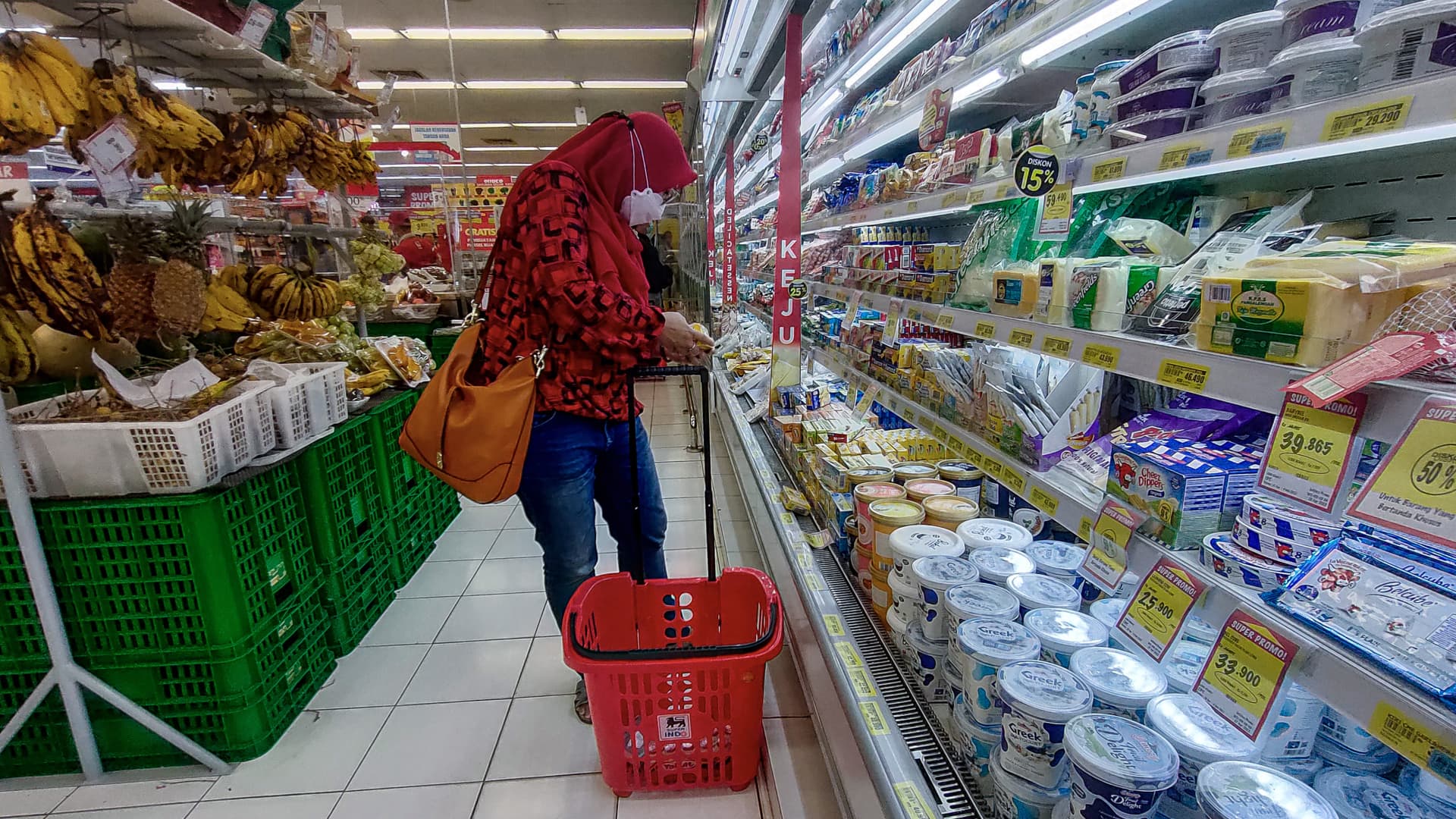
A supermarket in Indonesia on May 1, 2022. Relative to other countries, food consumption accounts for a large proportion of what people spend on in countries like Indonesia, the Philippines and Vietnam, said economist Mohamed Faiz Nagutha.
Adriana Adie | Nurphoto | Getty Images
Southeast Asia will face a “big risk” of social unrest if there are “big surges” in food prices, an ASEAN economist at Bank of America Securities told CNBC.
That’s because, relative to other countries, food consumption accounts for a large proportion of what people spend on in countries like the Philippines, Indonesia and Vietnam, said Mohamed Faiz Nagutha on Friday.
In 2021, Filipino households spent nearly 40% of their total expenditure on food and non-alcoholic beverages, according to the Philippine Statistics Authority.
In comparison, U.S. households spent 8.6% of their disposable income on food, the Economic Research Service reported.
“Having said this, ASEAN food inflation in particular has been a little bit less volatile (and) more contained than in the past because we depend a lot on intra-regional trade and there is a lot of government support in place to keep food inflation contained,” Nagutha told CNBC’s “Street Signs Asia.”
Nonetheless, he warned that prices will eventually have to increase, though the governments are hoping the increment will be gradual.
“It’s usually the big shock jump that causes a lot of unhappiness on the street,” he said.
Inflation outlook
Inflation in Southeast Asia has been rising but remains low from a historical perspective, Nagutha said, though he noted the situation will change over the coming months and quarters.
Regional inflation rose from 3% in February to 3.5% in March, according to FocusEconomics, an information services firm.
With economies reopening and people consuming more services, demand will contribute to a rise in inflation, he said. However, this will add on to cost pressures that businesses are sitting on, and they will be looking to pass on some of these costs to consumers, he added.
That, combined with energy and food inflation globally, will push overall inflation in Southeast Asia even higher, he said.
However, the longer-term outlook for inflation remains uncertain because it’s still unknown what prices oil and other commodities will stabilize at, Nagutha added.
“In our baseline, we assume they stay high,” he said, which will keep global inflation elevated. However, a recession is not in baseline expectations, he added.
“And for ASEAN, that means that inflation may come off from the peak, but it will still remain high relative to the historical context, and should remain high relative to where central banks want to see them,” he said.
Central bank reactions
With the exception of the Monetary Authority of Singapore, most Southeast Asian central banks have not reacted, Nagutha said.
Given how far Southeast Asia has come in its Covid recovery, central banks there should be getting ready to look beyond supporting growth and looking at inflation, he added.
“It’s about anchoring inflation expectations and sending a signal that the policy rates that we have in ASEAN no longer are warranted given where we in the global inflation cycle,” he said.
That said, Southeast Asian central banks are slowly coming around to the tightening bias, he said, starting with a possible rate hike from the Malaysian central bank next week.
“And for other ASEAN central banks, we see rate hikes from the second half of the year,” Nagutha said.
“One exception is Thailand because it has been a big laggard in terms of the growth of recovery — so we do think that they can afford to stay on hold for a bit longer,” he added.
However, Euben Paracuelles of Nomura, a financial services firm, said the Philippine central bank is also unlikely to be hiking rates this month, although it may do so in June if it sees signs of core inflation picking up.
“There is no real reason to raise rates because higher interest rates did not solve higher fuel prices or higher food prices,” Paracuelles told CNBC’s “Squawk Box Asia.”
“Inflation is high in the headline basis, but if you take out energy and food, core (inflation) is much lower,” he added.