


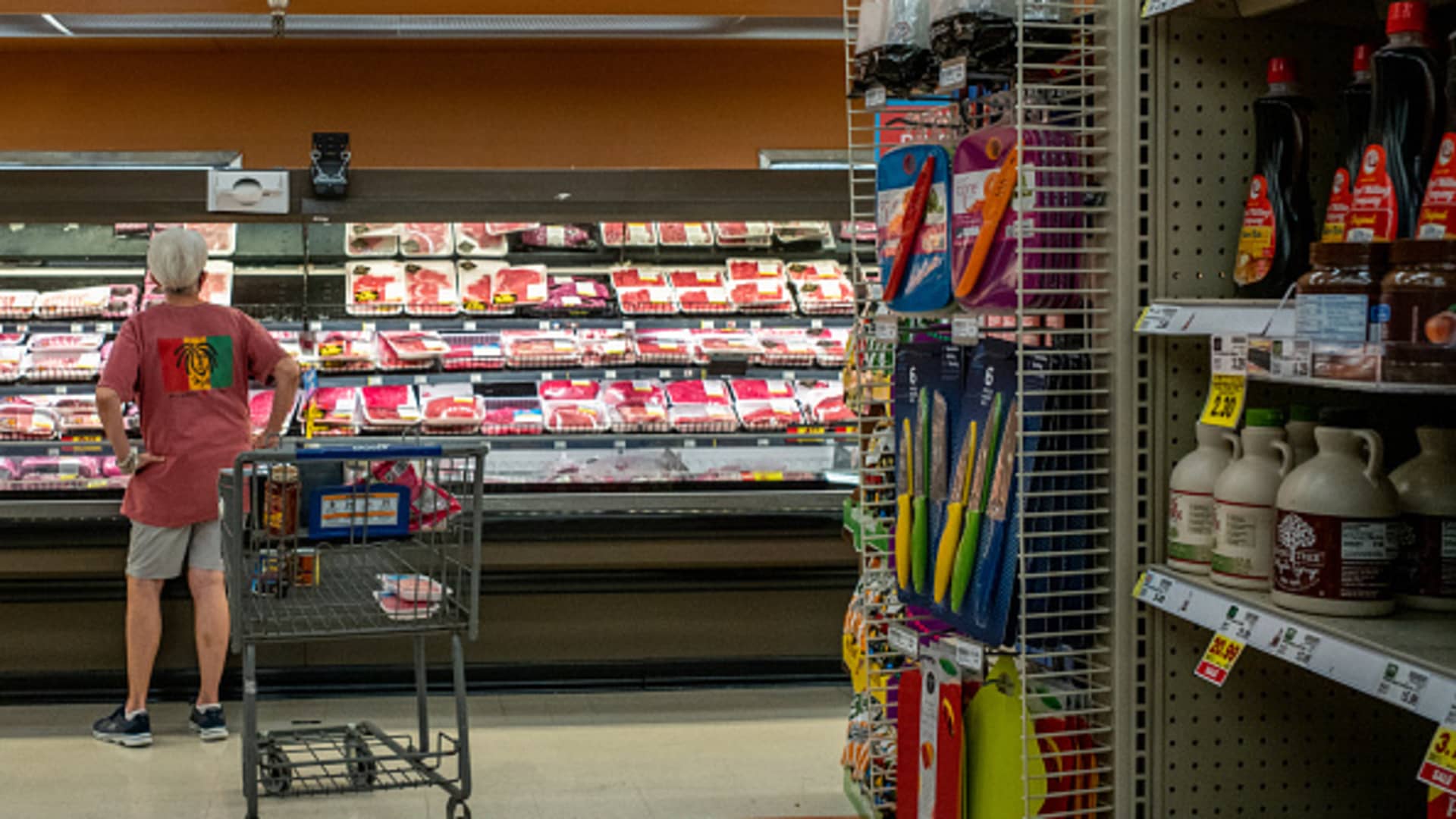
Good news for consumers is bad news for Kroger.
As prices that shoppers pay for groceries stabilize or fall, the supermarket operator’s sales are sagging.
On Friday, the company posted fiscal second-quarter sales that missed Wall Street’s expectations. The company stuck with its full-year outlook, but said the slowing rate of inflation will mean less revenue.
Here’s how the grocer did in the three-month period that ended Aug. 12 compared with what Wall Street was anticipating, based on a survey of analysts by LSEG, formerly known as Refinitiv:
- Earnings per share: 96 cents adjusted vs. 91 cents expected
- Revenue: $33.85 billion vs. $34.13 billion expected
The company posted a net loss of $180 million, or 25 cents per share, compared with a gain of $731 million, or $1 per share, in the year-ago period.
One factor was the company’s settlement of the majority of claims that it fueled the opioid crisis. The company agreed to pay $1.2 billion to U.S. states, local governments and Native American tribes to settle the majority of claims that it fueled the epidemic. Its quarter included a $1.4 billion charge, translating to a $1.54 loss per share, for that settlement.
Net sales fell from $34.64 billion in the year-ago period.
For retailers, inflation has been a mixed bag. On the one hand, it has contributed to higher overall sales as shoppers pay more for many items that they buy.
Yet it has hurt the volume of merchandise sold, as customers think twice about buying — especially when it comes to adding discretionary purchases to their shopping carts. Target and Walmart, in particular, have spoken about customers buying food and essentials, but less of the other stuff, at their big-box stores.
At Kroger locations, the slowdown in discretionary merchandise has been less of a factor since everyday items like groceries dominate the shelves. But it has created risk that customers could turn to retailers known for lower food prices, such as Walmart, Aldi or Dollar General. Kroger is made up of about two dozen grocery chains, including Fred Meyer, Ralphs and King Soopers, along with its namesake stores.
Home Depot has also seen the strange dynamic play out as inflation cools. Lumber prices, which shot up in price about two years ago, have come down and made its overall sales look lower. Yet it has also felt the pinch from consumers buying fewer big-ticket items like appliances as they are forced to spend more for basics like food and housing.
In the fiscal second quarter, Kroger’s identical sales without fuel grew by 1%, slightly lower than the 1.2% gain expected by analysts, according to StreetAccount. The industry metric takes out factors like store openings and closures.
Kroger reaffirmed its full-year guidance, saying it expects identical sales excluding fuel to range between 1% and 2%. That includes the impact of ending an agreement with Express Scripts, a pharmacy benefit management company. It said adjusted net earnings are expected to range between $4.45 and $4.60 per share, including the benefit from having an extra week in the year.
Even though Kroger did not change its outlook, Chief Financial Officer Gary Millerchip said Kroger expects identical sales will be at the low end of its annual range, and slightly negative in the back half of the year when excluding fuel.
In an earnings release, he said the grocer expects inflation to “continue to decelerate” and expects a tougher backdrop for consumers in the months ahead.
The prices that consumers pay for food at home aren’t rising as much as they were before, but were still up 3.6% year over year in July, according to consumer price index data from the U.S. Bureau of Labor Statistics.
Compared to pre-pandemic, food at home prices are up significantly — a jump of 25% when comparing January 2019 to July of this year.
On an earnings call with investors, CEO Rodney McMullen said the grocer has seen shoppers who feel squeezed by high inflation, reduced government benefits and rising interest rates. He said the company has tried to cater to budget-minded customers with lower-priced items from its own brands, personalized discounts, fuel rewards and weekly specials.
“We expect these broader economic headwinds to continue pressuring customer spending in the second half of the year,” he said. “While the environment is difficult, we are never satisfied with sales, and we are focused on driving more units in the back half of the year.”
Kroger put up strong online gains in the quarter, with digital sales rising 12% year over year. It has expanded to new markets, including Florida, by opening giant warehouses to fulfill online orders.


