


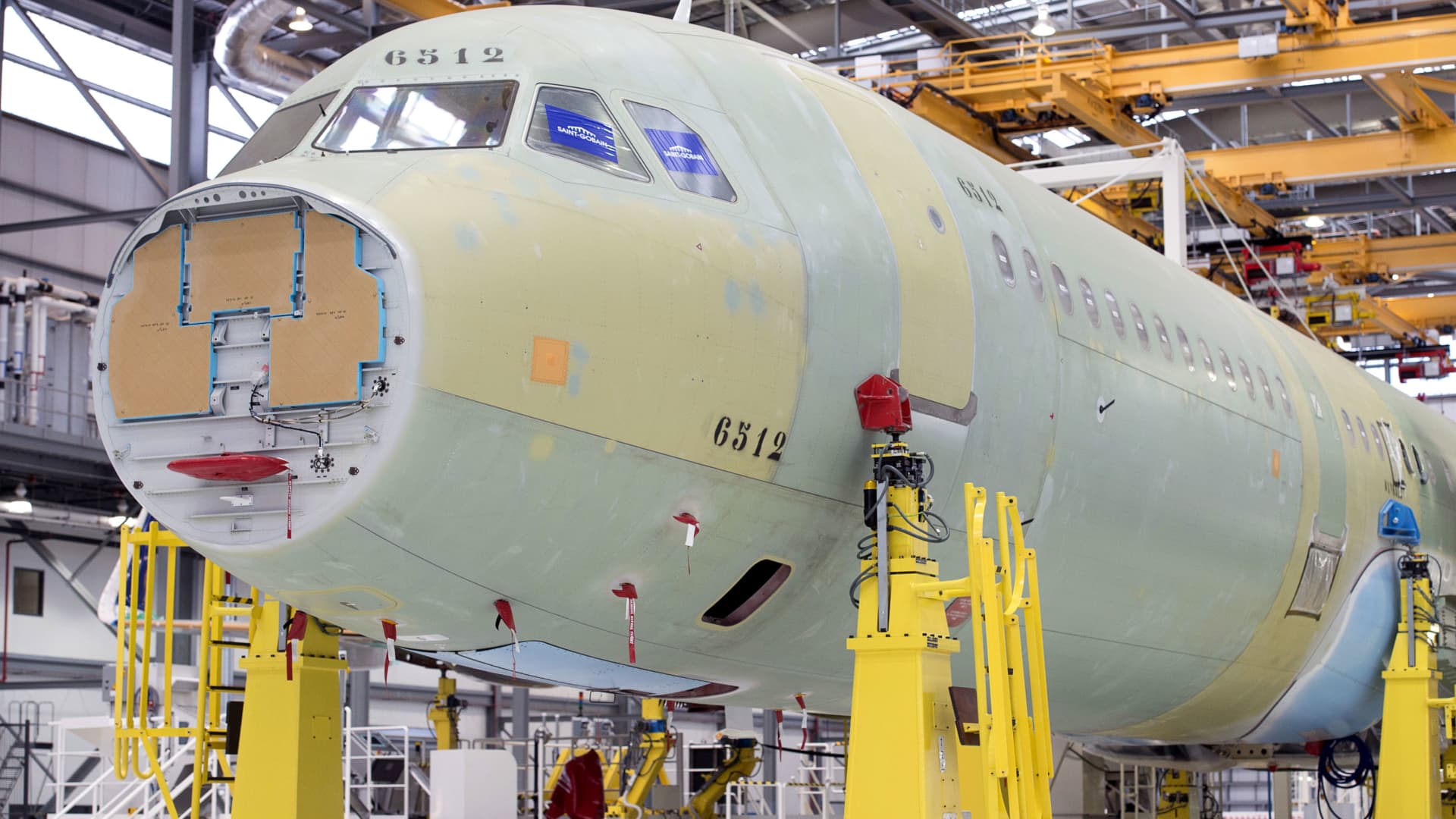
An Airbus A321 is being assembled in the final assembly line hangar at the Airbus U.S. Manufacturing Facility in Mobile, Alabama.
Michael Spooneybarger | Reuters
Passengers aren’t the only ones paying more to fly this year.
A tight supply of aircraft is driving up the price airlines pay to rent planes, just as travel demand returns.
The rent on a new Boeing 737 Max rose more than 20% between April 2020 and this July to $316,000 a month, estimates aviation advisory firm IBA Group. The competing Airbus A320neo climbed to $324,000 a month, up more than 14% from April 2020, and the highest price since before the pandemic. The larger version, the A321neo, was going for $375,000 per month in a July.
The world’s largest aircraft leasing firms, like Air Lease, Avolon and AerCap, which acquired GE’s airplane leasing business last year, are reaping the benefits.
More than 51% of the world’s nearly 23,000 single-and-double-aisle jetliners are owned or managed by leasing firms, according to aviation consulting firm Cirium. While many airlines do own their aircraft, some carriers choose to rent planes instead, or combine the two.
Reasons for leasing vary and include weak credit ratings that drive up borrowing costs, and the desire, or need, to conserve cash, rather than shelling out to buy new planes, which can run more than $100 million apiece at list prices.
The higher costs come as airlines are already facing high inflation, resulting in expenses that usually get passed along in fares. Aircraft rents are approaching or in some cases surpassing 2019 prices, and they’re set to go even higher. This year’s surge in oil prices make newer, fuel-efficient planes more attractive than older ones, and higher interest rates could also drive up lease rates.
“You have the rising interest rates and higher cost of capital,” said Mike Yeomans, director of valuations and consulting at IBA. “That will push lease rates higher through the rest of the year.”
Leasing firm executives told CNBC that many of their customers are extending leases, with new planes hard to find.
Steven Udvar-Hazy, executive chairman of Los Angeles-based Air Lease, said the company’s lease extension rate is nearing a never-before-seen 90%, and that it usually runs about 65% to 75%.
“We’re seeing a lot of lease extensions on a planes that a year ago we projected that we would have to remarket,” said Udvar-Hazy. That means the company doesn’t have to worry about transition costs and it gives them a steady stream of income.
The trend is the result of a resurgence in airline bookings while Boeing and Airbus – still recovering from a demand and production lull during the earlier days of the pandemic along with supply chain issues – are unable to ramp up production as much as they would like to.
Global passenger traffic rose in 76% in June from a year earlier, but is still down about 29% compared with before the pandemic, according to the International Air Transport Association’s latest available data.
Hazy said interest rates would have to climb higher and remain elevated to significantly dent travel demand.
For now, airlines are “now looking at a world where they can actually deploy more aircraft,” said Andy Cronin, Dublin-based Avolon’s CEO designate. “We’re definitely seeing a shortage of aircraft and accelerating demand over and above what we would have expected at this stage.”
Cronin said lease rates for Boeing Maxes and Airbus A320neos have risen by 10-15% so far this year.
Supply chain problems and labor constraints have challenged manufacturers from increasing production. Part of the issue stems from sanctions on Russia that has crimped titanium supplies since that country’s invasion of Ukraine in February.
“Now we’re not talking about dozens and dozens of aircraft, but you’re talking five to 10 airplanes that these customers that are going to be without engines because we don’t have the titanium forgings that we had expected to get this year,” Raytheon CEO Greg Hayes said on an earnings call last month, referring to the conglomerate’s Pratt & Whitney engine unit.
“We’ll work through it, but it’s not going to be without a little bit of pain to our customers.”
