


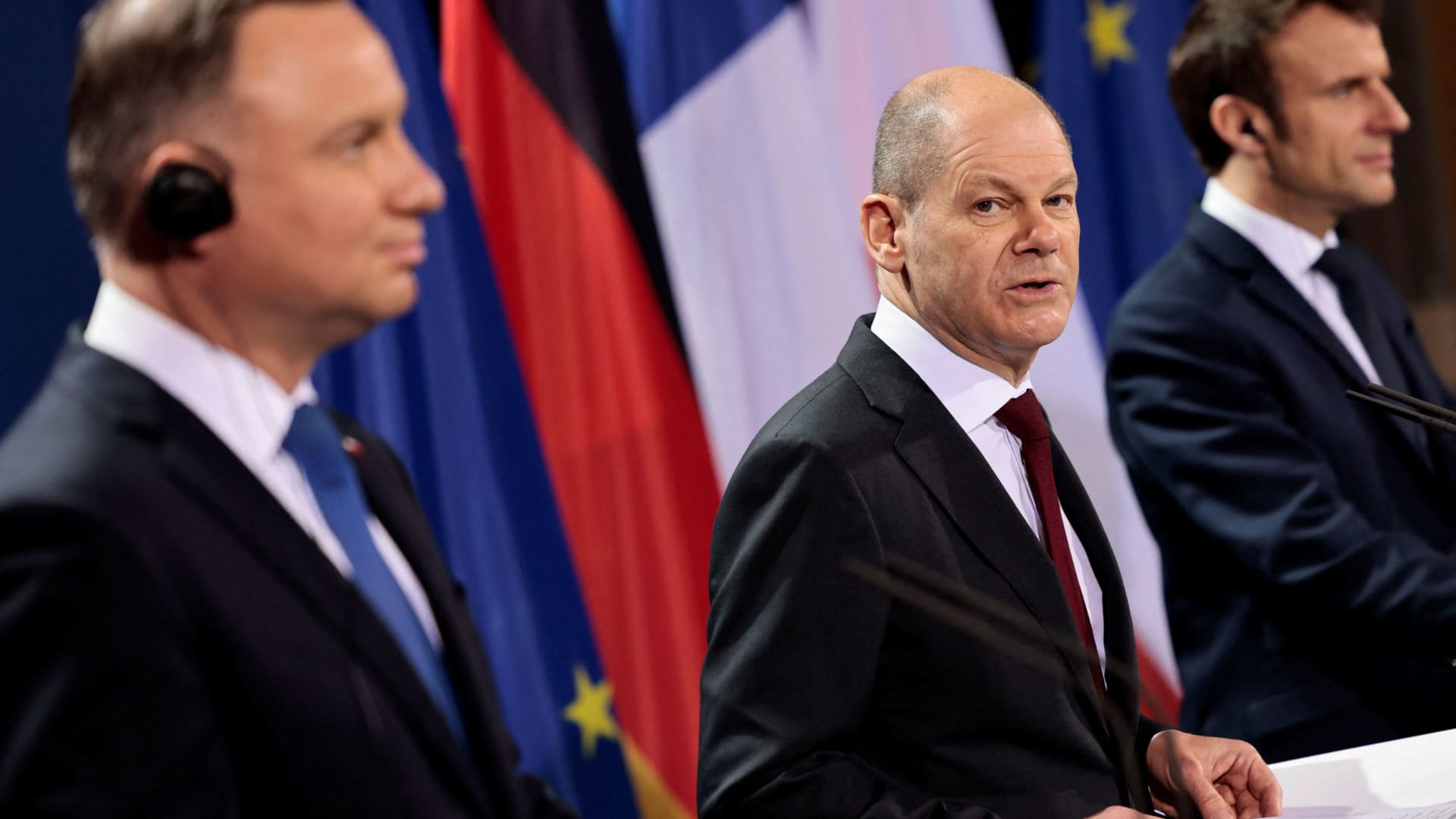
German Chancellor Olaf Scholz, French President Emmanuel Macron and Polish President Andrzej Duda attend a news conference ahead of a Weimar Triangle meeting to discuss the ongoing Ukraine crisis, in Berlin, Germany, February 8, 2022.
Hannibal Hanschke | Reuters
The war in Ukraine and the ensuing economic sanctions imposed on Russia will cause far bigger shifts for Europe’s economy and markets than previous crises like the coronavirus pandemic, economists have said.
In light of Russia’s unprovoked invasion of Ukraine, European leaders have been forced to rapidly accelerate plans to reduce their outsized dependence on Russian energy. The European Parliament on Thursday called for an immediate and total embargo of Russian oil, coal, nuclear fuel and gas.
However, this aggressive decoupling comes at a price for the European economy, driving up already high inflation to record levels and threatening to undermine the manufacturing recovery that began last year as economies attempted to re-emerge from the Covid-19 pandemic.
ING Head of Global Macro Research Carsten Brzeski noted last week that Europe is particularly at the risk of losing international competitiveness as a result of the war.
“For the continent, the war is much more of a game-changer than the pandemic ever was. I’m not talking just in terms of security and defense policies but notably about the entire economy,” Brzeski said.
“The eurozone is now experiencing the downside of its fundamental economic model, that of an export-oriented economy with a large industrial backbone and a higher dependency on energy imports.”
Having benefited from globalization and the division of labor in recent decades, the euro zone is now having to ramp up its green transition and pursuit of energy autonomy, while at the same time boosting spending on defense, digitization and education. Brzeski characterized this as a challenge that “can and actually must succeed.”
“If and when it does, Europe should be well-positioned. But the pressure on household finances and incomes will remain huge until it gets there. Corporate profits, meanwhile, will remain high,” he said.
“Europe is facing a humanitarian crisis and significant economic transition. The war is taking place in the ‘breadbasket’ of Europe, a key production area for grain and corn. Food prices will rise to unprecedented levels. Higher inflation in developed economies could be a matter of life and death in developing economies.”
Brzeski concluded that financial markets were “misguided” as European stocks attempt to grind higher, adding that “there’s no return to any sort of normality of any kind right now.”
Debt sustainability concerns
This tectonic shift for the European, and indeed global, economy will place additional pressure on central banks and governments caught between a rock and a hard place in juggling inflation against fiscal sustainability, economists acknowledge.
In a note Thursday, BNP Paribas predicted that a faster drive to decarbonize, higher government spending and debt, more intense headwinds to globalization and higher inflationary pressures would be an enduring theme.
“This backdrop presents central banks with a more challenging environment in which to conduct policy and keep inflation on target, not only diminishing their ability to commit to a certain policy path but making policy mistakes more likely,” BNP Paribas Senior European Economist Spyros Andreopoulos said.
He also noted that raising interest rates to rein in inflation will eventually make life difficult for fiscal authorities.
“While this is not an immediate concern, not least because governments have generally lengthened the average maturity of their debt in the low interest rate years, a higher interest rate environment may change the fiscal calculus as well. Eventually, debt sustainability concerns could resurface,” Andreopoulos said.
Low inflation throughout the euro zone’s recent history meant the European Central Bank was never forced to choose between fiscal sustainability and pursuing its inflation targets, since low inflation necessitated the accommodative monetary policy that aided fiscal sustainability.
“Politically, the ECB was able to – convincingly, in our view – deflect accusations that it was helping governments by pointing to low inflation outcomes,” Andreopoulos said.
“This time around, the ECB is having to tighten policy to rein in inflation against the backdrop of even higher public debt, a legacy of the pandemic, and continued pressures on the public purse.”

