


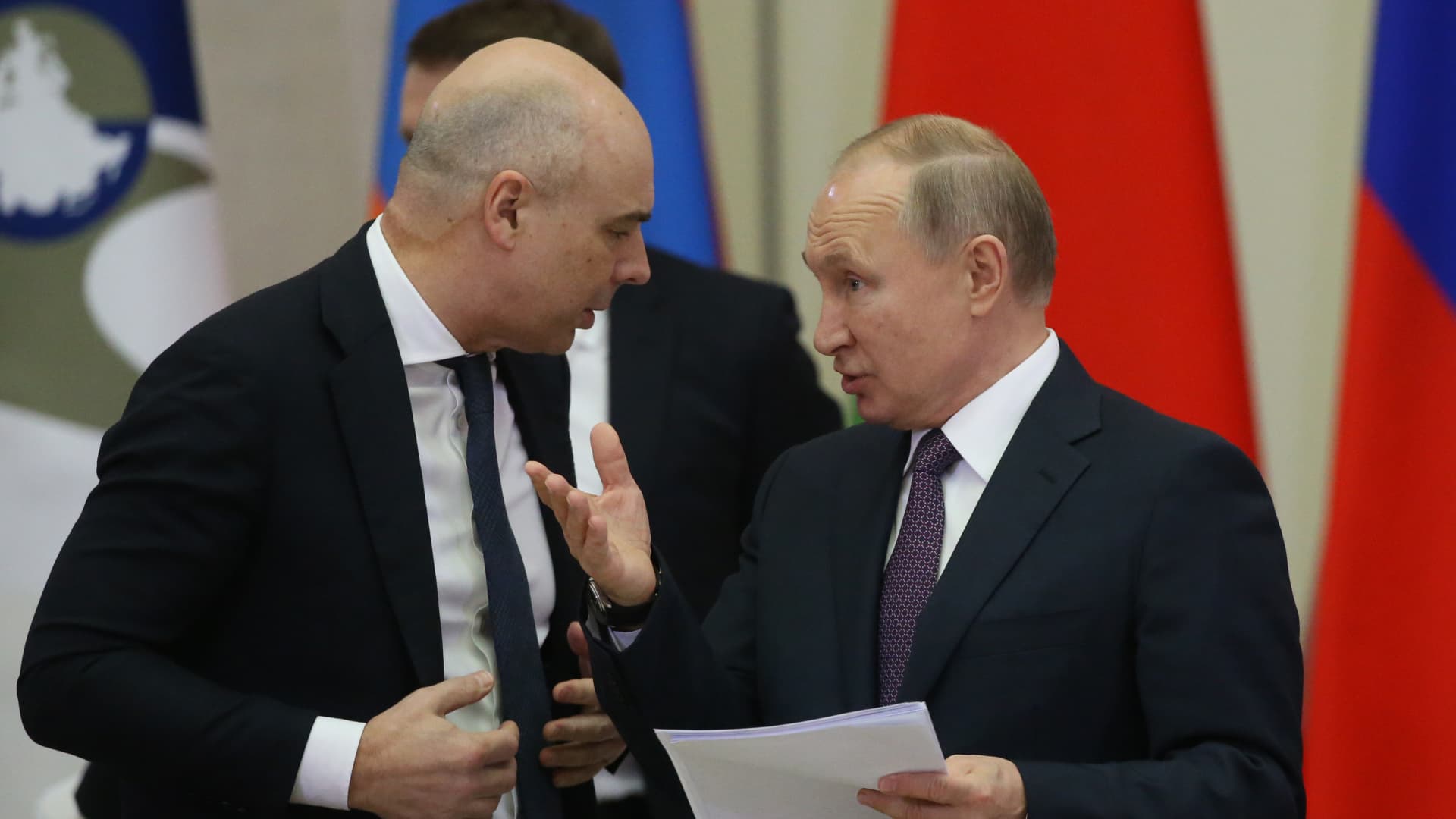
Russian President Vladimir Putin talks to Finance Minister Anton Siluanov during the EEU Summit meeting on December 20, 2019 in Saint Petersburg, Russia.
Mikhail Svetlov | Getty Images News | Getty Images
Russia made payments on its sovereign bonds in dollars on Thursday and that money would be distributed to bondholders, according to a report from Reuters, citing a source familiar with the situation.
The delivery of payment on the two eurobond coupons is a key test for Russia. The Kremlin is staring down the prospect of its first foreign currency debt default in more than a century after the U.S. and international allies imposed a barrage of economic sanctions over its invasion of Ukraine.
The penalties have blocked a bulk of Russia’s gold and foreign exchange reserves and sought to cut off Moscow from the global financial system.
Russia had until the end of business Wednesday to fulfill its obligations and pay $117 million in interest on two sovereign eurobonds.
Russia’s Finance Ministry claimed earlier Thursday it had fulfilled crucial interest payments on two dollar-denominated eurobonds, saying the order had been made to payment agent Citibank in London.
The ministry said it would later comment separately on whether the $117 million in total payments has been credited. Citibank declined to comment when contacted by CNBC on Thursday morning.
Kremlin spokesperson Dmitry Peskov reportedly said Thursday that any potential default would be “entirely artificial” because Russia had the funds necessary to fulfill its external debt obligations.
“The fact is that from the very beginning we have said that Russia has all the necessary funds and potential to prevent a default — there can be no defaults,” Peskov said, according to Reuters.
“Any default that could arise would have an entirely artificial character,” he added.
Finance Minister Anton Siluanov said Wednesday that Russia had attempted to deliver the payment and it was now up to the U.S. to decide whether it went through.
It was not immediately clear whether the order had been made in dollars amid speculation Russia could attempt to pay in rubles.
Credit ratings agency Fitch warned earlier this week that payment to bondholders in a currency other than dollars would constitute a default.
‘Russia blinked’
“Russia blinked,” Timothy Ash, senior emerging markets sovereign strategist at BlueBay Asset Management, said via email.
“It used resources in its limited war chest, beyond the reach of Western sanctions to make the payment. Let’s see if it ends up with bondholders.”
Ash suggested Russia had realized “the price of default was much larger.”
Citibank, as a paying agent to Russia’s foreign bondholders, has been thrust into the spotlight while investors await clarity on whether Moscow has been able to administer its debt payments.
A paying agent plays the administrative role of receiving and processing payments to a security holder on behalf of the issuer. It is not typically permitted to disclose confidential and financial information.
The prospect of nonpayment would kick-start a 30-day grace period before Russia falls into technical default, but the Kremlin will likely contend that Western sanctions prevented it from completing the payment.
If confirmed following the grace period, the nonpayment would mark Russia’s first sovereign default since 1998, when it defaulted on domestic debt, and the first sovereign default on foreign currency debt since 1918 during the Bolshevik Revolution.
Economists had been unsure as to how Russia’s Ministry of Finance would approach the payment in light of sanctions on the Central Bank of Russia that rendered much of its foreign exchange reserves inaccessible, prompting a slew of credit downgrades from the major global ratings agencies.
— CNBC’s Elliot Smith contributed to this report.

