


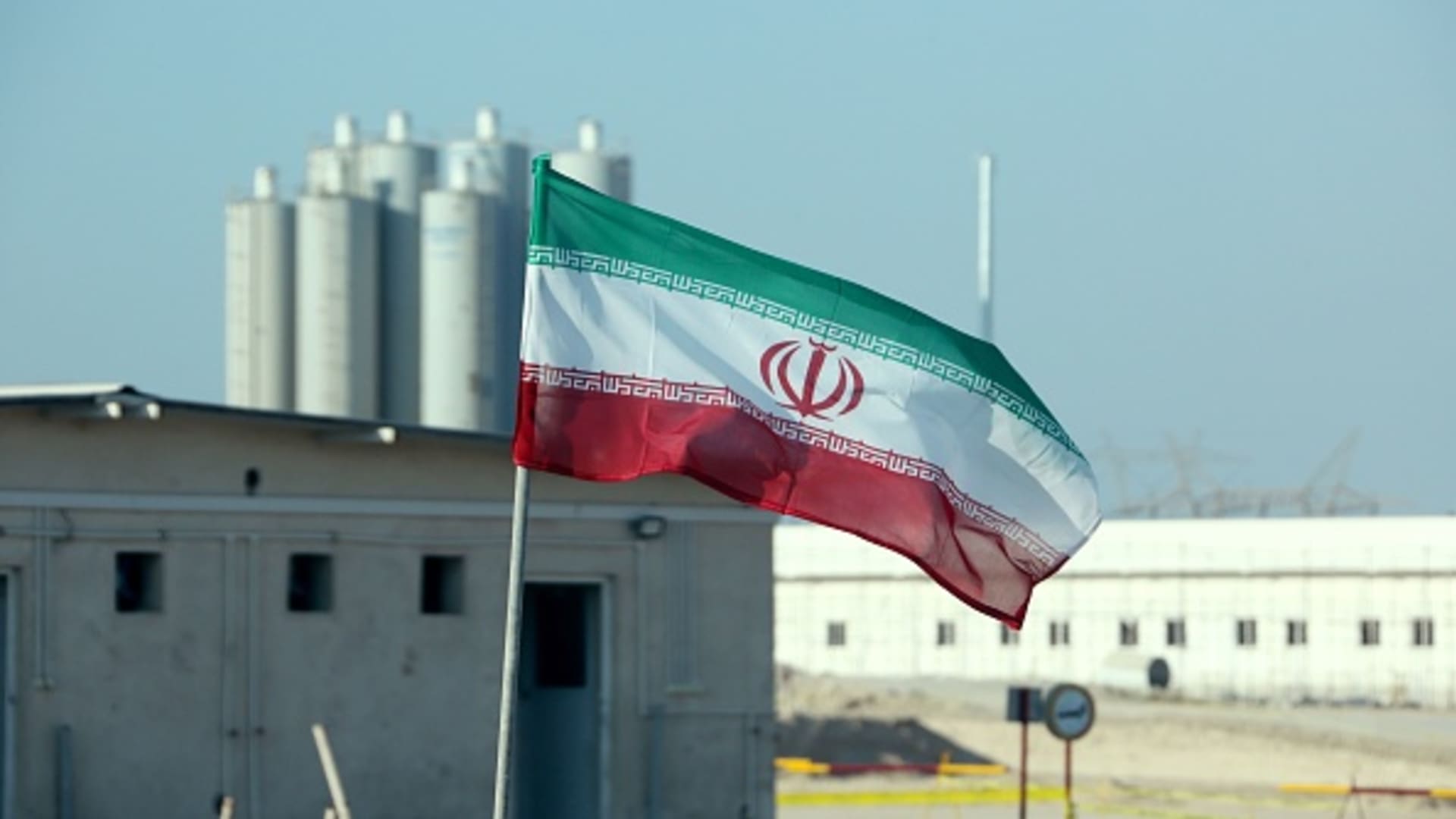
A picture taken on November 10, 2019, shows an Iranian flag in Iran’s Bushehr nuclear power plant, during an official ceremony to kick-start works on a second reactor at the facility.
ATTA KENARE | AFP via Getty Images
Russia has walked back its threat to torpedo the revival of the 2015 Iranian nuclear deal over recent sanctions imposed over its invasion of Ukraine, reopening the way to an agreement after nearly a year of talks.
The parties involved in the pact, formally known as the Joint Comprehensive Plan of Action, or JCPOA, were reportedly close to reaching a deal in Vienna until the U.S. and EU imposed sweeping sanctions on Russia over its invasion of Ukraine. Moscow then demanded that future trade with Iran not be impacted by Western sanctions, prompting the talks to be suspended last week.
Russian Foreign Minister Sergei Lavrov said Tuesday that he had “received written guarantees” from the U.S. that its demands would be met, meaning the talks will likely proceed. The nearly simultaneous release of British-Iranian dual nationals from years of Iranian detention back to the U.K. and a reported U.K. repayment of a decades-old $530 million debt to Iran have improved prospects for an agreement.
“Deal could come together quite quickly — potentially as soon as this week,” analysts at political risk consultancy Eurasia Group wrote in a note Wednesday.
“Russia’s decision to moderate its demands clears the most significant hurdle in front of the JCPOA’s revival,” the analysts wrote, putting the odds of a deal passing at an optimistic 80%. “The release of the two British-Iranian prisoners is another positive signal that talks are nearing a conclusion,” they said.
Iranian oil back on the market?
With the U.S. terminating its imports of Russian oil and the EU looking to reduce its energy dependency on Moscow, Iranian crude is looking more alluring — as is the crude from other heavily sanctioned countries like Venezuela, which has reportedly been in energy discussions with U.S. officials.
A return to the 2015 deal, which originally lifted sanctions on Iran in return for limits on its nuclear program, would see the return of Iranian oil to the market at a time when energy supply shortages and geopolitical volatility have brought crude prices to their highest in more than a decade.
This would “boost global oil supplies and could put downwards pressure on prices,” James Swanston, Middle East and North Africa economist at London-based firm Capital Economics, wrote in a note Thursday, adding that “it may also help to ease geopolitical tensions in the region.” Still, a return to previous production levels will take time.
Commodities analysts at S&P Global Platts predict that if sanctions were to be lifted on Iran immediately, it could export an additional 500,000 barrels of oil per day to markets from April to May of this year, with that figure reaching an additional 1.3 million barrels per day by the end of this year.
Iran was the fifth-largest producer in OPEC in 2020. Before the Donald Trump administration unilaterally ditched the deal in 2018 and re-imposed crippling sanctions on Iran’s economy, the country was producing 3.8 million barrels of oil per day. This later dropped to as low as 1.9 million barrels and is currently about 2.4 million barrels per day, according to the Atlantic Council — though most of this has had to remain in storage rather than be exported due to the sanctions.
Since the U.S. withdrawal from the deal, Tehran has made significant progress in terms of its nuclear activity, increasing uranium enrichment and stockpiles far beyond the parameters of the 2015 agreement.
This means it has shrunk its “breakout time,” or the amount of time it would take to be able to build a nuclear bomb. Iran’s leaders said its advances would continue as long as U.S. sanctions aren’t lifted.
Washington’s Gulf allies not happy
Eleven months after negotiations restarted, with the U.S and Iran not speaking directly but through European mediators, the remaining sticking points relate mostly to sanctions-related issues, including whether Iran’s Islamic Revolutionary Guard Corps will continue to be designated by the U.S. as a Foreign Terrorist Organization list.
“But these are unlikely to prove insurmountable,” Eurasia’s analysts say, considering that both Washington and Tehran want a deal.
The prospect of a return to the deal has not sat well with Washington’s Arab Gulf allies, particularly Saudi Arabia and the United Arab Emirates, two of OPEC’s leading crude producers and longtime adversaries of Iran. The two reportedly did not take President Joe Biden’s calls as he attempted to convince them to increase their oil production to alleviate soaring prices.
OPEC has not indicated any move to upping its production beyond pre-planned increases agreed between OPEC members and their non-OPEC allies, led by Russia, in 2021.