


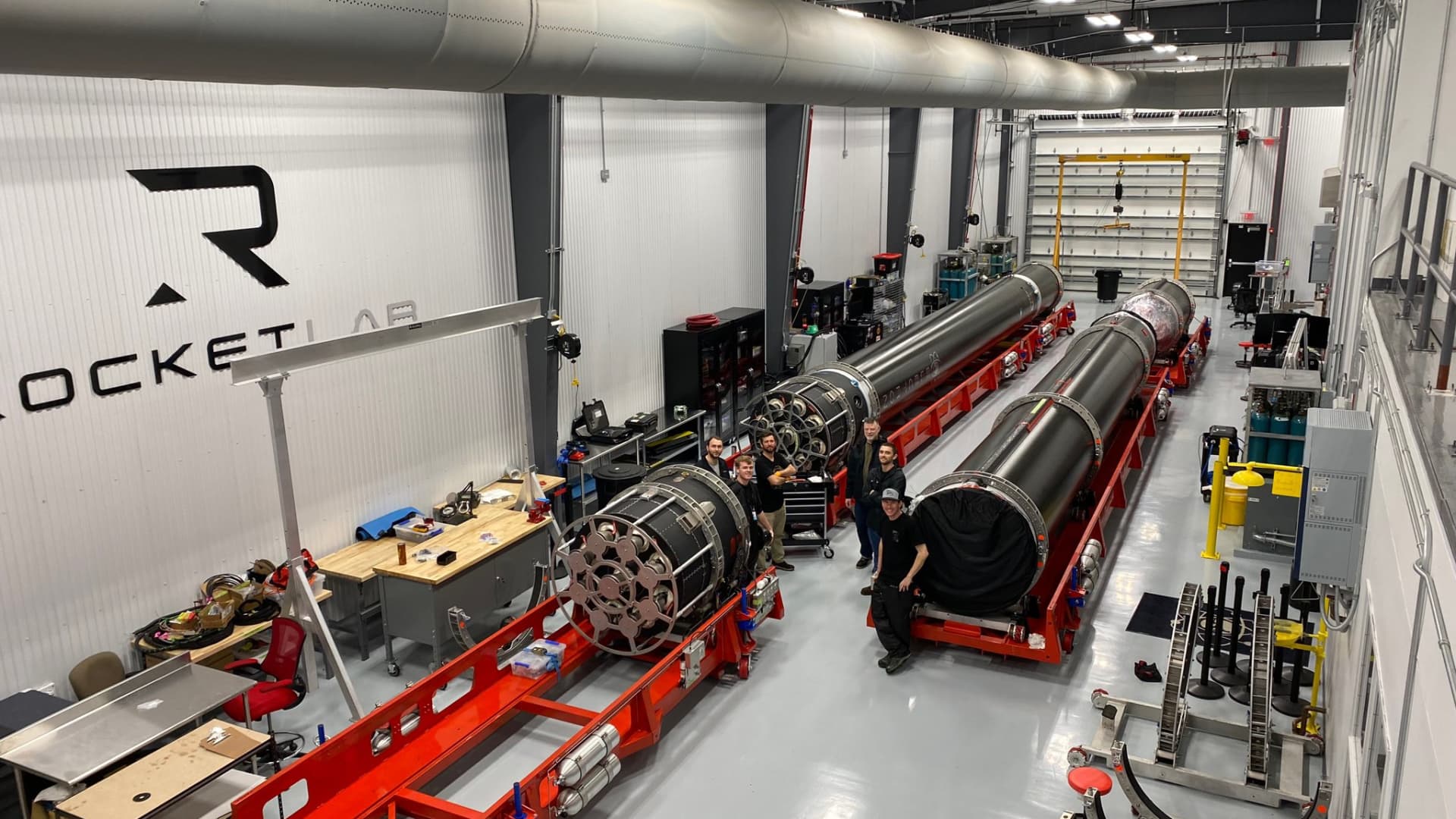
Electron rockets undergo preparation for launch.
Rocket Lab
Rocket Lab’s revenue increased slightly in the first quarter, but losses grew as well, as the spacecraft and launch company added a NASA contract and continued to invest in its future Neutron vehicle.
The company reported a net loss of $45.6 million, or 10 cents per share, wider than the net loss of $26.7 million, or 6 cents per share, that it reported a year earlier. On an adjusted EBITDA basis, the company lost $26.2 million, compared with loss of $8 million in the same period a year ago.
Rocket Lab said an increase in R&D spending for its Neutron rocket and Photon spacecraft drove a rise in expenses.
Revenue grew in the first quarter to $54.9 million – up about 6% from the prior quarter and about 35% from the same quarter last year. The company’s rocket business brought in $19.6 million, thanks to three launches during the quarter, while its space systems division saw revenue of $35.3 million, down from $39.8 million in the prior quarter.
“At a time when we’re starting to see a contraction of available small rockets, we’re also seeing an increase in launch bookings for Electron launches in 2023 and beyond from new and returning customers across government and commercial sectors. The development of our larger rocket Neutron is continuing at pace,” Rocket Lab founder and CEO Peter Beck said in a statement.
Rocket Lab’s order backlog decreased slightly to $494.2 million, as the company “recognized strong revenue in the quarter, combined with some larger potential deals taking longer to close.”
It had $450 million in cash on hand at the quarter’s end, down from $484.3 million the prior quarter.
Shares of Rocket Lab were little changed in after-hours trading from its close at $3.94 a share. The company’s stock is up 4.5% so far this year.
Sign up here to receive weekly editions of CNBC’s Investing in Space newsletter.
Rocket Lab made a pair of announcements alongside its quarterly results, including a deal with NASA to launch its Starling mission of “swarm” satellites on Electron in the third quarter. The company noted that it “will deliver the satellites to space within three months of the contract signing.”
It also announced the delivery of its first Photon spacecraft developed for in-space manufacturing company Varda, which is expected to launch “no earlier than June 8.”


