


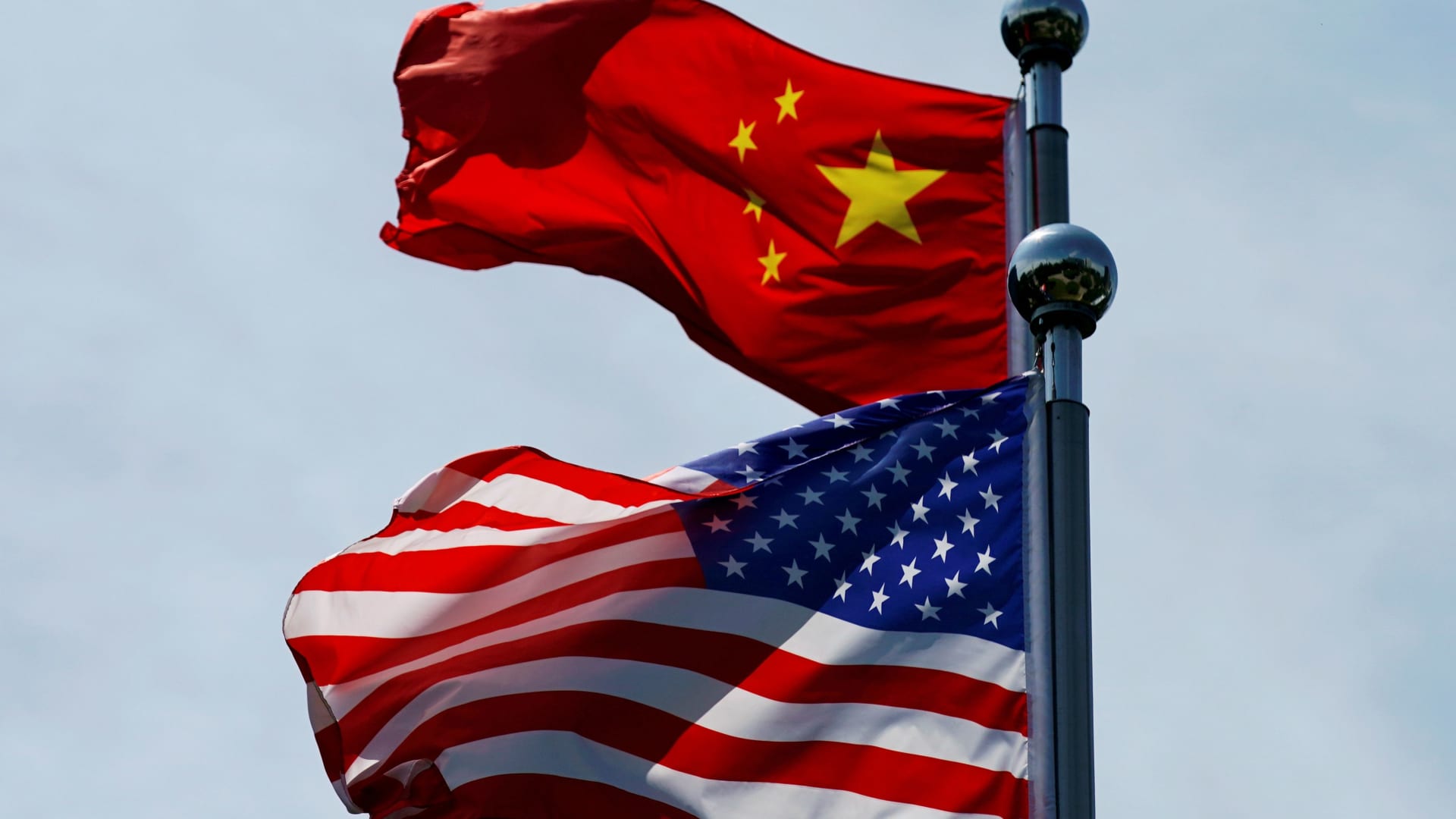
Chinese and U.S. flags flutter near The Bund, before U.S. trade delegation meet their Chinese counterparts for talks in Shanghai, China July 30, 2019.
Aly Song | Reuters
BEIJING — The flare-up in tensions between the U.S. and China over the weekend highlights the deepening mistrust dividing the world’s two biggest economies.
In the two days after Beijing ended its Golden Week holiday on Wednesday, the country announced a new framework for restricting rare earths exports, placed more U.S. companies on a blacklist and charged U.S.-linked ships with fees for docking at Chinese ports.
U.S. President Donald Trump then threatened 100% more tariffs on Chinese goods, a move which was followed by Beijing asserting its rare earths restrictions are a “legitimate” measure.
“The root cause of the tension is due to a lack of mutual trust,” Larry Hu, chief China economist at Macquarie, said in a note Monday.
“During the London talks in June, both countries agreed to a deal involving ‘rare earth for tech,'” he said. “Unsurprisingly, both feel betrayed when they perceive the other as acting in bad faith.”
The escalation in trade tensions is a result of a “misperception” on both sides, Hu said. Here’s how he and other analysts say both sides are seeing things differently.
Beijing may feel it needs to respond to a new U.S. rule released on Sept. 29 which expands the scope of export controls to majority owned subsidiaries of companies on a U.S. list — while Washington likely saw the change as a technical adjustment.
On the flip side, Beijing may see its rare earths restrictions as mimicking Washington’s wide-reaching effort to restrict China’s access to high-end tech, while the U.S. perception is that the restrictions are a negotiation strategy that aims to create leverage before a potential meeting between the two countries’ presidents.

U.S. chipmakers at risk
There’s a clear impact for businesses, reflected in part by Friday’s stock market sell-off.
“One rule in the new package requires that companies obtain a license from China’s Commerce Ministry to export products manufactured anywhere in the world if that product contains Chinese rare earths worth at least 0.1% of the product’s value,” Gabriel Wildau, managing director at Teneo, said in a note Saturday. “In theory, this rule could force companies like Nvidia, TSMC and Intel to obtain permission from Chinese regulators to sell their products inside the U.S.”
Wildau pointed out that “this Chinese rule is modeled after the U.S. Commerce Department’s own ‘foreign direct product rule,’ which imposes a license requirement on any product made with U.S. origin technology, no matter where the product is produced.”
Chinese stocks fell Monday following the U.S. stock market decline, although U.S. stock futures rebounded on hopes the tensions weren’t as bad as initially feared.
“On the specific episode the market is focused on, the two sides may still return to the table to find a short-term fix. However, it won’t be a lasting solution,” said Jianwei Xu, senior economist for Greater China at Natixis. “The trust between them is already gone.”
Trump has signaled he would meet with Chinese President Xi Jinping at the APEC meeting in South Korea at the end of October. China has yet to confirm or deny such plans.
The view from within the Asian country is that the U.S. will maintain its pressure on China, even as the two countries’ leaders are expected to meet, said Liu Weidong, research fellow at a state-affiliated think tank, the Chinese Academy of Social Sciences’ Institute of American Studies.
“History has shown that U.S. pressure is ineffective, and will only lead to a more confrontational relationship between China and the U.S.,” Liu said in comments translated by CNBC.
He cast the latest rare earths restrictions as a demonstration of China’s efforts to warn “unfriendly” foreign companies while welcoming others, and as an attempt to maintain bilateral stability through “moderate and controlled countermeasures.”
Trump and Xi spoke over the phone last month, but have yet to meet in person since the U.S. leader began his term in January. Trump previously indicated that he might visit China next year, followed by Xi traveling to the U.S.
The two countries are still negotiating since the effective dates for some of the announced measures are set for after the APEC summit in South Korea, said Nomura’s Chief China Economist Ting Lu.
“Despite mounting tensions, there remain opportunities for diplomatic resolution, as the timeline creates a strategic buffer: Trump’s tariff implementation, which is scheduled for 1 November, precedes Beijing’s 1 December deadline for rare-earth export restrictions by a full month.”
