


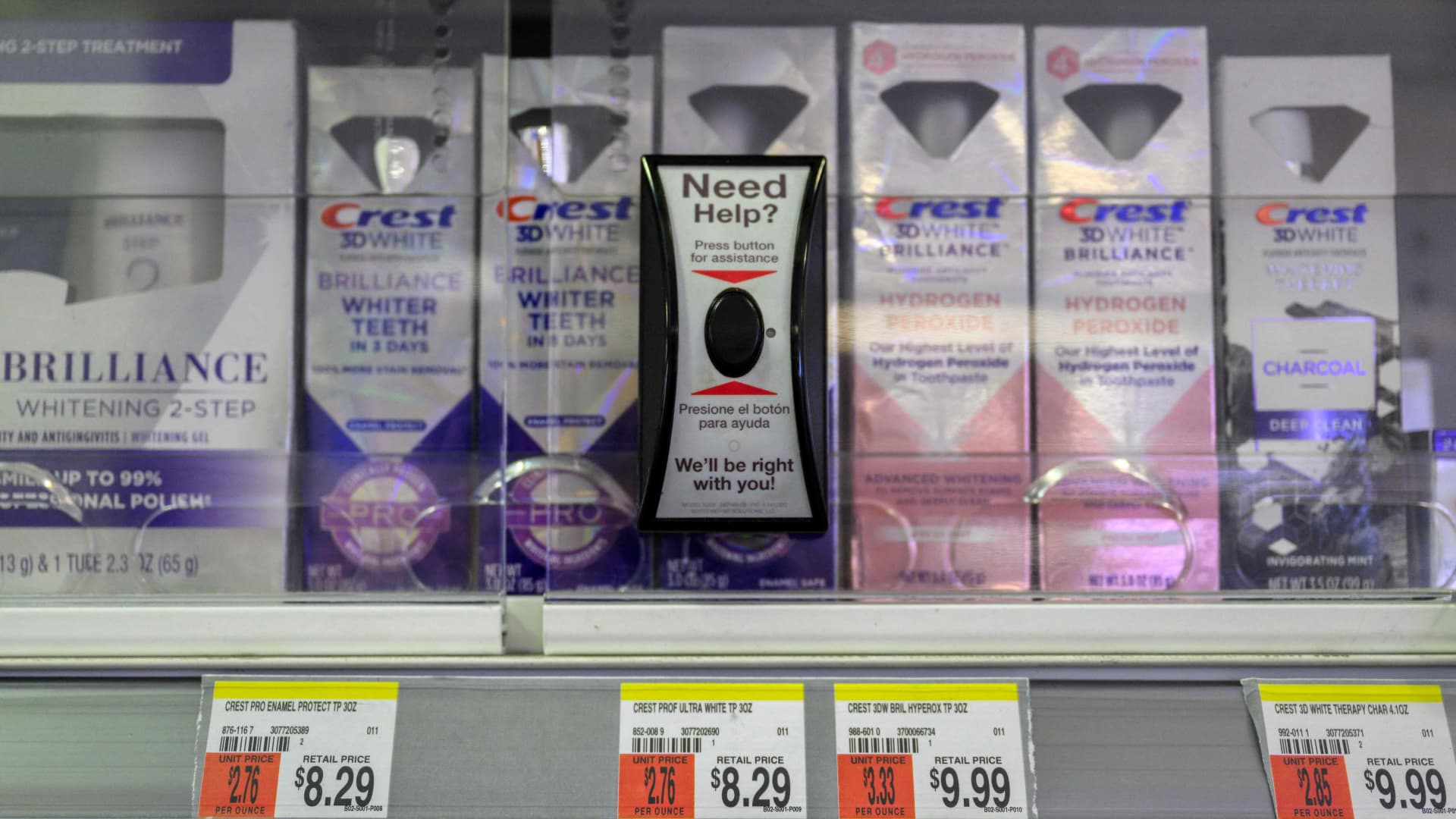
Locked up toothpaste to prevent shoplifting are seen at a Duane Reade drugstore and pharmacy on August 24, 2023 in New York City.
Angela Weiss | Afp | Getty Images
Retail theft has caught the attention of the masses in recent years, from startling smash-and-grab videos during the depths of the Covid pandemic to corporate earnings calls where retailers like Target and Foot Locker are discussing losses from organized retail crime more than they ever have.
But the effect of theft on retailers’ bottom lines is about the same as it has been for years, according to the latest data released Tuesday in the widely used industry survey conducted by the National Retail Federation.
Total retail shrink grew to more than $112 billion in 2022, up from $93.9 billion the year before, according to the newest National Retail Security Survey. The metric, which accounts for various types of inventory loss including theft, damage and vendor error, generally rises as retail sales climb.
While retailers and the NRF are increasingly saying crime is cutting into profits, losses from internal and external theft last year were largely on par with historical trends. They made up 65% of total shrink, the survey found.
External theft, which includes organized retail crime, was again reported as the largest source of shrink last year at 36.15%, but that was slightly below 37% in 2021. Internal theft, or goods stolen by employees, rose slightly to 28.85% from 28.5% in 2021. Process and control failures and errors made up 27.29% of shrink in 2022, up from 25.7% the year prior.
Sources of retail shrink in 2022
External theft (including organized retail crime): 36.15%
Internal/employee theft: 28.85%
Process/control errors: 27.29%
Unknown: 5.88%
Other losses: 1.32%
Source: NRF National Retail Security Survey
Retail shrink climbed in absolute dollars, but when reported as a percentage of sales as is commonly done, average annual shrink increased to 1.57%, up from 1.44% in 2021. The share is largely in line with past years. Average annual shrink was 1.62% of sales before the pandemic in 2019, though it was as low as 1.33% in 2017, according to previous surveys.
The NRF conducted the online survey of senior loss prevention and security executives in the retail industry. The results for 2022 include 177 retail brand respondents, which the organization said accounted for 22% of retail sales in 2022.
The NRF report said 78% of the retailers that responded to the survey do not include e-commerce goods in their shrink calculation and 57% don’t include supply chain losses, so “the actual dollar loss associated with shrink (and with theft in particular) is likely heavily underreported.”
It’s not necessarily the amount of theft taking place that most concerns the industry, but rather the increased violence associated with it.
“Far beyond the financial impact of these crimes, the violence and concerns over safety continue to be the priority for all retailers, regardless of size or category,” David Johnston, vice president for asset protection and retail operations at the NRF, said in a press release.
Locked up deodorant to prevent shoplifting are seen at a Duane Reade drugstore and pharmacy on August 24, 2023 in New York City.
Angela Weiss | Afp | Getty Images
Sixty-seven percent of respondents reported more violence associated with organized retail crime than a year ago. In the last survey, 81% reported an increase in violence.
Meanwhile, 45% of retailers in the survey said they have reduced specific store hours to deal with crime and violence, nearly 30% said they somehow changed store product selection, and 28% reported closing a specific location because of crime.
Companies identified Los Angeles, San Francisco/Oakland, Houston, New York and Seattle as the five cities and metropolitan areas most affected by retail crime.
Unsurprisingly, nearly all respondents, 93%, support some type of federal organized retail crime legislation. Congress passed one law, called the Inform Act, that aims to deter the sale of stolen goods online, and lawmakers have introduced another that calls for stiffer penalties for theft offenses. The NRF supports the bill and previously told CNBC it helped to write it.
Internal, or employee theft, also concerns retailers because “an employee who decides to steal or collude with outsiders to steal often does so at a higher loss per incident than external thieves.” Some companies have identified goods stolen by workers as a major issue and taken steps to address it, even as the industry focuses more on external theft in public, CNBC previously reported.
The NRF study said the average dollar loss reported for an internal theft was $2,180 per investigation in 2022, in line with 2021 and 2020 levels. The average dollar loss for external shoplifting incidents, for comparison, was $1,063 per incident.
It’s not only high-value products that are being stolen, but also consumable items that are easy to resell and often difficult to track. So while luxury items often get the “smash and grab” attention, energy drinks, beauty products, candles and detergent are also among the products thieves target.


