


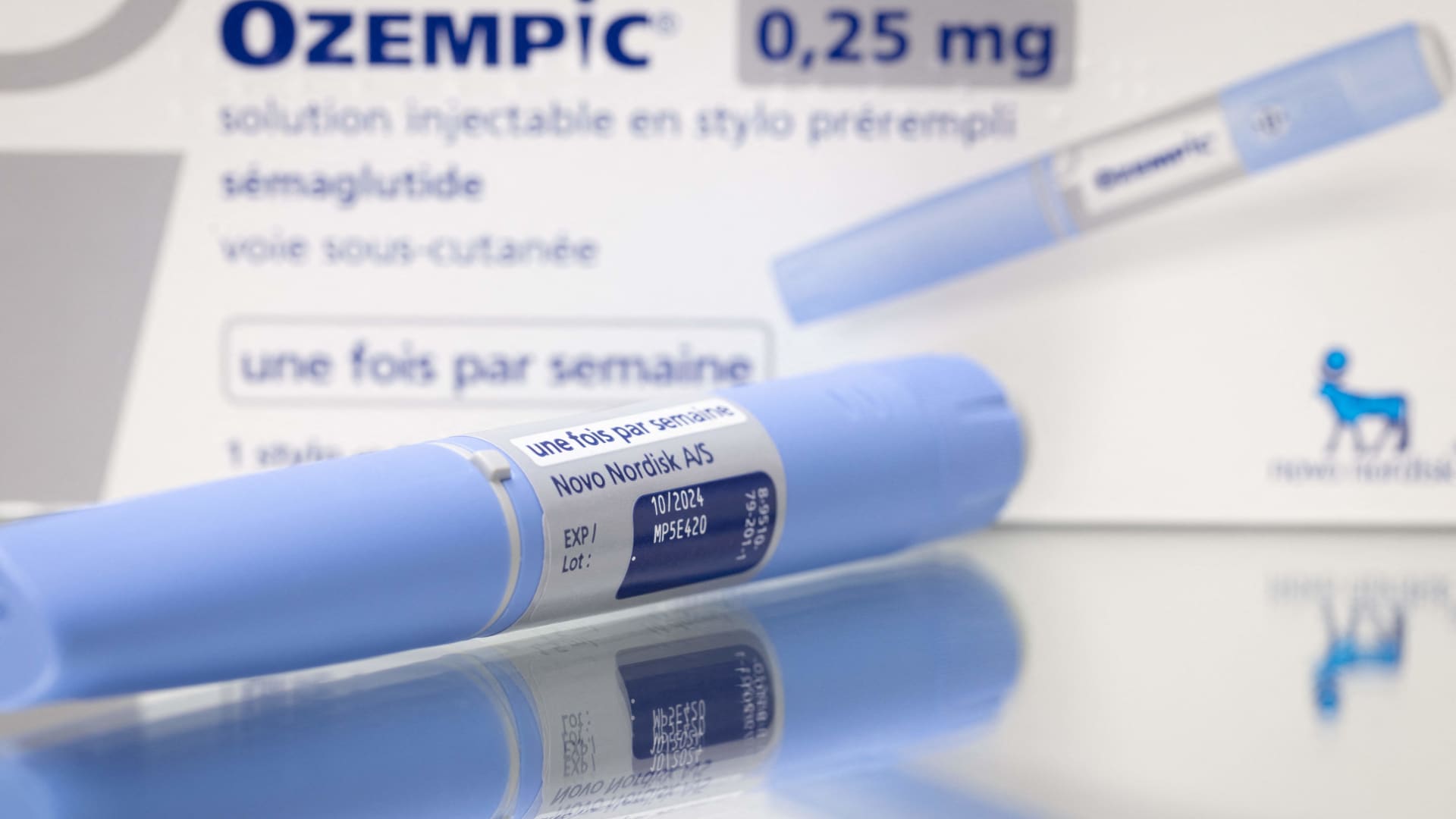
This photograph taken on February 23, 2023, in Paris, shows the anti-diabetic medication “Ozempic” (semaglutide) made by Danish pharmaceutical company “Novo Nordisk”.
Joel Saget | AFP | Getty Images
Patients taking blockbuster obesity drugs Ozempic or Wegovy will pack the pounds back on after they stop taking the medications.
“I think this is what we see when people go on diets or different exercise regimens, similar to when they go on a pharmacological treatment,” Karin Conde-Knape, Novo Nordisk’s senior vice president of global drug discovery, said in an interview at CNBC’s Healthy Returns Summit on Wednesday. “As long as you’re keeping your intake the same, your output the same, you’re able to control your weight. But if you go out of this, you will immediately start to come back.”
Conde-Knape said rates of weight gain after stopping Wegovy vary depending on the individual, adding that “some will come back earlier, some will come later.”
She said available data suggests most individuals will recover most of their weight within five years of stopping Wegovy, and roughly 50% of their weight after two to three years. Some individuals may actually gain more weight after stopping the drug than they initially lost, Conde-Knape added. Studies have similarly shown weight rebound in people who stop taking Ozempic. Novo Nordisk makes both prescription drugs.
She said it’s tied to how the drugs work. They mimic a hormone produced in the gut called GLP-1, which signals to the brain when a person is full. She called that a “direct effect on satiety,” and noted that the drugs can also control what type of food people crave.
But she said GLP-1 doesn’t rewire “your neural networks to really define a new body weight setpoint.” So any weight loss may not be permanent, according to Conde-Knape.
The Danish pharmaceutical company still needs to conduct more investigations and clinical trials to understand what drives those rates of weight gain, “but what is critically important is that definitely you need to stay,” Conde-Knape said.
Her remarks come after Ozempic and Wegovy catapulted to the U.S. national spotlight in recent years for being “weight loss miracles” in a nation obsessed with body image. In clinical trials, Wegovy was shown to decrease body weight by around 15%.
Hollywood celebrities, social media influencers and even billionaire tech mogul Elon Musk have reportedly used the popular pen-shaped injections to get rid of unwanted weight.
Wegovy has flown off shelves since gaining Food and Drug Administration approval for “chronic weight management” in June 2021. So has Ozempic, which was first authorized to treat diabetes and is now being used off-label for weight loss. That popularity sparked widespread shortages last year and prompted Novo Nordisk to ramp up production of Wegovy.
The shortage and other factors like out-of-pocket costs without insurance or unpleasant side effects have forced some people to stop taking Ozempic or Wegovy. That’s left many complaining of that rebound in weight that’s difficult to control.
Conde-Knape said so far data indicate that weight loss is maintained with long-term use of the drugs. But the company’s data only examines use for two to three years maximum.
“We’ll need to see how much more with the longer duration of treatment, how much more will people will be able to achieve,” she said.


