


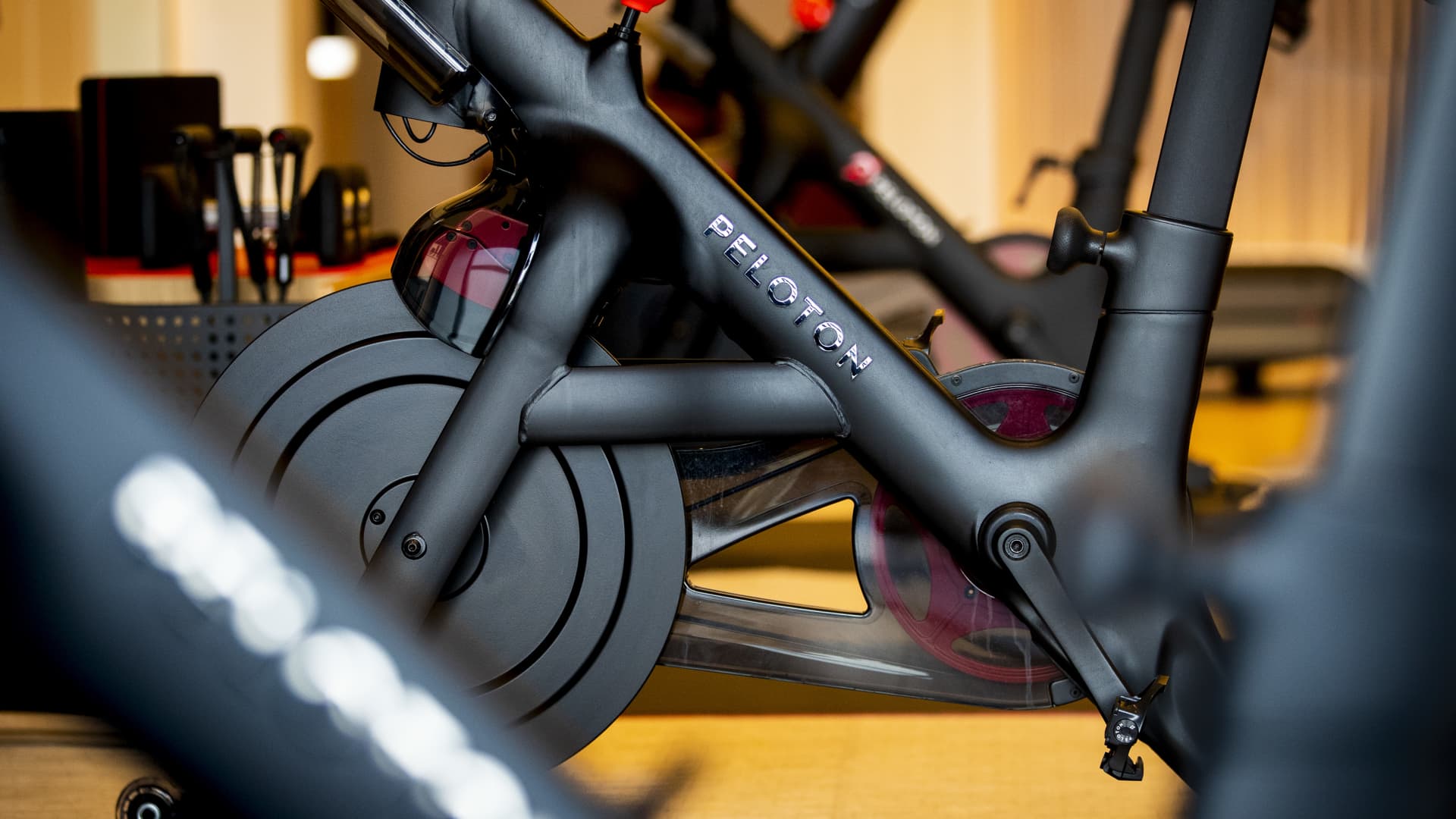
A Peloton stationary bike for sale at the company’s showroom in Dedham, Massachusetts, U.S., on Wednesday, Feb. 3, 2021.
Adam Glanzman | Bloomberg | Getty Images
Peloton on Tuesday reported a wider-than-expected quarterly loss and a steep decline in sales, as inventories piled up in warehouses and ate away at the company’s cash.
The connected fitness equipment maker also offered up a weak sales outlook for the fourth quarter, citing softer demand. The company anticipates planned subscription price hikes may lead some users to cancel their monthly memberships.
Peloton’s excess inventory forced the company to rethink its capital structure, Chief Executive Officer Barry McCarthy said in a letter to shareholders. Peloton finished the quarter “thinly capitalized” with $879 million in unrestricted cash and cash equivalents, he said.
To address this, the company earlier this week signed a binding commitment letter with J.P. Morgan and Goldman Sachs to borrow $750 million in 5-year term debt, according to the CEO. The two banks led Peloton’s IPO in 2019.
McCarthy said he is focused on stabilizing Peloton’s cash flow, getting the right people in the right roles and growing the business again. Expanding subscription revenue is a centerpiece of McCarthy’s strategy, something he takes from his prior experiences at Spotify and Netflix. He also said Peloton will soon be selling its products through third-party retailers, a step the company has not taken before.
Here’s how Peloton did in the three-month period ended March 31 compared with what Wall Street was expecting, based on a survey of analysts by Refinitiv:
- Loss per share: $2.27 vs. 83 cents expected
- Revenue: $964.3 million vs. $972.9 million expected
Peloton’s losses widened in the quarter to $757.1 million, or $2.27 per share, from a net loss of $8.6 million, or 3 cents a share, a year earlier. That came in larger than the per-share loss of 83 cents that analysts had been looking for.
Revenue dropped to $964.3 million from $1.26 billion a year earlier. That came in short of expectations for $972.9 million.
The company said the year-over-year decline was primarily driven by a steep reduction in consumer demand coming off of the Covid-19 pandemic’s peak. That was partially offset by higher treadmill sales, it said.
But Peloton also noted that it faced higher than anticipated returns of its Tread+ machine, which was recalled last May, that totaled about $18 million and weighed on the company’s results in the quarter.
Peloton generated $594 million in sales from its connected fitness products and $370 million from subscriptions in the latest period.
The company ended the quarter with 2.96 million connected fitness subscribers, representing a net addition of 195,000.
In its fourth quarter, Peloton is calling for revenue to be between $675 million and $700 million. Analysts had been looking for $821.7 million, according to Refinitiv estimates.
The company expects connected fitness subscribers to total 2.98 million, which would represent just a 1% increase from the prior quarter.
This story is developing. Please check back for updates.


