


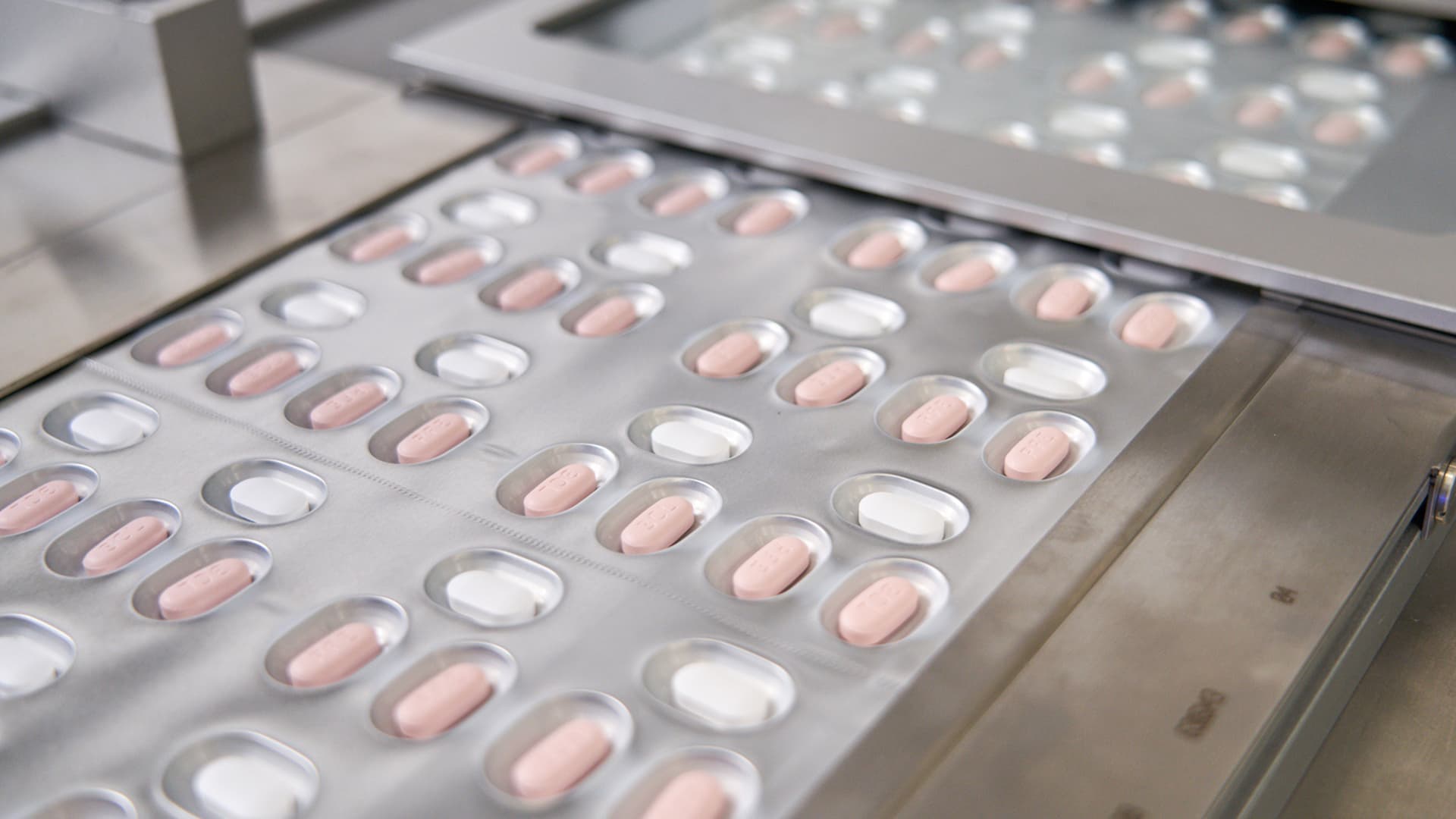
Pfizer on Tuesday said prescriptions for its oral antiviral to treat Covid-19 have increased tenfold in the U.S. since late February, as more pharmacies and other locations receive supply.
CEO Albert Bourla, in an earnings call Tuesday morning, said nearly 80,000 patients were treated with Paxlovid in the U.S. the week ending April 22, up from about 8,000 patients in late February. More than 33,000 sites in the U.S. now have supply of Paxlovid, Bourla said, a fourfold increase over February.
Shares of Pfizer were up over 1% in Tuesday afternoon trading.
Paxlovid supply was constrained when the antiviral first rolled out over the winter, but Pfizer is ramping up production with 6 million courses produced through the end of March, according to Bourla. Pfizer is on track to manufacture 30 million courses in the first half of 2022 and 120 million by the end of the year, Bourla said.
Pfizer on Tuesday reported $1.5 billion in Paxlovid sales for the first quarter and maintained its guidance of $22 billion in sales for 2022. Angela Hwang, Pfizer’s head of biopharmaceuticals, told analysts Tuesday that demand for the antiviral will increase as nations reorder doses and lower the eligibility age.
Covid transmission will increase as governments ease public health restrictions, and Paxlovid will play an important role in treating people who get infected, Hwang said. Pfizer doesn’t have any inventory on hand because every dose manufactured gets shipped, she said.
The U.S. has ordered a total of 20 million Paxlovid courses, with the delivery of the first 10 million courses to be completed in June and fulfillment of the second 10 million scheduled for September, according to the Biden administration. Patients in the U.S. had used more than 500,000 Paxlovid courses as of late April, a senior administration official told reporters last month.
The White House is ramping up distribution of Paxlovid as a key component of its strategy to fight Covid. The Health and Human Services Department aims to bring the antiviral to 40,000 locations across the nation. The U.S. has set up at least 2,200 sites where people can receive Paxlovid as soon as they test positive for the virus, including pharmacies, community health centers and long-term care facilities.
The Food and Drug Administration authorized Paxlovid in December for adults and children ages 12 and older who are infected with Covid and at risk of severe illness from the virus. The FDA authorized Merck’s molnupiravir shortly after, but said it should only be used for adults ages 18 and over who don’t have access to Paxlovid or other Covid treatments.
Paxlovid proved more effective and had a better safety profile than molnupiravir in clinical trials. Pfizer’s antiviral reduced the risk of hospitalization or death by 90% in adults who had Covid and were at risk of developing severe illness. Molnupiravir reduced the risk of hospitalization and death by 30% in clinical trials among Covid patients at risk of severe illness.
Paxlovid now has a 90% market share compared to Merck’s molnupiravir in the U.S. retail pharmacy, long-term care and mail order markets, Bourla said. The antiviral is now authorized in more than 60 countries, and Pfizer is in discussions to bring the treatment to additional markets, he said.
Patients prescribed Paxlovid take a three tablet course twice daily for five days. The course includes two nirmatrelvir pills developed by Pfizer, and one tablet of ritonavir, a widely used HIV drug. Nirmatrelvir inhibits an enzyme the Covid virus uses to reproduce, and ritonavir slows the patient’s metabolism so the medication remains active in the body for a longer period.
While Paxlovid is effective at preventing hospitalization and death in people who already have Covid, it failed to prevent infection from the virus in clinical trial results published Friday.


