


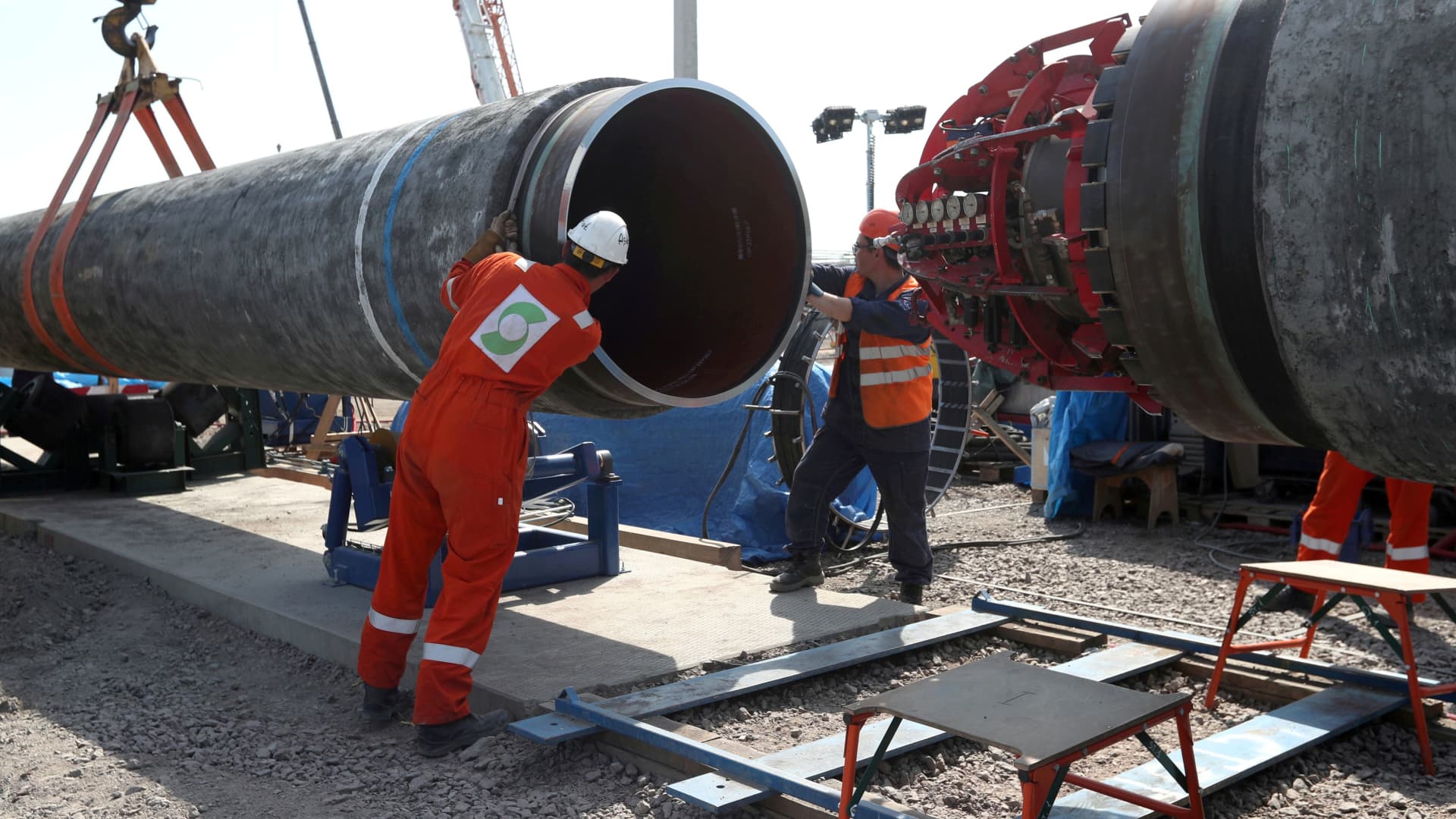
Workers are seen at the construction site of the Nord Stream 2 gas pipeline, near the town of Kingisepp, Leningrad region, Russia, June 5, 2019.
Anton Vaganov | Reuters
As a business executive friend of mine texted me Wednesday, “Europe feels like it’s starting to panic.” He’s right.
The concerns about energy supplies are accelerating into a full-blown crisis, with huge humanitarian and global economic implications.
Vladimir Putin’s disgusting war and the resulting Western sanctions on Russia are obviously playing a big role right now, but the macro risk — Europe’s reliance on Putin and the cheap gas Russia provides — was already years in the making before the war. It’s probably one reason Putin became emboldened.
If energy costs remain this high, the entire German industrial economy seems at risk of slowdowns or shutdowns in certain segments. The near-term risk is particularly high if Putin cuts off Nord Stream flows for longer than 10 days — and this is what’s scheduled to happen on Monday, as maintenance activities get underway. The pipeline is the European Union’s biggest piece of gas import infrastructure.
It’s not just Germany that’s at risk.
A labor strike has been threatening critical Norwegian gas flows to the U.K. This crisis may have been averted by the Norwegian government, which stepped in Wednesday to propose a “compulsory wage arbitration.”
But the U.K. also is reportedly racing to reopen a natural gas storage site that was shuttered in 2017, in the hope of providing more capacity.
France is pushing OPEC messaging and wants more Iranian barrels on the market, and Dutch farmers are currently mass protesting over clearly not thought out climate and emissions rules that could further threaten Europe’s food supply.
The race is on go to get German natural gas storage levels solidified before winter. It’s clear energy rationing of some kind is likely.
Unless Putin’s war with Ukraine ends or sanctions are removed before winter, it’s hard not to see a dramatic European economic and financial slowdown as demand destruction kicks in. How can German carmakers afford to make cars with energy costs so high? We will find out.
If this happens, the ultimate question is how much the people of Europe will be willing to sacrifice for Putin’s war, especially coming out of Covid.
I hate to say it, but it is starting to feel a bit like 2007, with second and third derivative impacts possible on debt, banks and the global economy. Europe — and Germany in particular — will likely be talking about more bailouts for multibillion-dollar utilities and industrials. The scenario seems inevitable without some kind of swift end to the war.
I would be more than happy to be wrong about this. After the pandemic pain, we just need things to be easy for a few years.
Pray for good weather across Europe this summer and winter. And maybe better leadership across Europe in the years to come.