


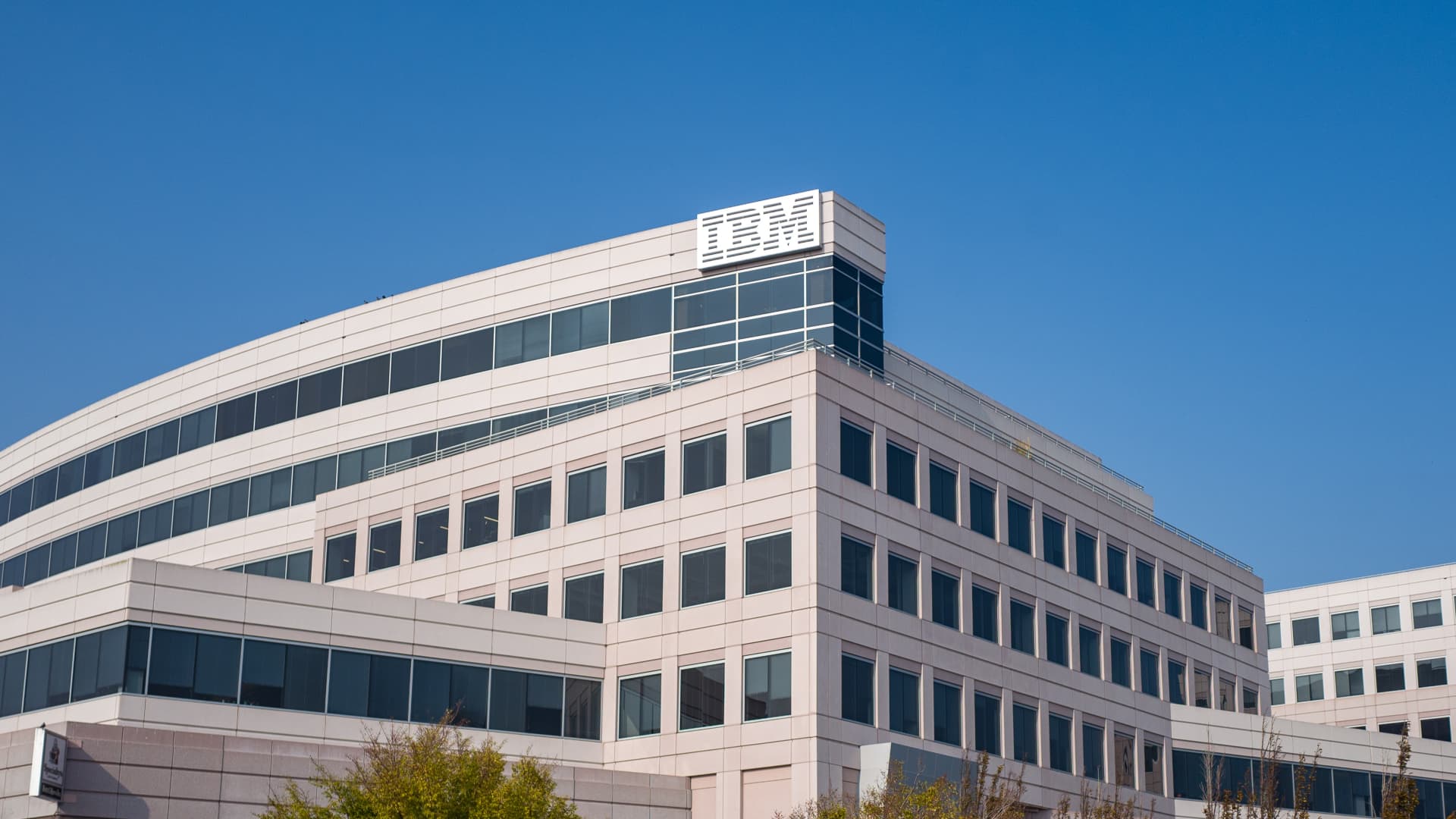
As major American corporations began to welcome workers back in the spring, they were surprised by what they saw: fewer employees than they expected who wanted to return to offices. That was the case at Ford, which told CNBC back in April that the initial numbers were “lower than we expected,” and more recent comments from the CEO of IBM show that many workers at the biggest firms prefer to remain working from anywhere but the office, at least most of the time.
Only 20% of IBM’s U.S. employees are in the office for three days a week or more, the tech company’s CEO Arvind Krishna told CNBC’s Sara Eisen at the Aspen Ideas Festival on Monday. Krishna added that he does not see a scenario where the balance ever gets back to over 60% of workers in the office more often than not.
In an earlier tech era, IBM was one of the first major tech firms to embrace remote work before it was common, with at one point in the 2000s as much as 40% of its workers remote, but it ended up reversing course and requiring workers to again be based in offices in 2017. Now, the paradigm has shifted again.
“I don’t think it’ll ever cross 60,” Krishna said. “So I think we’ve learned a new normal.”
IBM had over 280,000 workers globally at the end of last year.
Krishna does expect employers to get some leverage back when it comes to wages, though only a lower level of wage inflation rather than a reversal of it. “We will get an adjustment of wages,” Krishna said at the Aspen Ideas Festival. “I expect to see a decrease in the growth rate, a step down.”
He also indicated the wage pressures will vary depending on market.
“The 8-9% inflation or the 5% in wages is not uniform. Some pockets are 9 to 20,” he said. “Some pockets are close to flat, and that’s going to cause some inequity as we go forward.”
Krishna added that IBM’s own hiring inflation has been 9%-plus. “Ours is on the upper end, ours is well above nine I would say for replacement workers,” he said. “It is so hard to get people.”
Most of the layoffs taking place in tech, he said, are at the unprofitable firms, and other recent reporting from CNBC and survey data from the tech industry do show that workers remain in the driver’s seat when it comes to job offers and many firms plan to continue aggressively hiring.
Krishna does not expect overall inflation to come down quickly, staying well above the Fed’s target of 2% next year. IBM is preparing for a “period of more sustained inflation,” Krishna said, and a return to the Fed target of 2% not realistic for another three to four years.
This doesn’t mean he sees a recession coming, as he described the current period of high inflation combined with a labor market shortage as atypical and making past economic precedents less significant as forecasting tools.
Meanwhile, tech spending remains strong in the business to business segment, Krishna said, with sectors including retail, banking and finance, and pharmaceuticals and biotech all spending more on technology.
“We’re not seeing a slowdown in the B2B space,” he said.
Watch the vide above for highlights from the full interview with the IBM CEO at the Aspen Ideas Festival during which Krishna also provides the tech giant’s view on the Supreme Court abortion decision and its approach to responding to political issues.
Disclosure: NBCUniversal News Group is the media partner of the Aspen Ideas Festival.


